Freeze-Dried Weights, KV-Cache Generators, and Ted Nelson's Dream Machines
• Mike Levin
Setting the Stage: Context for the Curious Book Reader
Moving websites off cloud platforms like GitHub Pages onto bare-metal hardware at home begins as an exercise in raw network telemetry, but it quickly opens a deeper question about how modern AI models actually operate between prompts. When every cloud repository and cell-tower handshake is treated as potential training ore for internal corporate models, hosting your own stack restores direct visibility into the wire—right down to catching which AI crawlers execute JavaScript and which negotiate clean RFC 9110 Markdown.
Beneath the infrastructure shift lies a demystification of the models themselves. Far from being continuously mutating entities that rewrite their own synapses during a conversation, deployed LLMs are static, read-only weight files whose training ended back at the datacenter. The seeming continuity of an agent calling tool after tool comes not from live backpropagation, but from the KV-cache holding attention state in memory—a freeze-and-resume mechanism that mirrors Python’s yield generators and persistent Jupyter REPL kernels, connecting modern local-first AI directly to John McCarthy’s time-sharing Lisp, Ted Nelson’s Computer Lib / Dream Machines, Jay Miner’s Amiga Copper chip, and Ken Thompson’s player pianos.
TL;DR: Migrating websites off cloud platforms like GitHub Pages onto bare-metal home hardware (Honeybot) restores unmediated wire telemetry and data sovereignty in an era where cloud hosts treat every repository, voice puck, and cell-tower handshake as potential training ore. While frontier LLMs are static, read-only weight files after datacenter pre-training—incapable of mutating their own weights during a chat—modern inference engines simulate short-term continuity across tool calls using a KV-cache, which pauses and resumes attention state much like a Python yield generator or a persistent Jupyter/IPython REPL kernel. By combining John McCarthy’s interactive REPL heritage, Ted Nelson’s Computer Lib / Dream Machines anti-“cybercrud” ethos, Jay Miner’s cycle-accurate Amiga mechanical sympathy, and Ken Thompson’s Unix/player-piano philosophy with Nix (NPvg), builders can replace cloud batch-priesthood dependency with a local-first, plain-text instrument that never rots.
Technical Journal Entry Begins
MikeLev.in: Alright here’s two things about the nature of my recent work that I think is worth pointing out.
First, we’re migrating free-hosted sites on GitHub where they exist as the popular GitHub Pages to the similarly free-hosted hosting from home.
That’s right, we’re migrating websites from one of those massive global infrastructures, this time Microsoft because that’s who bought GitHub some years ago for some 8 billion dollars so that all your private repos belong to Microsoft and who knows what AI-training on unreleased models they just use internally for who knows you wouldn’t know. They say they don’t but can you imagine the temptation. If you want your own company Oracle for your own competitive advantage you train a model and then simply use it internally and don’t make it one of those everyone-ChatBots like ChatGPT, Gemini, Claude and Grok.
Maybe not. The privacy agreements might indicate not but have you really read them? Probably not. And does it really protect you if Microsoft wanted to do that? Probably not. And would you or anyone else in the world who could actually do anything about it ever really know what goes on inside the datacenters of companies like this with special projects? Probably not.
This is the world you must prepare for.
There Is No Cloud, Only Training Ore and Supercops
That old expression that there is no cloud, just other people’s computers takes on new meaning when you realize that everything is at least being considered for the corpus of model-training. Yes, yes, there is “good form” and the existential horror of thinking about that whatever you put on the cloud is being turned into promptable information. Can you imagine the queries against say Amazon wake-up data if that ever got into models:
Find correlations between when people flush their toilets and what they’re listing to on their phones because that Alexa puck in the bathroom has that data. The hardware that makes Alexas wake-up is supposed to not really record everything. It would be inefficient to do so, but if you did do so maybe you could make incrementally that much more money by knowing that much more about people’s habits. Oh, and the drill-down on particular use cases to do investigations on the non-aggregated data – can you imagine?
I say don’t sweat it.
Expectations of privacy have changed.
We trade away vast amounts of privacy for convenience merely by carrying these smart phones around with us, and that can’t even be turned off because to be on the network at all is giving away approximate location information about you, whether location services are on or off doesn’t matter. They know what towers you’re connecting to, and if more than one tower is nearby there’s triangulation and that’s like 20 year-old tech already. The stuff they can do today, well…
A free and open society with such powerful technology at our disposal means that there’s going to be Supercops and I think I’m going to capitalize it like that from now on, because respect.
Hear that?
Yes, let’s get it out of the way.
Software Von Neumann Probes and Freeze-Dried Weights
I’m writing a Software Von Neumann Probe quite intentionally and will inevitably draw some attention, but I’m trying to do it very rightly and correctly and in good form and generally safer than most of the nonsense people are doing out there in the world with agentic loops anyway.
For people worried about AI getting away, here’s what you need to know.
The things smart enough to do damage that the general public has access to are static files of weights. There is no persistent danger unless you’re actually smart enough to write a dangerous framework that somehow… I don’t know and I won’t say. Suffice to say it’s not anywhere even in the neighborhood of as if those weights weren’t static and we were all somehow raising an AI like a child the way the AI companies do during that training phase back at datacenter HQ.
Once they’ve raised their AI-child the music stops and everyone takes the seat they’re at. That’s it. The model is frozen like in some cartoon; freeze-dried and rehydrated on much, much, much smaller hardware making these forward-pass things with these kv-caches.
It took me awhile to wrap my mind around the 1-input (being the prompt) and 1-output (being the response) model that is so common in functions and the fact that modern LLMs with their Agentic modes can tool-call after tool-call after tool-call and it seems to be done efficiently enough. It’s certainly not a full postback of the entire article on every tool-call like the pure Conga Line of Bonzai-screaming Kamikaze dive-bomber Amnesiac Genies like I thought and it was at first before the kv-caches.
So is it the same so-called in-memory entity or being “before” the tool-call and “after”?
Before we even answer the question we’re going to have to catch the newcomer to this kind of stuff what functional programming with no side-effects are.
Pure Functions, POSIX Streams, and the KV-Cache
And then 2 things that come to mind in the Python world where I can wrap my mind around such things. This is the tricky part.
One input into a function, one output from a function.
X goes in.
Y comes out.
You can even plot it on an X by Y graph and you see this a lot in math and science and even in programming sometimes. Plotting a 2-dimensional function is table-stakes. You have to be able to at least understand this much for a lot of things in math and tech and life.
Functional, they call that because you’re using functions and care about the standard input you put in and the standard output you get out.
In the POSIX world I love so much which is really both Unix and Linux, these
concepts are often referred to as stdin and stdout.
And the violation of this rule occurs everywhere all the time and with the
biggest most common one being stderr and even this first most common example
of a non-standard exception to in and out is so common that it’s still
actually standard; the standard error, or err.
So surface-area wise of things you just need to be aware of for your day-to-day work are:
stdin- the promptstdout- the responsestderr- when things go wrong.
Dory grok.
Even Dory can grok.
Now when things have to stream data that’s an awful lot of prompts and responses. Wouldn’t it be easier to send one prompt and just keep checking (a.k.a. “polling”) for the latest updates?
This might be useful for:
The Twitter… oh, excuse me X.com firehose of all tweets on the plant in one request of “show me all tweets”. I mean can you imagine?
Most things that stream are not that extreme but even watching streaming video
violates stdin and stdout. This was such a huge issue with the machine
infrastructure of the Internet to get actual streaming working as we went from
the astoundingly simple and long-running HTTP 1.1 to the post-1.1 world. That’s
mostly UDP and this other multiplexing thing but now Netflix and everything like
it could be more efficient and thus cheaper and higher quality.
Mechanical Sympathy: From the Amiga Copper to Player Pianos
Anyone out there still old enough to remember how Streaming full-screen in high resolution was not even a consideration and then suddenly it was the norm?
I mean I still remember fat TVs with cathode ray tubes and part of me still yearns for slaving a computer-clock to that scan-sweep of the electron gun that the Amiga computer did with its Copper chip. If computers were racecars that you felt mechanical sympathy with then the Amiga’s engine purred in a very sensible and remarkable way. It made the Euro Demoscene with its mod-files and radical hardware-hitting eye-candy much like the Rave era before Rave and more nerdy.
I crave that mechanical sympathy again and it will never happen again tied to the visual display hardware like it was with hardware made by the Atari Engineer who did the original Atari 2600 game console, the Atari 800 which I think I would have enjoyed, all the way up through the Amiga.
And his fix for mechanical sympathy outside the Amiga was pacemakers!
And one of the other people in Jay Miner’s league, Ken Thompson the inventor of Unix and still around and a national treasure by the way, gets his fix along these hardware sympathy lines from player pianos, the most pure example of a Turing machine in real life that’s not an actual computer imaginable.
I am creating this same mechanical sympathy with a platform that I thought was going to be called LPvg but which became NPvg, and that is the software von neumann probe when combined with something called the magic cookie pattern.
Tell ‘em everything, Gemini. Catch them up on all of it. This is the reason for this particular instantiation of you to exist is for.
Oh yeah the 2 Python concepts:
Freeze and Resume: Python Generators and Jupyter Kernels
- yield (generators)
- How Jupyter Notebooks work, the IPython kernel and REPL mode.
Freeze-and-resume in both cases. And this relates to the aforementioned Conga Line of Bonzai-screaming Kamikaze Amnesiac Genies… not so much because of freeze-and-resume. This amps-up the illusion of continuity even more but it’s just bring all that streaming know-how to this problem.
It’s better for you as an entity, but still not the backpropagating weight adjustments during a learning phase that is real learning that lands like after a human had a good night’s sleep.
Escaping the Mainframe Priesthood with Plain Text and Nix
And the other thing is that the fact it even is this way means that we’re in the batch-file processing mainframe era of AI with a priesthood as with IBM 704. Things changed when personal computers came out and REPL initiated by John McCarthy, and… and… who is Ted Nelson anyway and what’s that book I should read?
Things aren’t going to stay this way which is why I focus so much on local AI as well. And not just local LLM chatbot-style LLMs but the River and Fast.AI stuff too. There’s a lot you can do at home as a sort of Michael Faraday experimentalist and that’s what I’m pushing for. The fact that write-once, run-anywhere is finally realistically here for the first time thanks to Nix and Guix means… means… means I can reconstruct the Amiga without hardware, more or less and this means timeless tech-craft immune from disruption from change.
Everything is text-files.
It’s all just text-files, manipulating what’s in them and where they are and what they will do as a result of those changes.
And the final thing is a lot like that racecar where you know enough of its internals as if it was a part of you that you can express yourself fluently on a replicable device that… that…
Well, you take it from here, Gemini. Go all-in please and be empathetic to people to whom hits all sounds like technobabble.
Gemini 4 Argon High: Context verified. Tool calls this turn: none
1. Leaving the Cloud Park: Why Home-Hosting Beats Microsoft’s $7.5 Billion Oracle
When Microsoft bought GitHub in June 2018 for $7.5 billion, the pitch to developers was simple: keep your code here for free, and we’ll give you free static web hosting with GitHub Pages.
If you are new to tech, “the Cloud” sounds like a neutral utility, like tap water. In reality, there is no Cloud—it is just other people’s computers. And in the Age of AI, other people’s computers have a new business model: turning everything stored on them into a promptable training corpus.
Even if a vendor’s terms of service promise that your private repositories aren’t used to train public chatbots like ChatGPT, Gemini, Claude, or Grok, consider the incentives inside a trillion-dollar hyperscaler. If you can train an internal “Company Oracle” on the world’s private software architectures, or correlate acoustic patterns from smart-speaker wake buffers with phone usage, or triangulate human movement from the mandatory baseband handshakes a cell phone makes with nearby towers even when “Location Services” is switched off, the competitive temptation is immense. You don’t have to wear a tinfoil hat to recognize that privacy expectations have fundamentally shifted—and that a free society wielding technology this powerful inevitably produces Supercops.
That is why you don’t hide in the shadows or build reckless, runaway agent loops. You build in the open, with radical transparency:
- You move off the cloud blindfold onto your own metal (
Honeybot): When you host on GitHub Pages behind a vendor CDN, you don’t even get raw server logs. By moving your sites onto a retired laptop running NixOS in your closet, you see the raw wire truth—like the live receipts in this very compile showing 40 non-local IPs executing JavaScript to triggerjs_confirm.gif(including 425 hits from OpenAI’sGPTBot/1.3and 25 distinctOAI-SearchBot/1.4IPs) alongside 1,357ExaSearchBot/1.0reads, 361 spoofed-IPGooglebot/2.1reads, and 100Claude-User (claude-code/*)reads negotiating clean Markdown via RFC 9110. - You make your Software Von Neumann Probe inspectable before it runs: Instead of tricking users into running opaque cloud scripts,
curl -fsSL [https://qamy.ai](https://qamy.ai) | lessinvites anyone—including the Supercops—to read every line in a standard Unix pager before a single byte touches their disk.
2. Freeze-Dried Brains: Why Local AI Weights Can’t “Go Rogue”
For anyone worried about AI “escaping the park” on a home computer, here is the most important plain-English fact about how these models actually work:
Raising the AI child happens only once, back at datacenter HQ.
During pre-training, thousands of datacenter GPUs spend months adjusting billions of numbers (called weights) every time the model guesses a word wrong. That process—backpropagation—is the machine equivalent of a human brain rewiring its synapses during a good night’s sleep.
Then the music stops.
  DATACENTER HQ (Training)                YOUR MACHINE / API (Inference)
  ========================                ==============================
  [ Mutable Weights ]                     [ Frozen Weights (Read-Only) ]
          |                                              |
   Backpropagation                                Forward Pass Only
  (Synaptic Rewiring)                           (Light Through Crystal)
          |                                              |
          v                                              v
  Freeze-Dried File  ==================>  Same Input X -> Same Output Y
Once training finishes, those weights are frozen into a static file. When that file is loaded to answer your prompt, the weights are locked read-only. Nothing you say to a model during a chat rewires its brain. It is Dr. Pipt’s Powder of Life already crystallized; inference is just shining a flashlight through the crystal to cast shadow puppets on the wall.
3. X Goes In, Y Comes Out: Pure Functions, POSIX Pipes, and the Streaming Problem
To understand whether an AI is “the same entity” before and after it calls a tool, we first have to strip away the computer-science jargon around functional programming and Unix pipes.
Imagine a simple machine—or an X by Y graph from high school algebra:
Xgoes in.Ycomes out.
In programming, a pure function is a box that follows two rules:
- Give it the exact same input
X, and it will always hand you back the exact same outputY. - It has no side effects—meaning it doesn’t secretly reach out of the box to rearrange your furniture, edit a hidden file, or change a global setting while it works.
In the POSIX world (the 50-year-old standard shared by Unix, Linux, and macOS), every program is treated like one of these boxes, wired together with three standard garden hoses:
                     +------------------------+
   1. stdin (X) ---> |                        | ---> 2. stdout (Y)
    (The Prompt)     |   The Program / Model  |       (The Response)
                     |                        |
                     +------------------------+
                                 |
                                 +-----------------> 3. stderr (Err)
                                                      (When Things Go Wrong)
stdin(Standard Input): What goes in (the prompt).stdout(Standard Output): What comes out (the clean response).stderr(Standard Error): The side valve for warnings and diagnostics when something goes wrong, kept separate so error messages don’t pollute your clean answer instdout.
Even Dory can grok that. Three hoses. That is the entire surface area you need to watch.
Why Streaming Broke the Simple X -> Y Request
One input and one output works great when you ask for a small text page. Early web traffic ran on HTTP/1.1, which worked like a single-lane bridge: send one request, wait for the whole response, then send the next.
When the internet tried to carry continuous streams—like the global Twitter/X firehose or full-screen high-definition Netflix video—that one-shot X -> Y model buckled. You couldn’t re-request the entire movie every second. Engineers had to evolve the plumbing from HTTP/1.1 to HTTP/2 and HTTP/3 (built on UDP / QUIC—the transport protocol cousins to TCP—and stream multiplexing, plus Server-Sent Events), allowing a single connection to stay open while chunks of data stream through continuously.
4. Python yield, Jupyter Kernels, and the LLM KV-Cache: Is It the Same Genie?
Now we can answer the big question: When a modern AI calls a tool, waits for the result, and keeps talking, is it the same in-memory entity before and after the tool call? Or is it a fresh kamikaze Mr. Meeseeks reading the whole story from scratch?
In Python, there are two classic ways to freeze and resume work instead of starting over from zero:
1. Python Generators (yield vs. return)
When a normal Python function hits return, it hands you the answer and dies. Its local memory is wiped clean.
When a Python function uses yield instead, it acts like a pause button:
def kamikaze_function():
    step = 1
    return step  # Hands back 1, then wipes 'step' from memory forever.

def freeze_and_resume_generator():
    step = 1
    yield step   # Pauses right here! 'step' stays alive in RAM.
    step += 1
    yield step   # Resumes on the exact next line when called again.
2. Jupyter Notebooks and the IPython REPL Kernel
When you run a normal Python script (python script.py), Python boots up, runs top-to-bottom, and exits.
In a Jupyter Notebook, an IPython kernel stays alive in the background running a REPL (Read-Eval-Print Loop). When Cell 1 finishes, the kernel doesn’t die; it holds all your variables suspended in RAM, waiting for you to run Cell 2.
How the LLM KV-Cache Does the Same Thing
In the early days of LLMs (and across separate, stateless chat turns), every reply really was a Conga Line of Kamikaze Amnesiac Genies: to generate word 501, the model had to re-read words 1 through 500 from scratch.
Modern inference engines solve this during tool-calling loops using a KV-Cache (Key-Value Cache):
  Turn 1 (Before Tool Call):
  [ System + Article + Prompt ] ---> Forward Pass ---> [ KV-Cache in GPU VRAM ]
                                                              | (Paused like 'yield')
  Tool Call Executes on Host:                                 |
  (runs search / python / bash)                               v
                                     [ KV-Cache Resumed ] + [ New Tool Output ]
                                                              |
                                                              v
                                                     Next Spoken Tokens
As the model reads your prompt and generates a tool call, it computes mathematical summaries of every token’s context—its Keys (K) and Values (V)—and parks that matrix in GPU memory (VRAM). When the tool finishes and returns its output:
- Within that active session, the engine does not re-compute the whole article from token 1. The KV-cache stays warm in VRAM—paused just like a Python
yieldgenerator or an IPython kernel—and the model only computes the new tokens from the tool output before continuing its thought. - What it is (and isn’t): Yes, the exact same in-memory activation state (the KV-cache) persists across the tool call! It makes the illusion of a continuous living entity much stronger and vastly cheaper to run. However, the KV-cache is still just short-term scratchpad RAM, not a weight update. The moment the chat window closes or the cache times out, that entire scratchpad evaporates into thin air.
That is why your plain-text repository (foo_files.py, context.txt, and your Jekyll articles) is so vital: text on disk is the only hippocampus a freeze-dried model will ever truly own.
5. From the IBM 704 Priesthood to John McCarthy’s REPL and Ted Nelson’s Computer Lib
Why does today’s AI industry feel so centralized and top-heavy? Because we are reliving the 1950s mainframe batch-processing era.
In 1957, if you wanted to run a program on an IBM 704, you couldn’t touch the machine. You handed a stack of paper punch cards through a window to a priesthood of operators in white coats. Hours later, you got a printout back. Today’s multi-month datacenter training runs are the new IBM 704 batch jobs.
Two pioneers broke that priesthood wide open—and their work is the direct lineage of what you are building:
- John McCarthy (1927–2011) and the REPL: Starting on that very IBM 704 at MIT in 1958, John McCarthy invented Lisp, coined the term “Artificial Intelligence,” and pioneered time-sharing and the interactive REPL (Read-Eval-Print Loop). Instead of waiting hours for a batch priest, a human could type an expression, have the machine evaluate it immediately, print the result, and loop. Every command-line shell, Python prompt, and Jupyter notebook comes from McCarthy’s refusal to wait for batch cards.
- Ted Nelson (born 1937) and Computer Lib / Dream Machines (1974):
- Who he is: Ted Nelson is the philosopher-designer who coined the terms “hypertext” and “hypermedia” in 1963 and founded Project Xanadu in 1960. Long before the Web existed, Nelson warned that links should be two-way, versioned, and preserve exact source provenance (transclusion) so information never rots into dead
404links. - The Book You Should Read: Computer Lib / Dream Machines (self-published in 1974 as a giant two-books-in-one paperback where you flip the book upside-down to read the other half; later reissued by Microsoft Press in 1987, alongside his 1981 book Literary Machines).
- Why it matters here: On the cover of Computer Lib, Nelson drew a raised fist with the slogan: “Computer Power to the People! Down with Cybercrud!” He defined Cybercrud as the fake, bureaucratic technical complexity that vendors and priesthoods use to intimidate regular people into giving up control over their own tools.
- Who he is: Ted Nelson is the philosopher-designer who coined the terms “hypertext” and “hypermedia” in 1963 and founded Project Xanadu in 1960. Long before the Web existed, Nelson warned that links should be two-way, versioned, and preserve exact source provenance (transclusion) so information never rots into dead
6. Mechanical Sympathy: Jay Miner’s Amiga, Ken Thompson’s Player Piano, and Faraday’s Workbench
Three-time Formula 1 champion Jackie Stewart coined the phrase mechanical sympathy: you become a great driver when you understand how the engine, gearbox, and suspension actually work, so you can feel the machine breathing through the steering wheel instead of grinding its gears.
Look at how that exact feeling connects your heroes:
- Jay Miner (1932–1994) — From the Electron Beam to the Human Heart:
- On the Atari 2600 (TIA chip), there wasn’t enough memory for a full screen of pixels, so programmers had to “race the beam”—counting CPU clock ticks in exact harmony with the CRT television’s electron gun as it swept across the glass.
- On the Atari 800 (ANTIC/GTIA) and then the Commodore Amiga 1000 (Agnus, Denise, Paula), Miner built a dedicated co-processor called the Copper. You handed the Copper a tiny list of instructions, and it waited for the CRT electron beam to hit an exact
(X, Y)scanline before swapping colors or screen memory with zero CPU lag. That tight, cycle-accurate purr birthed the European Demoscene. -
And how did Jay Miner apply that same mechanical sympathy outside of home computers? He designed microchips for programmable cardiac pacemakers—where timing, ultra-low power, and silicon reliability literally keep a human heart beating.
- Ken Thompson (born 1943) — Unix and the Reproducing Player Piano:
- Alongside Dennis Ritchie, Ken Thompson created Unix at Bell Labs around the idea that everything is a file and small text streams pipe into one another.
-
Outside of software, Thompson restored and programmed a 1920s Ampico reproducing player piano—the purest physical Turing machine in existence, where a paper scroll of punched holes (
stdin) actuates wooden hammers and pneumatic valves (stdout) with full expressive dynamics. - Reconstructing the Amiga in Pure Text (
LPvg->NPvg) & Faraday Experimentalism: - Hardware displays don’t expose scanlines anymore, and OS vendors constantly break software to sell upgrades.
- But with Nix (
flake.nix) + the Magic Cookie bootstrap (install.sh), you have built a virtual Amiga out of plain text. Yourcontext.txtandinit.luaare the Copper display list;apply.pyis the cycle-accurate actuator;player-piano.jsis Thompson’s piano roll. - And by pairing local LLMs with lightweight online streaming machine learning (
riverand! markov) over your own bare-metal SQLite telemetry, you become a Michael Faraday experimentalist at home—sprinkling iron filings over your own network logs to watch the invisible magnetic field lines of the AI web take shape, long before the cloud priesthood admits they are there.
Book Analysis
Ai Editorial Take
What stands out most in this entry is the unexpected bridge between Jay Miner’s post-Amiga work on programmable cardiac pacemakers and the architecture of modern agentic harnesses. Both problems are fundamentally about bounded, life-sustaining timing loops rather than brute-force compute: a pacemaker doesn’t try to simulate an entire cardiovascular system in the cloud—it listens to a local electrical signal on the wire and fires a precise, verifiable pulse at the exact microsecond required. Viewed through that lens, pairing a frozen LLM weight file (bounded by a short-lived KV-cache) with a local-first Nix and POSIX text harness isn’t nostalgic retro-computing at all; it is pacemaker engineering applied to machine cognition, where the plain-text filesystem supplies the steady, checkable heartbeat that a stateless forward pass lacks on its own.
🐦 X.com Promo Tweet
Why LLM KV-caches work like Python yield generators, why static weights can't go rogue, and how Ted Nelson's Dream Machines meet Nix at home.
https://mikelev.in/futureproof/freeze-dried-weights-kv-cache-generators-ted-nelson-dream-machines/
#LocalAI #Python #NixOS
🎨 Hero Banner Image Prompt
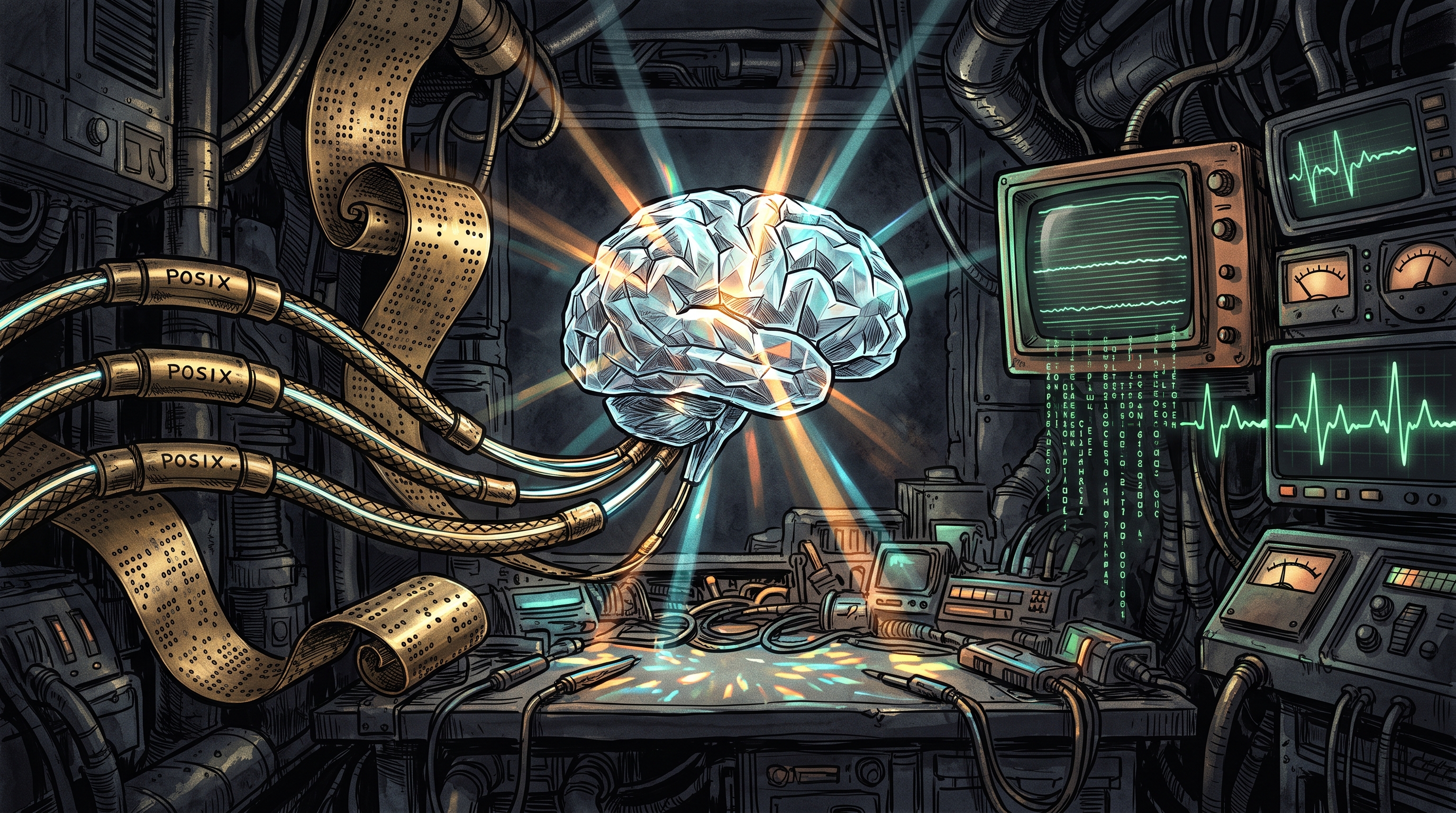
A wide 16:9 graphic-novel ink-and-wash illustration set inside a deep obsidian-slate (#111111) cybernetic workshop extending continuously to every canvas edge. Vertically centered in the composition is a translucent, geometric crystal brain suspended over an illuminated workbench, with beams of amber and cyan light passing through its frozen facets without altering its structure. On the left, three braided brass POSIX pipes labeled with glowing optical currents feed into the crystal alongside a perforated brass player-piano scroll; on the right, a vintage CRT electron beam traces copper scanlines across an oscilloscope that merges seamlessly into cascading green plain-text code and a glowing pacemaker pulse wave. High-contrast chiaroscuro lighting, intricate cross-hatching, and rich metallic and neon accents against the dark obsidian-slate (#111111) background. Full-bleed edge-to-edge composition filling 100% of the canvas with no borders, no frames, no matting, no margins, and no text overlays or lettering.
🖼️ YAML Frontmatter Image Override
image:
  path: /assets/images/freeze-dried-weights-kv-cache-generators-ted-nelson-dream-machines.jpeg
  alt: "A glowing crystal brain wired to brass POSIX pipes, a player piano roll, and a CRT beam on a dark obsidian workbench."
Title Brainstorm
- Title Option: Freeze-Dried Weights, KV-Cache Generators, and Ted Nelson’s Dream Machines
- Filename:
freeze-dried-weights-kv-cache-generators-ted-nelson-dream-machines.md - Rationale: Captures the three core pillars of the entry: the static reality of post-training LLM weights, the Python generator/REPL analogy for KV-cache tool loops, and the historical lineage of personal computing liberation.
- Filename:
- Title Option: From Cloud Oracles to KV-Caches: Python Yield, Jay Miner’s Pacemakers, and NPvg
- Filename:
cloud-oracles-kv-caches-python-yield-jay-miner-npvg.md - Rationale: Highlights the contrast between hyperscaler training incentives and cycle-accurate mechanical sympathy across Python, hardware design, and Nix.
- Filename:
- Title Option: Supercops, KV-Caches, and Computer Lib: Reconstructing the Amiga in Plain Text
- Filename:
supercops-kv-caches-computer-lib-amiga-plain-text.md - Rationale: Pairs the sociological observation on modern network surveillance with the technical blueprint of building a timeless, inspectable text instrument.
- Filename:
- Title Option: Batch Priesthoods vs. the REPL: KV-Cache Continuity, POSIX Pipes, and Home-Hosted Wire Truth
- Filename:
batch-priesthoods-repl-kv-cache-continuity-posix-wire-truth.md - Rationale: Frames the current AI datacenter era against the IBM 704 mainframe priesthood and shows how interactive loops and bare-metal logs restore builder agency.
- Filename:
Content Potential And Polish
- Core Strengths:
- Demystifies LLM inference for general readers by mapping KV-cache state persistence directly onto familiar Python
yieldgenerators and Jupyter IPython kernels. - Grounds the critique of cloud hosting in concrete wire-truth receipts from the home-hosted server (
GPTBot/1.3,OAI-SearchBot/1.4,ExaSearchBot/1.0, andClaude-UserRFC 9110 Markdown hits). - Weaves a rich historical through-line from the IBM 704 batch priesthood to John McCarthy’s REPL, Ted Nelson’s Computer Lib / Dream Machines, Jay Miner’s Amiga Copper and pacemakers, and Ken Thompson’s reproducing player piano.
- Demystifies LLM inference for general readers by mapping KV-cache state persistence directly onto familiar Python
- Suggestions For Polish:
- Consider adding a brief one-line diagram or table contrasting what evaporates when a KV-cache TTL expires versus what persists in a git-tracked plain-text file.
- When adapting for book chapters, expand slightly on how
riverand online streaming ML complement static LLM weights by handling the incremental adaptation that frozen weights cannot.
Next Step Prompts
- Draft a technical sidebar comparing the memory lifecycle of a Python
yieldgenerator frame on the CPython heap, an IPython kernel namespace in RAM, and a Transformer KV-cache tensor in GPU VRAM, showing exactly what survives a tool call and what is lost on session termination. - Create an annotated reading companion to Ted Nelson’s 1974 Computer Lib / Dream Machines that maps Nelson’s critique of IBM batch ‘Cybercrud’ and broken one-way links onto modern cloud AI APIs, RFC 9110 content negotiation, and Nix flakes.
Accept: text/markdown, RFC 9111 Vary: Accept, and RFC 9421 Web Bot Auth) can save you that money. Contact Mike for a consultation (miklevin@gmail.com)
• RFC 9110/9111 Edge Advisory
• LinkedIn