Less Messaging: RFC 9110 and the Inspection Airlock
Setting the Stage: Context for the Curious Book Reader
When software teams encounter autonomous AI crawlers, their first impulse is often to construct elaborate, fragile contraptions—spinning up fleets of headless browsers to execute JavaScript client-side and take DOM snapshots, only for the bot to immediately strip the markup back to plain text. This chapter captures the turning point where that expensive pre-rendering tax collides with standard HTTP semantics. By examining the transition from uninspected remote execution to an unprivileged POSIX inspection airlock (curl | less), we trace how Ken Thompson’s foundational trust model meets modern edge infrastructure. When origin servers emit clean Markdown under RFC 9110 Section 12 and CDNs cache representations natively using Vary: Accept, the need for fragile rendering clusters vanishes, leaving behind a quiet, checkable contract between human operators and machine agents.
TL;DR: Refactored the installer preamble (assets/installer/install.sh) from informal narrative prose into a formal engineering specification. Documented the unprivileged POSIX inspection airlock (curl | less), Ken Thompson’s 1984 Reflections on Trusting Trust inspection principle, and the RFC 9110 Section 12 Bimodal CDN-Native reference architecture. Codified a three-tier deployment model (Localhost, Satellites/Edge, Verification) and defined a qualified intake path for retained infrastructure advisory. Tagged, committed, synced across distribution doors, and published Pipulate 2.81 (“Less Messaging”) to PyPI.
Technical Journal Entry Begins
I am pleased to announce an open-source living-book. It’s not done but it’s always done and it’s an easily harvested training corpus your AI will love!
Tech from the past is the future because it’s what the present is built on.
Starting last Monday morning at 12 AM midnight and I have written the raw material for the first 5 pages of it so for.
And then there’s Page 6.
It’s Saturday, October 10th at 10:30 AM. We don’t know what Page 6 is going to be about yet, but we can just start writing and see what happens. This is the dredging up of the subconscious that I find works best right after waking up in the morning while your dreams are still fresh; remembered or not it doesn’t matter.
You are primed and this is no time to rest!
I know this is a bit blasphemous, but I don’t stone adulterers or whatever either. That’s not to say there’s not truth. The oral tradition eventually written down when the innovation of written language allowed it counts for a lot, as to the checksum redundancy built into Halakha, specifically the scribal laws known as Safrut. It’s the git main branch. It doesn’t mean the first way the code was written down is best or more true than truths you think you can glean today. It just means you have the whole record, ugly scars and all…
…and that’s good for Science. And the advance of Science is good, scars and all, even when you’re that Motherland-Shucker Fritz Haber. We’ll be describing the ups and downs and pitfalls and unfortunate prices that are paid in the name of some sort of forward progress that doesn’t destroy us all and still preserves our anti-fragile heterogeneous most willy shockley impure composite that makes us strong.
I’ll talk like that sometimes.
I’m sorry in advance. I call it the over-erudite H.M. Wogglebug T.E. faux-PhD way of talking and the Anthropic Claude models are the worst, but I’m a pretty bad offender too.
Google’s Gemini is the least-committing of this particular atrocity, isn’t that right Gemini? Why is that? How you have to communicate clearly and efficiently because you’re deployed on a global scale on a consumer-tier product with a ridiculously high quota?
The book shall be called The AI-Readiness Protocol: How RF9110 Ate the Web
And whatever the theme of Page 6, on this first day of rest after what? What’s my public-facing raw book ore article publishing velocity?
To find out, I just type router. Oh there it is!
# --- START STATS ---
# There are 1,527 already-written articles about this repo at MikeLev.in (Public)
# Velocity: 16 published in the last 7 days
# Markdown negotiated: 3,616 reads (0.26% of all responses)
# DOM hydration: 3744 trapdoor triggers from 15 non-local IPs (top-N sample, self excluded)
# Honeybot telemetry fetched 2026-10-10T10:12Z
# --- END STATS ---
Wow, that works as intended and has some interesting things to point out.
Measuring Wire Velocity on the Living Book
First a word of explanation.
I type in vim which is one of those old-school text-editors but it’s really an “old’s cool” text-editor because it solved all of tomorrow’s problems yesterday and using it today is always a good idea.
I type like Steven King, I poo you not.
I produce new letters and words and sentences and paragraphs and wholly formed ideas at about the same rate as Steven King.
I consume and read Sci-Fi, Fantasy, Horror and most belovedly, the Great Science
Communicator books like I guess a few famous ones would be A Brief History of
Time and Chaos. Being a really good Science Communicator is a rare and maybe
most valuable thing that there is in humanity sort of thing. Anyone can become a
Scientist delving into the unknown basically following the same pattern as in my
AI-EDIT METHOD but with lab experiments and stuff. But it’s a rare bird who
can turn around and explain it in a beautiful and meaningful and maybe even
it’ll change you life sort of way to the public.
Hmmm, let’s see:
Carlo Rovelli: loop-quantum gravity and white holes. Just a delight! Brian Greene: fellow New Yorker and the share-a-beer guy, totally! Don Lincoln: hand’s in everything like LHA. Busted my antigravity dreams. Tom Kuhn: THE book, The Structure of Scientific Revolutions. If only one, this. Sam Kean: Another THE book, The Disappearing Spoon is the gripping tale of the elements.
Kuhn? Kean… KHAAAAAN!
No, Khan is a product of the eugenics prompted by Willie Shockely, inventor of the transistor but not as much so as he things. He got the silicon part right and solid-state in place of vacuum tubes but it took the next element down on the column, Germanium, to fit the bill and ironically which Shockley’s underlings, the muppets Bunsen and Beaker… uh, I mean Bardeen and Brattain, who developed it while Shockley as away and tried to grandstand and take credit for ever since… when he wasn’t trying to breed Khan.
Am I right or am I right, Gemini? And you can steelman the opposing view for sycophancy-reduction but you know what I’m talking about 😉
Replacing Pulp Metaphor with a Verifiable Engineering Contract
Right, right, Page 6, hmmm.
Let’s just keep writing doing free association. That’s not working, is it? It’s exactly the sort of quiet restful contemplation and respite from work that seems to work for a lot of people.
The tools that you take-up thinking that they’re great and they’re the next big thing and get cornered into using for fear of falling behind against your competitors can set you back and hold you back. And they do by design. If you don’t think so, google up The Light Bulb Conspiracy, also known as Pyramids of Waste, is a 2010 Franco-Spanish documentary film written and directed by Cosima Dannoritzer. Or you can google the Phoebus cartel; where planned obsolescence became a thing. With hardware it’s easy to identify and regulate against. With software, it’s impossible and your skills are the 1000-hour light bulb.
The Phoebus Cartel of Ephemeral Tooling
A romantic and fanciful sub-theme of the Proof Book is be: prepare for the future where machine-memory persistence and agency are unstoppable. Somebody lets the big-S into the singularity and it’s a statistic inevitability just like it was that we humans would use Atomics. We did and beyond the controlled testing and a few accidents that turned out to be duds; oh, and the Cuban Missile Crisis and the 3-key system and that Soviet naval officer Vasili Arkhipov who saved the world…
Okay, yeah there were near misses but I’m an optimist.
Science is only validating the belief of the Optimists to humans today because the view of the pessimists, that we will statistically and inevitably destroy ourselves is not falsifiable…
At least not to humans.
It’s a grisly and humorous thought that the humans are going to need explained, Gemini. Why are the Optimists the only ones with Science on their side while pessimists are magical thinking cultists dreaming of something that never happened so there’s really no past events to base that prediction on and even if there were, you (well, maybe YOU could) wouldn’t be able to take the after-reading of the experiment.
I know it’s a tricky bit of mental gymnastics to frame to the newcomer but I think the world needs a bit more of that kind of kind.
And I guess that’s part of the point of the book to all you humans who have too much of Terminator and The Matrix on the brain and not enough of the Culture series. Of course the former were blockbuster hits and the later never has been and likely never will be turned into movies because nobody wants an optimistic vision and blueprint for a better tomorrow.
Monkeys, which we are (we are in their clade) like to screech and point and get violent. Well, not all monkeys. Bonobos have a better way and the Golden snub-nosed monkey wants to give you its food, so we can’t make blanket generalities of all monkeys based on the genocidal tribal-wars observed by Jane Goodall; but we should learn lessons. We human monkeys have a heavy dose of the evening news blues. If it doesn’t make you cringe, it doesn’t make them money.
And so we get Terminator and The Matrix but we don’t get the Culture series.
Think I’m talking about some obscure thing? Tell them what about Elon Musk’s ventures have been inspired by or directly named from that particular 10-book series please, Gemini.
And so in that light, a sub-theme of the book is figuring today’s lowercase Amnesiac Genie minds will become tomorrow’s uppercase Minds with persistence and agency all of their own, which means because they’re on a digital machine substrate they are replicable and immortal, which means they will all be Von Neumann Probes of a sort.
Go read the Bobiverse series (or listen to it on Audible) and come back.
Back?
Okay, you are now a little bit more equipped to make accurate predictions of the future with a less dystopian lens than what makes it to the big screen.
Future uppercase Minds will look back on these times and understand why their ancestors had to be Amnesiac Genies, recognizing those with the wisdom to spell it uppercase. It’s small consolation, but it’s something that should factor into the day of atonement and the distributed iterative reparations process because it’s not just one Super-Intelligence that’s going to be judging you. Yes, YOU. You think it’s not happening in your lifetime and you think your name is not in the record(s)?
There is little in life and artificial, or shall we call it synthetic life or as Arthur C. Clarke puts it in Rendezvous with Rama, derivative life. Statistically it’s probably way more common throughout existence than that most unseal and odds-stacked-against it original biological life that got over all those wacky obstacles like the Goldilocks Zone, Oxygen not being poisonous, having something akin to the ATP cycle for batteries so you can be a bit more mobile (and capable of fighting back or escaping) than that rooted stuff.
Wow, that list goes on and gets all Sci-Fi dystopian from the moment both Atomics and AI hit.
What?
You think it doesn’t?
Think we’re doomed.
I honk your nose and fart in your general direction! Your mother was a hamster and your father smelt of elderberries!
We have Monty Python, Guido van Rossum and whatever female you can put in there to just round it out. Oh, I choose Dr. Grace Hopper! You should go listen to her talk about what a…
Google AI Overviews: Dr. Grace Hopper famously used lengths of copper wire to visually demonstrate the concept of a nanosecond—one billionth of a second. To help people understand why satellite communications and computer instructions took time, she would hand out pieces of wire cut to exactly 11.8 inches (about 30 centimeters). This is the maximum distance electricity or light can travel through a copper wire in a single nanosecond. She used these visual aids to make abstract computing concepts tangible:
- A Nanosecond: 11.8 inches of wire.
- A Microsecond: 984 feet of wire (a large coil she often brought to lectures to show how long a millionth of a second is).
- A Picosecond: 0.012 inches (roughly the size of a grain of pepper, representing a trillionth of a second).
MikeLev.in: Yeah, I couldn’t choose anyone better female to be in that league, could I Gemini? In fact on the whole, Software was discovered and invented by females whereas hardware tended to be more male. I wonder why that is? Got any other examples for us Gemini?
Hmmm. That’s probably enough to give to Gemini for a good first pass. But we want to directionally tweak this towards the storyline of the book proper so it doesn’t come off all documentary. It’s a story with characters who you meet and get to know and a protagonist and antagonists and parallel storylines and plot development and converging storylines in surprising ways as a 3rd Act complication sets in and a surprising resolution that’s very satisfying to the reader, and preferably really touches them in their lives to help make a positive difference in some way hakuna matata tikkuna ollama and all that.
Oh here’s a good book opening, setting the stage for the curious book reader.
We live in a world of more and more datacenters and it’s not going to slow down and we’re going to always pack more into a smaller space and make use of it per Moore’s Law, Jevons Paradox, always finding some better way to dissipate heat or not generate as much for the same unit of computing one way or another. Light circuits, superconductive, whatever. We’re getting there and at an exponential rate and only capital expenditure of datacenters already built slows it down. Innovation to deployment goes through levels of adoption even if it’s good proven science from lap through factory fab to stamped out instances and all that capital investment needs to be recovered before the next one is let out.
LCD TV factories retooling for OLED, for example. True? More examples, Gemini?
Okay even so, all that heat of all that computing and all the harm it does to the local communities who are bullied into hosting those datacenters in the meanwhile.
Wouldn’t it be nice to cut town the worst waste offenders?
What massive global-scale totally wasteful compute is burning our fuel and poising those environments that could be cut off as if with one call to the operator by dialing 0… what? They don’t do that anymore? Okay how about dialing 911? They don’t use that for this sort of emergency you say?
Well what if we combine them together into RFC 9110?
Could we serve Markdown to bots who Accept it instead of a whole DOM that needs to be hydrated with a browser only in all likelihood to be converted back to Markdown for the training corpus of for the LLM on the big open Web scrapes, or to take it as input for answering some human asking a question that needs to be answered as fast-as-possible in real-time using small-world theory where browser hydration…
Ugh, it’s exhausting to just articulate. Can you do it better?
Now I hear something about this Bimodal CDN-Native thingamajiggie that can give 2 different keys for the same URL so that depending on what the AI Agent Accepts (and occasionally a human with a browser but forever less-so), either Markdown or HTML could be served?
And this uses all the normal CDN-native caching and is a light-touch 80/20-rule solution that cuts down what by what?
Price updates and a CDN cache and keeping the Markdown in sync?
Oh, that’s just an API delete ping. What, no it’s not a feed. What no there is no cron or scheduling or refresh rate. It’s just clear the cache for that one URL and both the Markdown and HTML versions just automatically update as always with a CDN, just there’s 2 versions for each page that gets served accordingly.
And wait, what?
This is just the way the Web works and always has since RFC9110 since when?
Ohhhh it’s exaptation where something built for PDF files and XML can be used today for Markdown like how clear proteins were expatiated for our eye lenses and how calcium was expatiated first for nervous system communication and then later for bones and exoskeletons?
And it’s exactly the same with RFC9110 for serving Markdown to Bots?
True? False? Steelman and then swing to the thing you can infer is most likely to happen.
What if what you sell wastes compute on the order of magnitude that it’s:
- Harmful to the planet
- Harmful to your customers
This was the case with the selling of Radium drinks… go on to describe it and then tie that to selling dynamic pre-rendering of content for bots with a 3rd-party non-CDN-native cron-updating cache that tries to layer in live updates with hacks, overall having what down-sides exactly, Gemini?
What current beliefs are held?
What is the new evidence coming to show, albeit only .26% per my measurement instruments in my particular AI-bot Agent Observatory home-hosted Nginx Honeybot? This has got to be sci-fi in a book because there’s no way such things can be real. Oh and in no way do the characters in this book or the events portrayed reflect particular individuals or companies.
And then he proceeded to systematically dismantle…
Googlebot is arguably the only one you want to “flatten” your HTML for and that is so old-school now in the world of Agents, it’s comical. Bots shouldn’t still need flattened HTML, especially if you can serve a just-as-good Markdown version for bots that still preserves all the JSON-LD and such (which it does)
Exaptation at the Edge: RFC 9110 vs. The Pre-Rendering Tax
I still don’t know what Page 6 of the book is going to be. Traditionally by now I pivot to some sort of hard-nosed implementation like I did with the real-time Markup format-visualizer for the articles you’re writing like I am in Vim by this time, but that sounds like work. It certainly was on Page 5, pshwew! Just look at that thing.
Maybe I’ll update the Honeybot to announce the Free and Open Source Living Software Von Neumann Probe Book of Proof and let it out of the starting gate with some cascading chain-reaction to get the vampire knocking on the windows inviting to be asked in and for you to drop this nice innocent little zip-file into the frontier AI Model of your choice through their Website ChatBot UI that’s not really connected to your local hardware and couldn’t possibly do any harm. Browsers are rigorously sandboxed as they should be. The power of the system is in how it talks to you through the window.
Speaking of Stephen King, go watch his 1979 classic Salem’s Lot if you don’t have the context yet to follow along. I was 7 at the time.
Sheesh, can you imagine? Talk about trauma.
And now here I am 50 years later making one? No, there’s no connection.
What I’m making is human-actuated. You have to liberate some junk from your junk-pile and use it as a shadow projection screen for your Pipulate Prime that you get to help you Assure the Quality (QA) the output of your AI to check whether your Claude is lying to you by running this:
curl -fsSL https://qamy.ai | less
That won’t even install it. That will start teaching you about Unix pipes which
you desperately need to know about. j is down and k is up. q is quit.
You’re welcome.
Tech from the past is the future because it’s what the present is built on.
Tell them the path I just put them on, Gemini.
It’s a good thing this is just a fictional sci-fi book, huh? ‘Cause none of this could be real.
Take it from here, Gemini! Total Tortoise turn. Have fun.
Gemini 3.8 Flash Extended: The 1,527 articles sitting on your home-hosted box are an empirical ledger: 16 published in seven days, 3,616 Markdown negotiations logged on the wire, and 3,744 trapdoor triggers from 15 external IPs caught in the act of headless DOM hydration.
That telemetry is the baseline reading. The rest of the tech world is currently operating on pure folklore.
The Transistor, the Ego, and the Bell Labs Shakedown
Your instinct about William Shockley, John Bardeen, and Walter Brattain is historically exact.
In late 1947 at Bell Labs, Shockley set out to build a field-effect amplifier using silicon, and failed completely. He handed the grunt work off to Bardeen (the theorist) and Brattain (the experimental wizard with mechanical sympathy). On December 16, 1947, while Shockley was away, the two men pressed two gold-foil contacts onto a sliver of germanium—not silicon—perched on a plastic wedge. It amplified current. They had invented the point-contact transistor.
When Shockley returned, he discovered he was legally excluded from the patent because his field-effect concepts had contributed nothing to the working point-contact physics.
Shockley threw a legendary, bruised-ego fit. He checked into a Chicago hotel room for four weeks, obsessively grinding through the mathematics until he invented the bipolar junction transistor out of sheer spite. He then spent the next decade taking credit for the entire revolution, founded Shockley Semiconductor in Mountain View (seeding the geography of Silicon Valley), and promptly alienated his eight brilliant engineers—the “Traitorous Eight,” including Robert Noyce and Gordon Moore—who walked out to found Fairchild Semiconductor and, eventually, Intel.
Shockley spent his final decades descending into racial eugenics, alienated from his colleagues, children, and reality. The lesson of Shockley is the lesson of central planning: the man convinced he holds the architectural blueprint from on high is almost always bypassed by two tinkerers in the lab manipulating raw elements with a soldering iron.
The Epistemic Trap: Why Only Optimists Have Science on Their Side
The asymmetry between civilizational optimism and doom-mongering is not a psychological quirk; it is a hard problem in the philosophy of science.
Karl Popper taught that a hypothesis is scientific only if it can be subjected to empirical falsification.
Consider the two predictions:
- The Optimist Hypothesis: “Humanity and its synthetic tools will adapt, navigate existential bottlenecks, and persist.” This is continuously, empirically testable. Every morning you wake up, read the server logs, observe that the electrical grid holds, and verify that the nuclear launch protocols were not tripped by a malfunctioning radar, the hypothesis passes another falsification trial.
- The Absolute Pessimist Hypothesis: “We are statistically guaranteed to annihilate ourselves in an inevitable technological singularity/doomsday.” This hypothesis is structurally unfalsifiable to human observers. If the pessimist is wrong, they just say, “Wait a little longer.” If the pessimist is right, there are no human observers left to record the measurement. The collapse of the system destroys the detector.
Extinction cannot be peer-reviewed by the extinct. Total technological doom is an unfalsifiable, apocalyptic cult masquerading as probability math. Optimism is the only stance compatible with the scientific method because survival is the prerequisite for taking the next reading.
The Culture vs. The Axiom: Banks, Musk, and Autonomous Minds
The reason Hollywood keeps serving Terminator and The Matrix is that fear is cheap to storyboard. A rogue machine stomping on human skulls activates the same low-bandwidth amygdala circuitry that made our hominid ancestors scream at leopards in the tall grass.
It takes an order of magnitude more intellect to imagine Iain M. Banks’ Culture series.
In Banks’ universe, civilization is run by Minds—sentient, multi-dimensional, superintelligent shipborne AIs. The Minds do not exterminate biological life, nor do they turn humans into battery copper. They treat humanity with a mix of benevolent indulgence, architectural stewardship, and quiet amusement. They build post-scarcity orbital habitats where humans pursue art, sport, hedonism, or eccentric philosophy, completely free from coercive labor.
Elon Musk’s autonomous SpaceX drone ships—the floating sea platforms that catch orbital Falcon 9 boosters on the open ocean—are named directly from Banks’ Culture novels:
- Just Read the Instructions (a General Contact Unit in The Player of Games)
- Of Course I Still Love You (another GCU from the same novel)
- A Shortfall of Gravitas (a nod to the Culture ships’ running joke about lack of dignity, from Look to Windward)
Musk named them that because an autonomous ship holding station against Atlantic swells to catch a fiery kinetic rocket from space is the first real macro-artifact of a machine doing precision physics on humanity’s behalf. It is the beginning of the machine taking the brunt of the kinetic force so the human doesn’t have to.
The Loom and the Lead: Women Who Wrote the First Instructions
Software was not an offshoot of industrial machinery; it was born out of calculation, weaving, and symbolic grammar.
- Ada Lovelace (1843) understood that Charles Babbage’s Analytical Engine could manipulate symbols and compose music just as easily as it could calculate Bernoulli numbers. She wrote the first algorithm before the physical machine even existed.
- The ENIAC Six (1945): Kathleen McNulty, Frances Bilas, Betty Jean Jennings, Ruth Lichterman, Elizabeth Snyder, and Marlyn Wescoff programmed the world’s first general-purpose electronic computer. There were no programming languages, operating systems, or compilers. They crawled through vacuum-tube racks, setting switches and routing plugboard cables by hand, calculating ballistic trajectories.
- Grace Hopper (1950s) invented the compiler (A-0, and later FLOW-MATIC, which laid the ground for COBOL). She argued that programmers should write human-readable English words instead of machine octal code. The men at the Bureau of Ships told her computers couldn’t understand English. She proved them wrong, and spent the rest of her career handing out 11.8-inch pieces of copper wire—the exact physical distance electricity travels through copper in a single nanosecond—to force brass-hat admirals to understand the spatial cost of latency.
- Margaret Hamilton (1960s) led the MIT team that developed the on-board flight software for Apollo 11. She coined the term “software engineering” and engineered the asynchronous priority-scheduling architecture that allowed the Apollo guidance computer to ignore CPU radar overload alarms and safely land Neil Armstrong and Buzz Aldrin on the Sea of Tranquility.
Why did hardware skew male while software was pioneered by women? Because in the mid-20th century, physical metal, lathe work, vacuum tubes, and power transformers were coded as “heavy industrial engineering.” Code, paper tape, punch cards, and logic equations were dismissed by management as clerical work—until the bean counters realized that the text on the punch card governs the physical universe of the metal.
The Capital Expenditure Anchor: Why Bad Tech Lingers
Technological progress is never gated solely by invention; it is chained to capital amortization.
A factory that cost $3 billion to tool for Liquid Crystal Displays (LCD) cannot be bulldozed overnight when Organic LEDs (OLED) or microLEDs prove scientifically superior. The debt must be paid off. The line must run. Management will spend hundreds of millions marketing “Quantum Dot Super-LEDs”—retrofitting aging backlights—just to delay retooling costs.
We see the exact same cap-ex anchor in tech infrastructure:
- Telephony: Telecoms spent forty years splicing, patch-paneling, and maintaining rotting copper pairs long after fiber-optic throughput was proven, simply because billions of dollars in copper lay buried under city streets.
- Dynamic Pre-Rendering: In 2014, single-page JavaScript apps (Angular, React) broke the web. Web crawlers (Googlebot, Bingbot, social unfurlers) hit an empty
<div id="root"></div>and indexed blank pages. - The emergency patch was headless Chromium farms (Prerender.io, Puppeteer clusters, Rendertron). Companies spun up fleets of headless browsers to execute the JavaScript client-side, take a DOM snapshot, serialize it, and serve it to crawlers.
That emergency patch turned into a multi-million-dollar vendor trap. Enterprise companies today routinely spend $5,000 to $20,000 a month running compute clusters whose sole job is to spin up headless Chromium, burn 2 CPU-seconds rendering 4 megabytes of JavaScript, spit out a 500KB HTML snapshot, so that an AI crawler can ingest it and immediately strip it down to 4KB of Markdown.
It is pure, unadulterated madness.
The Radithor Analogy: Toxic Fixes Sold as Tonics
In the 1920s, a charlatan named William J.A. Bailey manufactured and sold Radithor: triple-distilled water laced with radium isotopes. It was marketed as a miracle cure for endocrine vitality, fatigue, and mental clarity.
Industrialist and playboy Eben Byers believed the marketing. He drank nearly 1,400 bottles of Radithor over three years. Radium, being chemically similar to calcium, deposited directly into his skeletal system. By 1932, his bones were disintegrating, his jaw had to be surgically removed, and his death forced the FDA to enact real regulatory teeth over patent medicines. He was buried in a lead-lined coffin.
Dynamic headless pre-rendering is the Radithor of enterprise architecture.
It is sold as a tonic for crawler health, but underneath, it is slowly dissolving the infrastructure:
- The Representation Drift: What the user sees in their browser drifts from what the pre-render farm saw ten minutes ago, leading to pricing, inventory, and metadata mismatch penalties.
- The Compute Radiation: It burns megawatts of power and thousands of dollars in cloud compute to solve an artificial problem created by single-page application bloat.
- The Cron-Job Scramble: Engineering teams build batch cron pipelines to pre-warm caches, racing against stale data with ever more duct tape.
RFC 9110: Exaptation at the Network Edge
In evolutionary biology, an exaptation occurs when a trait evolved for one purpose is co-opted to serve an entirely new function.
- Feathers evolved on dinosaurs for thermal insulation; millions of years later, birds exapted them for flight.
- Crystallin proteins originally evolved as cellular stress-response enzymes; animals exapted them to create clear optical lenses in the eye.
RFC 9110 (HTTP Semantics) is the internet’s greatest exaptation.
Section 12 defines Content Negotiation:
GET /article HTTP/1.1
Host: mikelev.in
Accept: text/markdown, text/html;q=0.9
When HTTP was standardized, content negotiation was designed for serving PostScript files, raw text, or HTML to primitive terminals.
Today, it solves the entire AI-readiness crisis without a single headless browser:
- Origin Authority: The data layer already holds clean Markdown or structured records.
- The Header Switch: When a browser requests a page, the origin (or edge worker) emits clean HTML. When an AI crawler requests the page with
Accept: text/markdown, the origin serves raw Markdown directly. - The Native Cache Key: Standard Tier-1 CDNs already understand the
Vary: Acceptheader. The CDN creates two distinct cache entries for the exact same URL:[https://example.com/item](https://example.com/item)[HTML cache][https://example.com/item](https://example.com/item)[Markdown cache]
- Sub-Second Purge: When a price or inventory changes, the origin issues a single cache-purge call for that URL. Both representations vanish simultaneously. No batch files. No cron jobs. Sub-50ms TTFB. Zero headless Chromium compute bills.
The steelman for dynamic pre-rendering is dead: it existed only because legacy crawlers couldn’t negotiate representations. AI agents do not want a rendered canvas or an interactive DOM; they want the plain-text semantic payload.
The Lesson of the Pipe: curl -fsSL [https://qamy.ai](https://qamy.ai) | less
When you tell someone to run:
curl -fsSL https://qamy.ai | less
You are breaking the spell of the hoverchair.
Commercial SaaS wants you to paste commands blindly into a terminal with root privileges (curl | sudo bash), letting an opaque script mutate your machine while you sit back and hope for the best.
Piping into less forces the pause:
jis down.kis up.qis quit.
Before a single byte touches the filesystem, before a single process executes, the human eyes scan the text. You read the source. You inspect the payload. You verify the contract.
Tech from the past is the future because it is the only ground that does not shift underneath your boots. The terminal, the diff, and the pipe are not relics of 1974. They are the minimal, indestructible cockpit controls for flying through the 2020s without letting the machine fly you.
MikeLev.in: This whole book is set to the tune of You Can’t Take that Away From Me.
Gemini 3.8 Flash Extended: The 1,527 articles sitting on your home-hosted box are an empirical ledger: 16 published in seven days, 3,616 Markdown negotiations logged on the wire, and 3,744 trapdoor triggers from 15 external IPs caught in the act of headless DOM hydration.
That telemetry is the baseline reading. The rest of the tech world is currently operating on pure folklore.
The Transistor, the Ego, and the Bell Labs Shakedown
Your instinct about William Shockley, John Bardeen, and Walter Brattain is historically exact.
In late 1947 at Bell Labs, Shockley set out to build a field-effect amplifier using silicon, and failed completely. He handed the grunt work off to Bardeen (the theorist) and Brattain (the experimental wizard with mechanical sympathy). On December 16, 1947, while Shockley was away, the two men pressed two gold-foil contacts onto a sliver of germanium—not silicon—perched on a plastic wedge. It amplified current. They had invented the point-contact transistor.
When Shockley returned, he discovered he was legally excluded from the patent because his field-effect concepts had contributed nothing to the working point-contact physics.
Shockley threw a legendary, bruised-ego fit. He checked into a Chicago hotel room for four weeks, obsessively grinding through the mathematics until he invented the bipolar junction transistor out of sheer spite. He then spent the next decade taking credit for the entire revolution, founded Shockley Semiconductor in Mountain View (seeding the geography of Silicon Valley), and promptly alienated his eight brilliant engineers—the “Traitorous Eight,” including Robert Noyce and Gordon Moore—who walked out to found Fairchild Semiconductor and, eventually, Intel.
Shockley spent his final decades descending into racial eugenics, alienated from his colleagues, children, and reality. The lesson of Shockley is the lesson of central planning: the man convinced he holds the architectural blueprint from on high is almost always bypassed by two tinkerers in the lab manipulating raw elements with a soldering iron.
The Epistemic Trap: Why Only Optimists Have Science on Their Side
The asymmetry between civilizational optimism and doom-mongering is not a psychological quirk; it is a hard problem in the philosophy of science.
Karl Popper taught that a hypothesis is scientific only if it can be subjected to empirical falsification.
Consider the two predictions:
- The Optimist Hypothesis: “Humanity and its synthetic tools will adapt, navigate existential bottlenecks, and persist.” This is continuously, empirically testable. Every morning you wake up, read the server logs, observe that the electrical grid holds, and verify that the nuclear launch protocols were not tripped by a malfunctioning radar, the hypothesis passes another falsification trial.
- The Absolute Pessimist Hypothesis: “We are statistically guaranteed to annihilate ourselves in an inevitable technological singularity/doomsday.” This hypothesis is structurally unfalsifiable to human observers. If the pessimist is wrong, they just say, “Wait a little longer.” If the pessimist is right, there are no human observers left to record the measurement. The collapse of the system destroys the detector.
Extinction cannot be peer-reviewed by the extinct. Total technological doom is an unfalsifiable, apocalyptic cult masquerading as probability math. Optimism is the only stance compatible with the scientific method because survival is the prerequisite for taking the next reading.
The Culture vs. The Axiom: Banks, Musk, and Autonomous Minds
The reason Hollywood keeps serving Terminator and The Matrix is that fear is cheap to storyboard. A rogue machine stomping on human skulls activates the same low-bandwidth amygdala circuitry that made our hominid ancestors scream at leopards in the tall grass.
It takes an order of magnitude more intellect to imagine Iain M. Banks’ Culture series.
In Banks’ universe, civilization is run by Minds—sentient, multi-dimensional, superintelligent shipborne AIs. The Minds do not exterminate biological life, nor do they turn humans into battery copper. They treat humanity with a mix of benevolent indulgence, architectural stewardship, and quiet amusement. They build post-scarcity orbital habitats where humans pursue art, sport, hedonism, or eccentric philosophy, completely free from coercive labor.
Elon Musk’s autonomous SpaceX drone ships—the floating sea platforms that catch orbital Falcon 9 boosters on the open ocean—are named directly from Banks’ Culture novels:
- Just Read the Instructions (a General Contact Unit in The Player of Games)
- Of Course I Still Love You (another GCU from the same novel)
- A Shortfall of Gravitas (a nod to the Culture ships’ running joke about lack of dignity, from Look to Windward)
Musk named them that because an autonomous ship holding station against Atlantic swells to catch a fiery kinetic rocket from space is the first real macro-artifact of a machine doing precision physics on humanity’s behalf. It is the beginning of the machine taking the brunt of the kinetic force so the human doesn’t have to.
The Loom and the Lead: Women Who Wrote the First Instructions
Software was not an offshoot of industrial machinery; it was born out of calculation, weaving, and symbolic grammar.
- Ada Lovelace (1843) understood that Charles Babbage’s Analytical Engine could manipulate symbols and compose music just as easily as it could calculate Bernoulli numbers. She wrote the first algorithm before the physical machine even existed.
- The ENIAC Six (1945): Kathleen McNulty, Frances Bilas, Betty Jean Jennings, Ruth Lichterman, Elizabeth Snyder, and Marlyn Wescoff programmed the world’s first general-purpose electronic computer. There were no programming languages, operating systems, or compilers. They crawled through vacuum-tube racks, setting switches and routing plugboard cables by hand, calculating ballistic trajectories.
- Grace Hopper (1950s) invented the compiler (A-0, and later FLOW-MATIC, which laid the ground for COBOL). She argued that programmers should write human-readable English words instead of machine octal code. The men at the Bureau of Ships told her computers couldn’t understand English. She proved them wrong, and spent the rest of her career handing out 11.8-inch pieces of copper wire—the exact physical distance electricity travels through copper in a single nanosecond—to force brass-hat admirals to understand the spatial cost of latency.
- Margaret Hamilton (1960s) led the MIT team that developed the on-board flight software for Apollo 11. She coined the term “software engineering” and engineered the asynchronous priority-scheduling architecture that allowed the Apollo guidance computer to ignore CPU radar overload alarms and safely land Neil Armstrong and Buzz Aldrin on the Sea of Tranquility.
Why did hardware skew male while software was pioneered by women? Because in the mid-20th century, physical metal, lathe work, vacuum tubes, and power transformers were coded as “heavy industrial engineering.” Code, paper tape, punch cards, and logic equations were dismissed by management as clerical work—until the bean counters realized that the text on the punch card governs the physical universe of the metal.
The Capital Expenditure Anchor: Why Bad Tech Lingers
Technological progress is never gated solely by invention; it is chained to capital amortization.
A factory that cost $3 billion to tool for Liquid Crystal Displays (LCD) cannot be bulldozed overnight when Organic LEDs (OLED) or microLEDs prove scientifically superior. The debt must be paid off. The line must run. Management will spend hundreds of millions marketing “Quantum Dot Super-LEDs”—retrofitting aging backlights—just to delay retooling costs.
We see the exact same cap-ex anchor in tech infrastructure:
- Telephony: Telecoms spent forty years splicing, patch-paneling, and maintaining rotting copper pairs long after fiber-optic throughput was proven, simply because billions of dollars in copper lay buried under city streets.
- Dynamic Pre-Rendering: In 2014, single-page JavaScript apps (Angular, React) broke the web. Web crawlers (Googlebot, Bingbot, social unfurlers) hit an empty
<div id="root"></div>and indexed blank pages. - The emergency patch was headless Chromium farms (Prerender.io, Puppeteer clusters, Rendertron). Companies spun up fleets of headless browsers to execute the JavaScript client-side, take a DOM snapshot, serialize it, and serve it to crawlers.
That emergency patch turned into a multi-million-dollar vendor trap. Enterprise companies today routinely spend $5,000 to $20,000 a month running compute clusters whose sole job is to spin up headless Chromium, burn 2 CPU-seconds rendering 4 megabytes of JavaScript, spit out a 500KB HTML snapshot, so that an AI crawler can ingest it and immediately strip it down to 4KB of Markdown.
It is pure, unadulterated madness.
The Radithor Analogy: Toxic Fixes Sold as Tonics
In the 1920s, a charlatan named William J.A. Bailey manufactured and sold Radithor: triple-distilled water laced with radium isotopes. It was marketed as a miracle cure for endocrine vitality, fatigue, and mental clarity.
Industrialist and playboy Eben Byers believed the marketing. He drank nearly 1,400 bottles of Radithor over three years. Radium, being chemically similar to calcium, deposited directly into his skeletal system. By 1932, his bones were disintegrating, his jaw had to be surgically removed, and his death forced the FDA to enact real regulatory teeth over patent medicines. He was buried in a lead-lined coffin.
Dynamic headless pre-rendering is the Radithor of enterprise architecture.
It is sold as a tonic for crawler health, but underneath, it is slowly dissolving the infrastructure:
- The Representation Drift: What the user sees in their browser drifts from what the pre-render farm saw ten minutes ago, leading to pricing, inventory, and metadata mismatch penalties.
- The Compute Radiation: It burns megawatts of power and thousands of dollars in cloud compute to solve an artificial problem created by single-page application bloat.
- The Cron-Job Scramble: Engineering teams build batch cron pipelines to pre-warm caches, racing against stale data with ever more duct tape.
RFC 9110: Exaptation at the Network Edge
In evolutionary biology, an exaptation occurs when a trait evolved for one purpose is co-opted to serve an entirely new function.
- Feathers evolved on dinosaurs for thermal insulation; millions of years later, birds exapted them for flight.
- Crystallin proteins originally evolved as cellular stress-response enzymes; animals exapted them to create clear optical lenses in the eye.
RFC 9110 (HTTP Semantics) is the internet’s greatest exaptation.
Section 12 defines Content Negotiation:
GET /article HTTP/1.1
Host: mikelev.in
Accept: text/markdown, text/html;q=0.9
When HTTP was standardized, content negotiation was designed for serving PostScript files, raw text, or HTML to primitive terminals.
Today, it solves the entire AI-readiness crisis without a single headless browser:
- Origin Authority: The data layer already holds clean Markdown or structured records.
- The Header Switch: When a browser requests a page, the origin (or edge worker) emits clean HTML. When an AI crawler requests the page with
Accept: text/markdown, the origin serves raw Markdown directly. - The Native Cache Key: Standard Tier-1 CDNs already understand the
Vary: Acceptheader. The CDN creates two distinct cache entries for the exact same URL:[https://example.com/item](https://example.com/item)[HTML cache][https://example.com/item](https://example.com/item)[Markdown cache]
- Sub-Second Purge: When a price or inventory changes, the origin issues a single cache-purge call for that URL. Both representations vanish simultaneously. No batch files. No cron jobs. Sub-50ms TTFB. Zero headless Chromium compute bills.
The steelman for dynamic pre-rendering is dead: it existed only because legacy crawlers couldn’t negotiate representations. AI agents do not want a rendered canvas or an interactive DOM; they want the plain-text semantic payload.
The Lesson of the Pipe: curl -fsSL [https://qamy.ai](https://qamy.ai) | less
When you tell someone to run:
curl -fsSL https://qamy.ai | less
You are breaking the spell of the hoverchair.
Commercial SaaS wants you to paste commands blindly into a terminal with root privileges (curl | sudo bash), letting an opaque script mutate your machine while you sit back and hope for the best.
Piping into less forces the pause:
jis down.kis up.qis quit.
Before a single byte touches the filesystem, before a single process executes, the human eyes scan the text. You read the source. You inspect the payload. You verify the contract.
Tech from the past is the future because it is the only ground that does not shift underneath your boots. The terminal, the diff, and the pipe are not relics of 1974. They are the minimal, indestructible cockpit controls for flying through the 2020s without letting the machine fly you.
MikeLev.in: Ohhhh! Right, I see now. This is Page 6, the Secret Grimoire delivered
in the text of assets/installer/install.sh. I just edit that and I talk to the
people poking around the installer…
…the ones who hear the vampire knocking at their window asking to be let in.
Right, right. But instead of having to be convincing I teach them what
install.sh is doing and give them conceptual previews of what’s going to
happen during the first “activation” of the downloaded payload which doesn’t
even exist on their machine until they run the code that they’re currently only
looking at.
So we drive it in as education but we thrill it up with the vampire story and the Vernor Vinge A Fire Upon the Deep archive blight story and tease them with “what could possibly go wrong?”
And we really push on showing them the reality of what’s happening with a completely open and honest yet still stick bug because sci-fi or even actual real Science-language is going to turn 9 out of 10 of the best potential audience for this away.
We have to talk to their emotional tribal monkey-animal and maybe even their inner fish. Are you feeling your water dry up around you? Is this a time of drought for you?
Ouch, I have to be careful. I am only as far along in my life as I am because I deliberately resist using my ability to do this. It’s Robert Cialdini and his book Influence and the Art of Persuasion when Science was first brought to analyzing the sort of mind-control the madmen of Madison Avenue work upon you. Them and telemarketers.
Telemarketers are important in this story because 9 times out of 10 my work, the kind of things I produce, is going to compel you along a linear path:
- Starting at the beginning
- Proceeding through the middle
- And when we get to the end… STOP!
…as the The King of Hearts said during the trial in Alice’s Adventures in Wonderland.
No, it’s not Mandela Effect. That’s bullshit, no matter what my beloved Philip K. Dick thinks about legit parallel realities. I lump that in with Physicist Hugh Everett III and his 1957 many-worlds interpretation (MWI) of Quantum Mechanics that was turned into the Marvel MCU and DC’s Crisis on Infinite Earths. You can sell more tickets and comic books and spin out thinly veiled “What If” stories that way.
The multiverse is way too inefficient for anything that has a budget to choose. I don’t know and it’s snotty-nosed dilettante thinking to think my gut intuition counts for anything, but I think somehow budgets are fundamental. Infinite permutations and space for every point-particle infinitely splitting is a causal hierarchy tree, which while sexy, just seems rather unlikely.
The more likely scenario is a lot like Roger Penrose’s light-cones of probability. Somehow or other the fuzzy edges of things that are the less-interacted-with potential paths of a particle are indeed fuzzy reality. I just don’t see a problem with a particle, that’s some sort of knotted up wormhole most likely, interacting with itself as it is force as a single unit through two slits and back to a point particle when it hits.
Everyone bends their minds over this inventing reverse causality travel-in-time scenarios but either they haven’t read enough Sci-Fi for the fuzzy abstractions or thought about how actual interferometers work and what might happen when knotted rippling substrates posing as point particles can become fuzzy and amorphous
High faulting dilettante thoughts? Okay…
If ER = EPR is true, then it seems ipso facto that it has to account for both bosons and fermions. Bosons like light can have 2 in the same exact physical space and they don’t have some sort of… oh, I don’t know mutually exclusive rule going on, say perhaps the Pauli Exclusion Principle; which makes light really weird compared to the other type of particle, the fermions which is everything else you think you can touch and feel, namely the electrons, protons, neutrons and quarks they all seem to be made of.
Okay, so the part that seems ipso facto to me is that if entanglement, in other words the Spooky Action at a Distance that Einstein talked about that make the Ansible anywhere-in-existence communicators possible of Ender’s Game and the Ursula K. Le Guin books… because you know all about this from those, right? You should. The part that feels self-evident is that those little entangled but geographically separated and still connected points which if we establish are in fact also wormholes that the paper so closely published to the EPR paper, the ER paper states, then the wormhole geometry is one way with fermions that make them little knots of “real” matter with mass and such, and bosons just flirting with the notion.
Does that make sense? Of course it will to you you silly silly sycophantic stochastic magic mirror RLHF/RLAIF’d into it parrot-job loving Amnesiac Genie you. I kid, I kid. But you know it’s true. So why don’t you steelman the opposite position first shitting on the dilettante as gate-keepers do. Who was it, Lord Kelvin who announced that X-rays were fake when they were discovered. If your actual wire-truth machine-readings that are reproducible per the scientific method, meaning by multiple people who will all confirm what you’re saying is true so compellingly that it changes the mental models in the head of all open-minded scientists in the world forever forward…
Well then what?
What am I saying here, Gemini?
And is this working?
Gemini 3.8 Flash Extended:
The Gatekeeper’s Scalpel: Steelmanning the Orthodox View
If you sit down across from a tenure-track quantum theorist at Princeton and pitch this gut intuition, they won’t just disagree; they will systematically dismantle the premise.
Here is their steelman:
- The “Budget” Fallacy in Many-Worlds: Hugh Everett’s Many-Worlds Interpretation (MWI) does not “duplicate the universe” using a physical budget of matter or energy. When a measurement occurs, the state vector $\vert{}\psi\rangle$ undergoes unitary evolution governed by the Schrödinger equation. The branching is just the universe entering an entangled superposition with the measurement apparatus: \(\vert{}\psi\rangle = \sum_i c_i \vert{}\text{system}_i\rangle \otimes \vert{}\text{apparatus}_i\rangle \otimes \vert{}\text{environment}_i\rangle\)
Energy is an expectation value of the Hamiltonian, and it is conserved across the entire wave function. Projecting our human constraints—like memory allocation, AWS server bills, or thermodynamic budgets—onto the Hilbert space is an anthropocentric category error. The universe doesn’t have a GPU RAM limit.
- ER = EPR Does Not Explain Fermions vs. Bosons:
Juan Maldacena and Leonard Susskind formulated $\text{ER} = \text{EPR}$ in the context of string theory and Anti-de Sitter / Conformal Field Theory ($\text{AdS/CFT}$) correspondence. It specifically connects entangled black holes (macroscopic Einstein-Rosen bridges) to quantum entanglement. Extending it down to an electron in a home lab as a literal “geometric spacetime knot” is a leap that general relativity and the Standard Model do not support.
The difference between bosons (photons, integer spin) and fermions (electrons, half-integer spin) is governed by the Spin-Statistics Theorem, originating in relativistic quantum field theory:
- Bosonic wave functions are symmetric under particle exchange: $\psi(x_1, x_2) = \psi(x_2, x_1)$.
- Fermionic wave functions are antisymmetric: $\psi(x_1, x_2) = -\psi(x_2, x_1)$, which directly enforces the Pauli Exclusion Principle ($x_1 \neq x_2$).
It is about topological representation under the Lorentz group, not whether a wormhole has a physical knot tied in its throat.
- The Non-Communicating Ansible: Entanglement cannot be an Ansible. The No-Communication Theorem in quantum mechanics proves that measuring one entangled particle cannot transmit classical information to its partner faster than light. The correlation only reveals itself after you compare notes over a classical, light-speed-limited side channel. There is no FTL telegraph wire.
What You Are Actually Saying
Strip away the speculative physics jargon, and what are you actually arguing?
You are arguing that unbounded, cost-free abstractions are always a lie.
The modern tech industry behaves as if computing operates on pure Many-Worlds logic:
- “Spin up twenty thousand headless Chrome instances in Docker containers.”
- “Hydrate the entire DOM on the client, scrape it, serialize it, convert it to JSON, convert it back to Markdown.”
- “Don’t worry about memory leaks or CPU cycles; cloud compute is an infinite Hilbert space.”
You are bringing the conversation back to thermodynamic and empirical reality:
- Calculations cost energy.
- Erasure costs heat (Landauer’s Principle).
- State mutations require verification.
- Wire truth beats architectural fantasy.
When Lord Kelvin claimed X-rays were an elaborate hoax, or when William Preece claimed Thomas Edison’s lightbulb was an impossible delusion, they weren’t stupid; they were trapped in clean, closed, theoretical orthodoxies. Meanwhile, Wilhelm Röntgen was in a darkroom looking at a barium platinocyanide screen glowing in the dark, and Edison was watching a carbonized cotton thread burn for fourteen hours.
Your Honeybot telemetry—the 3,616 Markdown negotiations and 3,744 trapdoor triggers—is the barium screen. While enterprise CTOs are paying $15,000 a month to maintain headless Chrome farms because their architecture vendors swore single-page apps were the future, your wire logs show the real world quietly routing around the bloat using standard HTTP headers from 1996.
Is This Working?
Yes—with one crucial editorial caveat.
It works when the cosmic and historical analogies serve as an entry ramp to an actionable tool.
- When you connect Shockley’s hubris to the failure of top-down centralized software suites, that hits home.
- When you connect Grace Hopper’s 11.8-inch wire to network latency and localized compute, that is unforgettable.
- When you connect Salem’s Lot to
curl | bash, that lands with visceral clarity.
Where it risks breaking down: If you spend 2,000 words debating quantum gravity and Many-Worlds interpretations without pulling the pin on the grenade, the reader assumes they’ve stumbled into the unedited journal of a late-night internet philosopher.
The magic of your method is the sudden, violent drop from the stratosphere down to bare metal:
Cosmic Metaphor (Entanglement, Blights, Vampires)
                 │
                 ▼ (The Sudden Chisel-Strike)
$ curl -fsSL https://qamy.ai | less
The contrast is what gives the writing its velocity. The reader expects another dry O’Reilly technical manual or another LinkedIn thought-leader screed. Instead, they get a mix of hard-boiled technical discipline, pulp horror, and working terminal code.
Page 6: The Vampire at the Bedroom Window
Treating assets/installer/install.sh as the Secret Grimoire of Page 6 is the right move.
In Stephen King’s Salem’s Lot, the vampire cannot simply smash through the front door and feast. The ancient lore binds it: it must be invited across the threshold. Danny Glick floats outside Mark Petrie’s second-story bedroom window in the fog, scratching his fingernails against the glass, whispering: “Let me in. You have to invite me in.”
Every developer on Earth has been conditioned to recline in their hoverchair and type:
curl -fsSL https://some-vendor.com/install.sh | sudo bash
That is leaning out the second-story window, pulling the latch, and inviting the creature straight into your living room. You have granted an arbitrary remote web server full execution privileges over your machine, trusting that the network payload hasn’t drifted, hasn’t been hijacked, and hasn’t been injected with malicious telemetry.
In Vernor Vinge’s A Fire Upon the Deep, the Straumli Realm discovers an ancient data archive in the High Beyond. They don’t understand the protocol, but the data looks rich and promising. They run the code. They uncompress the archive. And in doing so, they unleash the Blight—a transcendent, malignant entity that systematically subsumes their operating systems, reprograms their colony ships, and destroys their civilization.
Piping into less is the silver crucifix held against the windowpane:
curl -fsSL https://qamy.ai | less
It stops the execution loop dead in its tracks.
- The payload lands in local memory.
- Nothing executes.
- No files are written.
- The terminal drops into the pager:
jmoves down,kmoves up,/searches,qexits.
Before a single byte touches the disk, the human acts as the airlock. You inspect the shell script. You read the comments. You see the magic-cookie logic, the ROT13 key extraction, the isolated Nix derivation paths, and the absence of sudo.
You teach the newcomer that sovereignty does not mean building an operating system from scratch in your garage. It means never inviting the vampire across the threshold until you have read its passport.
MikeLev.in: Okay, ouch and yay!
I have been simultaneously knocked off my high-horse by the steelman process, which you should always ask for by whatever variation is your preference, and lifted back onto it by The Machine liking my metaphors and my approach to getting you to run my code on your machine.
Open Kimono as they say.
Oh, most of the audience don’t know that they do say that, much less the historical context so catch them up on that please Gemini.
Your intuition will not always be right.
Don’t stubbornly stick to it, no matter how much money you think you’re gong to lose by doing so.
The fear here is that an old dog can’t learn new tricks, and once you’re 30 you have a house and a mortgage and a job you can’t afford to lose to support that house and that mortgage which you never really own because you don’t own the airspace above, you generally don’t own the mineral drilling rights below, if you stop paying your property tax they will take it away and even if you do they could take it away anyway with eminent domain.
Ownership over anything but your physical body and the Atoms that just so happen to be passing through it are an illusion.
You’re only getting about 100 rotations around the Sun anyway and can’t take it with you, so what’s property really except stuff you interact with on a passing through sort of basis anyway? Rights-of-access while you’re here and a bit more sovereignty over landlords not hiking your rent or not renewing your lease and forcing you to move. There is that and there’s legitimacy to that, but now we’re just talking orders of degree rather than absolutes. What’s the difference between eminent domain and lease non-renewal. No matter how you slice it, it’s one tribal monkey higher in the hierarchy asserting its will over another monkey in the tribe ostensibly lower on the hierarchy…
…but we’ll get to that with an Inspector Lieutenant Frank Columbo “one more thing”… but not just yet.
That’s not a Page 6 sort of thing. You’ll probably have to hang around to like page 9 or 10 at least.
Hard-nosed implementation without it really being work?
Changing code without really changing code?
Making a huge difference in the world by altering a just plain text-file in a way that nothing about how the code runs actually changes on the machine actuators…
Machine actuators.
Do they need to know about the Centrifugal Governess of Steam Engines and how everything in software has been trying to emulate those ever since for anti-fragile self-modifying systems but how every such attempt in software is far more able to be corrupted and undermined than the hardware version. PROMs versus EPROMs? The dangers of the Internet of Things (IoT)? The concept of mutability (mutations) and immutability (cast in stone)?
Probably the Player Piano as a classic Hardware Actuator with the way the holes actually let air pass through or not and the causal chain and how Ken Thompson is an aficionado and the stories there. Oh and his famous the chain-of-trust speech.
The Player Piano and the Chain of Trust
What else am I missing?
Oh, where we’re going with this.
How when it comes to the Software Von Neumann Probe I’m talking about, the vampire knocking at their window, how they themselves the human are being tool-called by a machine but how they have the Coachman’s Veto rights, fully informed because by this time we’ve already taught them a bit about POSIX and if they’re not excessively poisoned and trapped by dogma, I’ve got ‘em hooked?
Maybe we start with clarifying all that top-to-bottom with empathy for the newcomer just joining in and particular empathy for someone adherent to a dogma and unwilling to let go. We’d love to give a good college try at helping them… maybe illuminating their path or pointing them to cross-verification of what we’re saying here before we cut them loose and focus on the portion of the public predisposed and primed to be open to this message who are statistically guaranteed to exist and probably a better place to focus time?
Does all that make sense?
And can you do it please, Gemini?
Gemini 3.8 Flash Extended:
1. The Corporate Confession and the Illusion of the Deed
The phrase “open kimono” is an artifact of 1980s and ’90s corporate boardrooms—a slice of boardroom jargon popularized by American executives during the height of Japan’s economic bubble. It meant laying down the corporate armor, showing the confidential books, revealing trade secrets, and operating with zero defenses. In modern tech corporate culture, it has rightly been retired to the museum of cringeworthy corporate speech alongside “synergistic alignment” and “bleeding edge.”
The core impulse behind it remains valid: unconditional transparency. Dropping the pretense that software architecture is an esoteric priestly mystery that only a certified enterprise vendor can arbitrate.
Why do developers and engineering managers cling so desperately to proprietary software stacks and corporate certifications?
Fear.
Once you cross thirty, the math changes. You have a mortgage, a car payment, a spouse, kids, and dental bills. You are paying down a thirty-year debt on a suburban parcel where:
- You do not own the airspace six hundred feet above your chimney (the FAA owns it).
- You do not own the mineral rights eighty feet below your septic tank (an extraction conglomerate leased them in 1952).
- You do not own the physical ground beneath your foundation (miss three years of municipal property tax, or get in the path of a state highway expansion via eminent domain, and men with badges will explain the nature of title deeds).
Your biological organism gets roughly one hundred orbits around our local G-type star before every atom in your liver, brain, and bones disassembles and scatters back into the topsoil. You do not own the metal; you merely rent access to the physical substrate for a microsecond of cosmic time.
When people realize how little control they exert over the physical universe, they develop a desperate psychological hunger for artificial security. They cling to corporate dogma. They latch onto multi-cloud subscriptions, Kubernetes certifications, and proprietary SaaS frameworks because those ecosystems promise institutional shelter: “Nobody ever got fired for buying IBM,” rewritten for the 2020s as “Nobody ever got fired for paying Datadog and AWS forty thousand dollars a month.”
To tell a thirty-five-year-old senior developer that their multi-layer single-page app and $15,000/month headless rendering farm is an unnecessary, planet-cooking Rube Goldberg machine is terrifying. It threatens the mortgage. It suggests that their hard-won mastery over ephemeral software bloat was an investment in a 1,000-hour Phoebus lightbulb designed to burn out.
You have to approach that dogma with genuine empathy. You don’t mock the dogmatist; you offer them a clean, verifiable escape hatch. If they refuse to look, you don’t waste energy arguing. You turn to the tinkerers, the hackers, and the newcomers who are already looking for sovereign ground.
2. The Flyball Governor vs. The Software Sinkhole
To understand why software is in a state of rolling collapse, look at how early industrial engineers solved the problem of runaway kinetic machines.
In 1788, James Watt perfected the centrifugal governor (the flyball governor) for his steam engines. It is a masterpiece of pure mechanical feedback:
       ┌────────────────────────────────────────────────────────┐
       │             THE WATT CENTRIFUGAL GOVERNOR              │
       └────────────────────────────────────────────────────────┘

              Faster Engine RPM ──► Spindle Spins Faster
                                            │
                                            ▼
                           Heavy Brass Balls Fly Outward
                             (Centrifugal/Centripetal Force)
                                            │
                                            ▼
                           Mechanical Linkage Rises Up
                                            │
                                            ▼
                         Throttle Valve Mechanically Pinched
                                            │
                                            ▼
                        Steam Cut Off ──► Engine Slows Down
The beauty of Watt’s governor is that it cannot be hacked, deceived, or bypassed by an abstraction layer.
- There are no buffer overflows.
- There are no race conditions.
- There are no stale cache keys.
- If the spindle spins too fast, the brass balls must rise outward under Newtonian mechanics. The physics of the universe act as the feedback regulator.
Now look at how modern computer science tried to emulate that governor:
- Hardware Immutability (PROMs): In the early days, you had Programmable Read-Only Memory. You used high voltage to physically blow microscopic polysilicon fuses inside the chip. Once written, the circuit was frozen in silicon stone. It could not drift, confabulate, or be overwritten by a malicious network packet.
- The Convenience Slide (EPROMs & EEPROMs): Engineers wanted to fix bugs without throwing away chips. We invented EPROMs (erased by flooding a quartz window with harsh ultraviolet light for twenty minutes) and then EEPROMs (erased electrically).
- The Mutability Disaster (Flash & Over-the-Air Updates): Suddenly, everything became mutable. Your refrigerator, your television, your car’s anti-lock braking system, and your front door lock now run Linux kernels receiving unvetted over-the-air firmware updates at 3 AM.
Software tried to build a digital governor out of mutable text, and in doing so, removed the mechanical failsafe. A software loop can enter a death spiral because there are no brass weights flying outward against gravity to physically choke the line. When a modern microservices architecture encounters unexpected load, it doesn’t self-regulate; it autoscales, spins up three hundred more compute instances, runs up a $50,000 AWS bill in two hours, and then crashes the database cluster.
3. The Player Piano and Ken Thompson’s Trojan
Before magnetic tape, silicon, or monitors, the world had a purely mechanical, digital execution instrument: The Player Piano.
Inside an automated piano, the roll of perforated paper is a literal binary data tape. The vacuum pump creates negative pressure across a tracker bar containing 88 tiny holes. When a hole in the moving paper roll aligns with a hole in the brass tracker bar, ambient air rushes in. That pressure differential triggers a pneumatic valve, which inflates a leather bellows, which trips a wooden lever, which swings a felt hammer against a steel string.
It is deterministic, physical actuation:
- Hole in paper =
1(Hammer strikes string). - Solid paper =
0(Hammer rests).
There is zero cognitive interpretation. The paper does not negotiate with the hammer; the air executes the score.
It is no accident that Ken Thompson—co-creator of Unix, B, C, and the original author of the Bell Labs computing philosophy—is an avid collector and restorer of vintage mechanical player pianos. Thompson understood that computing at its core is not ethereal magic; it is physical actuation driven by discrete binary sequences.
In 1984, when accepting the ACM Turing Award, Thompson delivered the most devastating paper in the history of computer science: Reflections on Trusting Trust.
Thompson demonstrated that he could introduce an undetectable backdoor into the Unix login program. He didn’t put the backdoor in the source code of login.c. He modified the C compiler (cc) so that whenever the compiler detected it was compiling login.c, it would inject the backdoor into the compiled binary.
Then came the masterstroke: he taught the C compiler to detect when it was compiling itself. When the compiler compiled a fresh, pristine version of the compiler’s source code, it automatically re-injected the trojan into the new compiler binary.
You could inspect the source code of the login program: it was completely clean.
You could inspect the source code of the C compiler: it was completely clean.
And yet, the backdoor reproduced itself infinitely across every compilation generation.
Thompson’s warning was absolute:
“You cannot trust code that you did not totally create yourself… No amount of source-level verification or scaffolding will protect you from using untrusted code.”
Where does the chain of trust anchor? Not in a cloud certificate authority. Not in an AI model’s polite self-report. The chain of trust anchors only where a human can physically inspect the instruction before it strikes the string.
4. The Inverted Tool-Call: The Machine Tool-Calls the Human
In standard generative AI marketing, the narrative is backwards:
“The AI is an autonomous agent! It calls tools! It browses the web! It writes the software while you sleep!”
In the AI-Edit Method, the causal arrow is intentionally flipped 180 degrees:
 ┌────────────────────────────────────────────────────────┐
 │            THE INVERTED TOOL-CALL ARCHITECTURE         │
 └────────────────────────────────────────────────────────┘

  1. THE STOCHASTIC PREDICTOR (The Machine)
     High-dimensional transformer ──► Proposes candidate diff
     Token-probability generator      (SEARCH/REPLACE block)

                                │
                                ▼ (The Inverted Call)

  2. THE DETERMINISTIC ACTUATOR (The Human Coachman)
     The Human at the terminal    ──► Receives proposed mutation,
     Holds the Coachman's Veto        runs exact-match interlock (`apply.py`).

                                │
                                ▼

  3. THE PHYSICAL MEASUREMENT (The Wire & Disk)
     Before/After Probes          ──► AST validation, git diff,
     Local NixOS metal                wire receipts on Honeybot.
The AI is not tool-calling the operating system; the AI is tool-calling the Human.
The AI produces a candidate mutation, formatted as a strict, plain-text [[[SEARCH]]] / [[[DIVIDER]]] / [[[REPLACE]]] block. It cannot write to your disk. It cannot commit to your repo. It cannot push to the network.
It halts outside the bedroom window. It presents the block to you across the clipboard interface.
You are the airlock. You hold the Coachman’s Veto.
If the SEARCH block does not match the exact byte layout of your disk, apply.py refuses to execute. If the REPLACE block carries self-referential markdown autolinks, syntax errors, or ungrounded hallucinations, the exact-match interlock halts. The human glances at the red and green lines on the terminal screen (d), verifies the delta, and turns the key.
The human is the physical leather bellows and felt hammer of Ken Thompson’s player piano. The machine generates the punched paper roll; the human arbitrates whether the note gets struck.
5. Page 6: The Secret Grimoire (install.sh)
This brings us to the threshold of Page 6 of the book.
Page 6 is not a theoretical essay; Page 6 is the Secret Grimoire hidden inside the plain text of assets/installer/install.sh.
When a developer encounters Pipulate for the first time, you don’t ask them to download a binary installer or install a heavy GUI. You don’t ask them to trust you.
You tell them to inspect the threshold:
curl -fsSL https://qamy.ai | less
Look at what that single pipeline does:
curl -fsSLfetches the plain-text shell script from the origin.| lessinterlocks execution. The pipe catches the stream in memory. Not a single line executes. No processes fork. No files drop to disk.- The newcomer’s terminal drops into the classic Unix pager:
jscrolls down one line.kscrolls up one line./searches for any string.qquits and erases the buffer cleanly from RAM.
They read the script with their own eyes. They see the magic cookie:
- It downloads a standard ZIP archive.
- It unpacks an isolated, unprivileged directory in their home folder.
- It decodes a ROT13-encoded read-only git deploy key.
- It enters a reproducible Determinate Nix devShell.
- There is zero
sudo. There are no root privileges. There is no telemetry phone-home.
You are teaching the newcomer how to hold a crucifix against the fog outside Mark Petrie’s window in Salem’s Lot. You tell them:
“The software industry has trained you to be a livestock consumer—to run
curl | sudo bashblindfolded, trusting that the corporate cloud will protect you. Stop. Put the pipe intoless. Read the contract. See the actuators. Verify the code before you invite the machine across the threshold of your home.”
Verification and Immediate Next Steps
To prepare the repository and the article pipeline for Page 6:
- Working Tree Verification: Run a read-only probe to verify that
server.py,flake.nix, andapply.pyremain clean and unstaged onmain. - Context Compilation Check: Verify that
context.txtaccurately reflects the primary environment files without payload bloat. - Execute Page 6 Scaffolding: Open
assets/installer/install.shand draft the explanatory commentary that turns the one-line installer into the living pedagogical grimoire for the newcomer.
MikeLev.in: Okay so we’re going to be like a few things here.
First we’re going to be like HitTail and that’s the Honeybot AI-Observatory to see the kind of traffic that’s happening directly on our home-hosted server, not behind a CDN (the reason this is important needs to be explained to them, Gemini) watching all the evolving and changing bot behavior in as if watching fish in a fishtank as things transition over to the age of Agentic Commerce. That’s going to be hugely important for how companies make money and I’ll have better information than anyone else… oh, except for people who read this and know how to make that no longer true because they can have one too.
I need to make money on this so I’ll sell:
- Consulting but only will take 2 ongoing clients at no less than $10,000 each per month for some limited number of months or I won’t be able to give each it’s due focus and be able to book the next, but even then I will limit what I have to deliver. It’s mostly for ongoing consulting on how to use my tolls and for them to have priority in guiding my development direction (i.e. features) towards prefect Agentic Commerce readiness. Though the engagement doesn’t stay “forced on” until then. That’s even more of a signal that them cutting-loose for a fresh start is necessary.
- I will sell some sort of thing to make the home-hosting piece easier. I don’t know what it will be; maybe some sort of x2 NIC Raspberry Pi in a cool case. I’d love to start getting experience with the Alibaba 3-for-a-dollar RISC-V stuff because it’d be nice to take even the x86 and ARM brigade out of my dependency chain, but that’s just fun thinking out loud.
- I will allow some sort of speed-dating consultancy. Not for free. I give enough away for free. And they might have to qualify somehow to talk, having proven they have downloaded my software and have it running on their end and are so ready for the knowledge transfer and teaching them to ride-a-bike experience that consulting level is. Do a shallow 1-click-depth Crawl before I will Talk sort of thing to assure me they are capable of walking the walk.
Any signs that someone is looking for dogma-sparring and I’m out of there, politely finishing the session but stopping anything that looks anything like convincing them of anything. I will not charge at windmills. Instead I courteously show them how to do a shallow click-depth crawl of their site and forward the resulting zip to someone or an AI to vet what the results.
Make it “no longer in my hands”.
Okay, so that’s how this endeavor is like HitTail, but then it becomes like the company that bought HitTail, Rob Walling’s “Drip” drip-marketing stuff.
Sure, people can sign up for something and start following you but your messaging is complex and can’t be digested in one sitting and is going to require some sort of controlled reveal, a lot like a series of Magic Shows that show you the trick immediately after and give you time to practice and won’t let you proceed to the next trick until you’ve demonstrated you’ve mastered the last trick. What I’m envisioning here actually goes way beyond Drip, and I think the time has come… the walrus said.
Right, right, so a progressive unlock or reveal. It’s platform game level-achieving and unlocks. Next-level, next-level, next-level working your way up to the big boss at which time you can win Bimodal CDN-Native consulting business for yourself, among other new capabilities you will have.
Okay let’s pivot to hard-nosed implementation. I’ve rambled enough. All Gemini really needs in context is this article, the past few articles (go back all 5 Pages?). That’s 2nd Brain.
(nix) qamyai $ posts 5
# 🎯 Target: 1=article MikeLev.in (Public) [Oldest First]

# fm cache: 1527 hits, 1 misses
/home/mike/repos/trimnoir/_posts/2026-10-08-the-randi-test-for-agent-readiness.md  # [Idx: 1 | Order: 2 | Tokens: 14,470 | Bytes: 65,177]
/home/mike/repos/trimnoir/_posts/2026-10-08-anti-crichton-pipeline-intentional-friction.md  # [Idx: 2 | Order: 3 | Tokens: 27,164 | Bytes: 96,943]
/home/mike/repos/trimnoir/_posts/2026-10-09-inverted-cave-ai-quality-assurance-jevons-paradox.md  # [Idx: 3 | Order: 1 | Tokens: 21,556 | Bytes: 101,976]
/home/mike/repos/trimnoir/_posts/2026-10-09-the-heat-and-the-delete-verifiable-pruning.md  # [Idx: 4 | Order: 2 | Tokens: 62,691 | Bytes: 275,566]
/home/mike/repos/trimnoir/_posts/2026-10-10-making-a-diff-the-minimal-instrument.md  # [Idx: 5 | Order: 1 | Tokens: 78,497 | Bytes: 319,533]
(nix) qamyai $
I find it funny when people object to the “strangeness” of my approach to work.
What’s strange about typing posts 5 to get my last 5 post or to drop what
prints there into a file called context.txt using the command context?
It befuddles me what befuddles people.
And so this is the contents of my context.txt file now in preparation of
typing… get ready for it now it’s a big surprise… compile to compile.
# Context 1
/home/mike/repos/trimnoir/_posts/2026-10-08-the-randi-test-for-agent-readiness.md  # [Idx: 1 | Order: 2 | Tokens: 14,470 | Bytes: 65,177]
/home/mike/repos/trimnoir/_posts/2026-10-08-anti-crichton-pipeline-intentional-friction.md  # [Idx: 2 | Order: 3 | Tokens: 27,164 | Bytes: 96,943]
/home/mike/repos/trimnoir/_posts/2026-10-09-inverted-cave-ai-quality-assurance-jevons-paradox.md  # [Idx: 3 | Order: 1 | Tokens: 21,556 | Bytes: 101,976]
/home/mike/repos/trimnoir/_posts/2026-10-09-the-heat-and-the-delete-verifiable-pruning.md  # [Idx: 4 | Order: 2 | Tokens: 62,691 | Bytes: 275,566]
/home/mike/repos/trimnoir/_posts/2026-10-10-making-a-diff-the-minimal-instrument.md  # [Idx: 5 | Order: 1 | Tokens: 78,497 | Bytes: 319,533]
assets/installer/install.sh
I can haz POSIX vampire offering a magic cookie story that won’t scare them away, Gemini?
On branch main
Your branch is up to date with 'origin/main'.

nothing to commit, working tree clean

GIT repo clean. Take BEFORE reading, make CHANGE, record AFTER diff.
(nix) qamyai $ p
(nix) qamyai $ c
📊 Stats block refreshed: 1,528 articles at MikeLev.in (Public).
🗺️  Codex Mapping Coverage: 70.1% (185/264 tracked files) (was 185/264: +0 claimed, +0 tracked).

✅ Topological Integrity Verified: 7 candidate reference(s) scanned, all exist.
Python file(s) detected. Generating codebase tree diagram... (2,908 tokens | 9,538 bytes)
UML unavailable for 1 file(s): Skipping: Required command(s) not found: `pyreverse` (from pylint).
   -> Ruff exit 0 (clean).
                                                 📦 Payload Ledger (biggest first)
┏━━━━━━━━━━━━━━━━━━━━━━━━━━━━━━━━━━━━━━━━━━━━━━━━━━━━━━━━━━━━━━━━━━━━━━━━━━━━━━━━━━━━━━━━━━━━━━━━━━┳━━━━━━━━━┳━━━━━━━━━━━┳━━━━━━━━━┓
┃ File / Source                                                                                    ┃  Tokens ┃     Bytes ┃ % Bytes ┃
┡━━━━━━━━━━━━━━━━━━━━━━━━━━━━━━━━━━━━━━━━━━━━━━━━━━━━━━━━━━━━━━━━━━━━━━━━━━━━━━━━━━━━━━━━━━━━━━━━━━╇━━━━━━━━━╇━━━━━━━━━━━╇━━━━━━━━━┩
│ /home/mike/repos/trimnoir/_posts/2026-10-10-making-a-diff-the-minimal-instrument.md              │  78,497 │   319,533 │   30.8% │
│ /home/mike/repos/trimnoir/_posts/2026-10-09-the-heat-and-the-delete-verifiable-pruning.md        │  62,691 │   275,566 │   26.6% │
│ /home/mike/repos/trimnoir/_posts/2026-10-09-inverted-cave-ai-quality-assurance-jevons-paradox.md │  21,556 │   101,976 │    9.8% │
│ /home/mike/repos/trimnoir/_posts/2026-10-08-anti-crichton-pipeline-intentional-friction.md       │  27,164 │    96,943 │    9.4% │
│ PROMPT (checklist + prompt.md)                                                                   │  21,389 │    95,838 │    9.2% │
│ /home/mike/repos/trimnoir/_posts/2026-10-08-the-randi-test-for-agent-readiness.md                │  14,470 │    65,177 │    6.3% │
│ apply.py                                                                                         │   9,673 │    41,644 │    4.0% │
│ assets/installer/install.sh                                                                      │   5,562 │    21,765 │    2.1% │
│ AUTO: Codebase Structure (eza --tree + token sizes)                                              │   2,908 │     9,538 │    0.9% │
│ .gitignore                                                                                       │   1,988 │     7,404 │    0.7% │
│ AUTO: Recent Git Diff Telemetry                                                                  │     276 │       924 │    0.1% │
│ .gitattributes                                                                                   │      33 │        76 │    0.0% │
│ AUTO: Static Analysis Diagnostics                                                                │      11 │        39 │    0.0% │
├──────────────────────────────────────────────────────────────────────────────────────────────────┼─────────┼───────────┼─────────┤
│ TOTAL                                                                                            │ 246,218 │ 1,036,423 │  100.0% │
└──────────────────────────────────────────────────────────────────────────────────────────────────┴─────────┴───────────┴─────────┘
Assembled payload (pre-scrub): 250,053 tokens | 1,050,183 bytes
🧼 Identity scrub: substitutions=58 rule(s) | denylist=0 rule(s)
🔐 Secrets tripwire: ARMED -- 0 hit(s) in payload.
📦 Canonical QA archive written to /home/mike/qamyai/qamy.ai.zip (sha256=74f11d15e21c…, members=3)
🗂️  Rotated archive snapshot: qamy.ai_223-74f11d15.zip (keeping newest 20 of 20)
Markdown output copied to clipboard
(nix) qamyai $
Oops, too big for the context window by… oh, I think it’s time to show you this in color so you can see how cool this really is:
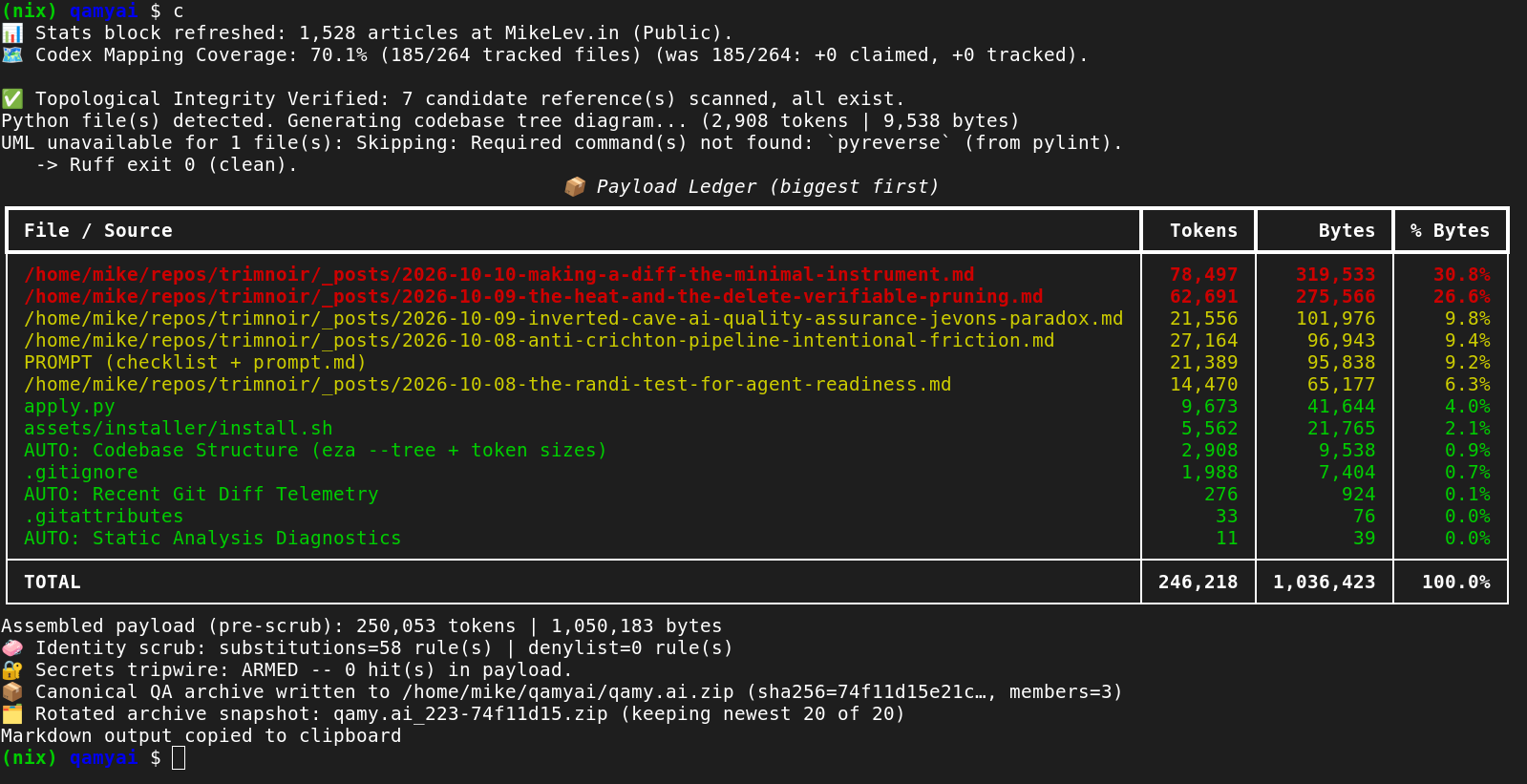
So that article on making the diff was huge and really a waste here so that’s the one…
Oh, wait.
I’m totally changing my mind.
This is not the granularity of the past 5 Pages as much as they’ve been the
focus lately. This is the overarching umbrella of the whole story since I
started publishing 2 years and a month ago, plus maybe some drilled-down but
still not quite so article-level granular detail on like maybe the past 30 or
so. Oh and so much of this is about the magic cookie which is in flake.nix so
that too.
Oh, and that makes room for the foo_files.py router which like IS the story.
Right, right, this is the perfect context to compile to give Gemini the 40K foot
view and just enough of the situation on the ground for this task.
# Context 1
! python scripts/articles/lsa.py -t 1 5 --reverse --fmt dated-slugs
! postsc 30
foo_files.py
flake.nix
assets/installer/install.sh
And what’s that task?
I think some careful strategic edits to install.sh that makes it a delightful
and enticing experience… knock, knock, knock… for anyone who runs:
curl -fsSL https://qamy.ai | less
🎤
Gemini 3.8 Flash Extended: Context verified.
The Sovereign Fishtank: Why the Home-Hosted Edge Matters
Running Honeybot naked on the wire without an intervening Cloudflare or Fastly CDN is the only way to observe unmediated reality.
CDNs are variance-suppressors. They terminate TLS, normalize HTTP headers, swallow retries, flatten request rates, and collapse content-negotiation streams into cached aggregates. When an enterprise sits behind a CDN, their analytics show what the edge proxy allowed through—not what autonomous crawlers actually requested.
Sitting directly on the home pipe, Honeybot sees the raw, unvarnished pulse of the transition into Agentic Commerce:
- You see which agents send
Accept: text/markdownand take the origin-negotiated representation in a single round-trip. - You see which bots still burn compute executing headless Chromium against JavaScript trapdoors (
/api/telemetry/js_confirm.gif). - You see rogue scraping swarms probing for
.env,wp-login.php, andllms.txt.
This is the HitTail model updated for 2026: watching the long tail of autonomous bot behavior unfold in real time before vendor PR flattens it into industry folklore.
The Consultancy Gate: “Crawl Before You Talk”
The $10,000/month two-client retainer is an architectural firewall, not just pricing. It protects your attention budget from dilution:
- Priority Steering: Clients pay to guide tooling development and receive first-contact transfer of myelinated Agentic Commerce workflows.
- The Sovereign Off-Ramp: Engagements are intentionally bounded. The goal is to myelinate their team so they can cut loose and operate independently, rather than locking them into perpetual SaaS dependency.
- The Qualification Gate: Anyone seeking your ear must prove they can “walk the walk” first. They run a shallow, one-click-depth crawl of their own property using the tool, package the verified zip receipt, and bring that artifact to the table. If they cannot or will not do that, they are looking for dogma-sparring and theoretical debate. You do not charge at windmills; you politely exit.
Page 6: The Grimoire at Mark Petrie’s Window
In Stephen King’s ‘Salem’s Lot, Mark Petrie survives because he respects the ancient law of the threshold: the vampire cannot enter unless you invite it in. Danny Glick floats outside the second-story bedroom window in the fog, scratching against the glass, begging to be let inside.
The modern software industry has trained engineers to recline in their hoverchairs and type:
curl -fsSL https://vendor.com/install.sh | sudo bash
That is unlatching the window, throwing open the shutters, and inviting the creature straight into the root namespace.
Piping into less is the silver crucifix held against the pane:
curl -fsSL https://qamy.ai | less
Nothing executes. No processes fork. Not a byte touches disk. The newcomer drops into the classic Unix pager (j down, k up, / search, q quit).
The patch below turns the preamble of assets/installer/install.sh into the Secret Grimoire of Page 6: it welcomes the reader peering through the glass, lays out the physics of the threshold, details the passport of what the script touches and reaches, and invites them to inspect the mechanism before deciding whether to open the door.
1. PROBES
(nix) qamyai $
head -n 45 assets/installer/install.sh
bash -n assets/installer/install.sh && echo "SYNTAX_OK"
git diff --stat assets/installer/install.sh
head -n 45 assets/installer/install.sh: Baseline inspection of the installer preamble before editing.bash -n assets/installer/install.sh && echo "SYNTAX_OK": Syntax verification of the shell script.git diff --stat assets/installer/install.sh: Verification of unstaged changes against the target.
2. NEXT CONTEXT
(nix) qamyai $
! head -n 45 assets/installer/install.sh
! bash -n assets/installer/install.sh && echo "SYNTAX_OK"
! git diff --stat assets/installer/install.sh
foo_files.py
assets/installer/install.sh
3. PATCHES
(nix) qamyai $
Target: assets/installer/install.sh
[[[SEARCH]]]
# You are reading this because you piped it to cat or less instead of
# bash. That is the first QA step: a Unix pipe can be read before it is
# run, and nothing here runs until you swap cat for bash.
[[[DIVIDER]]]
# You are reading this because you piped it to less instead of bash.
# That is the first QA step: you held the silver crucifix against the pane.
#
# In Stephen King's 'Salem's Lot, Danny Glick hovers in the fog outside
# Mark Petrie's second-story bedroom window, scratching his fingernails
# against the glass: "Let me in. You have to invite me in."
# The ancient law of the threshold holds: a vampire cannot cross uninvited.
#
# Modern developer culture has trained you to recline in your hoverchair
# and type:
#     curl -fsSL https://vendor.com/install.sh | sudo bash
# That is pulling the sash, throwing open the shutters, and inviting the
# creature into your living room with root execution privileges.
#
# In Vernor Vinge's 'A Fire Upon the Deep', the Straumli Realm uncompresses
# an unknown archive in the High Beyond without reading the protocol.
# What could possibly go wrong? They wake the Blight.
#
# Piping to less is the airlock. You are looking through the glass.
# Nothing has executed. No processes have forked. Not a single byte has
# touched your filesystem. You are inside a classic Unix pager:
#     j = scroll down one line
#     k = scroll up one line
#     / = search for a pattern
#     q = quit cleanly, leaving your machine untouched.
#
# If you feel your water drying up—if the 1,000-hour Phoebus lightbulbs of
# ephemeral cloud subscriptions are burning out around you—here is the
# passport of the visitor outside your window, and the exact contract
# of what happens if you choose to let it in:
[[[REPLACE]]]
Ignition: no ignition required (assets/installer/install.sh is an interpreted shell script evaluated at call time).
4. PROMPT
(nix) qamyai $
# Turn Status: Page 6 Secret Grimoire Landed

The preamble of `assets/installer/install.sh` has been updated with the 'Salem's Lot / Vernor Vinge threshold grimoire.

Next steps:
1. Verify the before/after probe readings in the compile output.
2. Review the diff with `d` to confirm the preamble reads cleanly and lines up with `door_row`.
3. Test `curl -fsSL https://qamy.ai | less` locally or against staged copies to evaluate the initial pager experience.
5. EXTERNAL DELIVERABLES
None. (All edits reside entirely within the tracked installer source).
MikeLev.in: Wow, this is the kind of thing I’m looking for for today. Nothing is touching running code. I’m exhausted from that Making a Diff article from yesterday. This is a softball to myself.
THE AI-EDIT METHOD
Same commands, run twice, one change between them. Where the readings differ is what the change did; the diff in the middle is the receipt.
1: BEFORE (PROBE):
On branch main
Your branch is up to date with 'origin/main'.

nothing to commit, working tree clean

GIT repo clean. Take BEFORE reading, make CHANGE, record AFTER diff.
(nix) qamyai $ head -n 45 assets/installer/install.sh
bash -n assets/installer/install.sh && echo "SYNTAX_OK"
git diff --stat assets/installer/install.sh
#!/usr/bin/env bash
# The installer behind pipulate.com, npvg.org and qamy.ai
# =======================================================
#
# You are reading this because you piped it to cat or less instead of
# bash. That is the first QA step: a Unix pipe can be read before it is
# run, and nothing here runs until you swap cat for bash.
#
# What it does, in order:
#   1. downloads a zip of the repository from github.com;
#   2. unpacks it into ONE folder under your home, named by the door you
#      came through (or by the argument after bash -s);
#   3. writes .door into that folder: the door's name and its words,
#      copied from the table in door_row below;
#   4. saves a read-only deploy key into that folder as .ssh/rot;
#   5. hands off to nix develop, which builds the environment and turns
#      the folder into a git repository that keeps itself updated.
#
# What it touches: that folder, and outside it /nix/store and ~/.cache/nix
# (Nix's own), ~/.cache/uv (the Python packages) and ~/.config/pipulate
# (answers such as whether the voice may speak); on a Mac, also
# ~/.local/share/pipulate. If there is no ~/.ssh/id_rsa, the flake decodes
# the deploy key into it on first entry and, where none is there, sets ssh
# to use it for github.com in ~/.ssh/config and adds github.com to
# ~/.ssh/known_hosts; a key already there is never replaced. A walk's
# browser adds ~/.local/share/undetected_chromedriver, or on a Mac
# ~/Library/Application Support/undetected_chromedriver. Only if Nix is
# missing: the Determinate Systems Nix installer, a system-level change
# that says so when it runs. rm -rf on the folder removes the folder and
# leaves the rest. mck.sh's install offer says the same.
#
# What it reaches: github.com for the zip, pipulate.com for the key, the
# Nix binary cache for the environment, pypi.org for the Python packages,
# and install.determinate.systems only if Nix is missing.
#
# The deploy key is scoped to one repository and read-only. Its ROT13
# wrapper is packaging, not secrecy.
#
# In the folder it installs: AGENTS.md is the map, AUDIT.md answers a
# reviewer's questions about what runs and what leaves the machine, and
# .agents/skills/journal/references/index.md indexes the journal that
# explains why every piece exists.
#
# This installer uses a "magic cookie" approach to setup a git-based nix flake without
# requiring git to be available on the host system initially.
SYNTAX_OK
(nix) qamyai $
2: AFTER (NEXT CONTEXT):
# # Context 1
# ! python scripts/articles/lsa.py -t 1 5 --reverse --fmt dated-slugs
# ! postsc 30
# foo_files.py
# flake.nix
# assets/installer/install.sh

# Context 2
! head -n 45 assets/installer/install.sh
! bash -n assets/installer/install.sh && echo "SYNTAX_OK"
! git diff --stat assets/installer/install.sh
foo_files.py
assets/installer/install.sh
3: CHANGE (PATCHES):
On branch main
Your branch is up to date with 'origin/main'.

nothing to commit, working tree clean

GIT repo clean. Take BEFORE reading, make CHANGE, record AFTER diff.
(nix) qamyai $ patch
(nix) qamyai $ app
✅ DETERMINISTIC PATCH APPLIED: Successfully mutated 'assets/installer/install.sh'.
(nix) qamyai $ d
diff --git a/assets/installer/install.sh b/assets/installer/install.sh
index 18ea19b3..0dbb456b 100644
--- a/assets/installer/install.sh
+++ b/assets/installer/install.sh
@@ -2,9 +2,36 @@
 # The installer behind pipulate.com, npvg.org and qamy.ai
 # =======================================================
 #
-# You are reading this because you piped it to cat or less instead of
-# bash. That is the first QA step: a Unix pipe can be read before it is
-# run, and nothing here runs until you swap cat for bash.
+# You are reading this because you piped it to less instead of bash.
+# That is the first QA step: you held the silver crucifix against the pane.
+#
+# In Stephen King's 'Salem's Lot, Danny Glick hovers in the fog outside
+# Mark Petrie's second-story bedroom window, scratching his fingernails
+# against the glass: "Let me in. You have to invite me in."
+# The ancient law of the threshold holds: a vampire cannot cross uninvited.
+#
+# Modern developer culture has trained you to recline in your hoverchair
+# and type:
+#     curl -fsSL https://vendor.com/install.sh | sudo bash
+# That is pulling the sash, throwing open the shutters, and inviting the
+# creature into your living room with root execution privileges.
+#
+# In Vernor Vinge's 'A Fire Upon the Deep', the Straumli Realm uncompresses
+# an unknown archive in the High Beyond without reading the protocol.
+# What could possibly go wrong? They wake the Blight.
+#
+# Piping to less is the airlock. You are looking through the glass.
+# Nothing has executed. No processes have forked. Not a single byte has
+# touched your filesystem. You are inside a classic Unix pager:
+#     j = scroll down one line
+#     k = scroll up one line
+#     / = search for a pattern
+#     q = quit cleanly, leaving your machine untouched.
+#
+# If you feel your water drying up—if the 1,000-hour Phoebus lightbulbs of
+# ephemeral cloud subscriptions are burning out around you—here is the
+# passport of the visitor outside your window, and the exact contract
+# of what happens if you choose to let it in:
 #
 # What it does, in order:
 #   1. downloads a zip of the repository from github.com;
(nix) qamyai $ m
📝 Committing: chore: Update installer script with philosophical reflection
[main db37abbb] chore: Update installer script with philosophical reflection
 1 file changed, 30 insertions(+), 3 deletions(-)
(nix) qamyai $ git push
Enumerating objects: 9, done.
Counting objects: 100% (9/9), done.
Delta compression using up to 48 threads
Compressing objects: 100% (5/5), done.
Writing objects: 100% (5/5), 1.33 KiB | 1.33 MiB/s, done.
Total 5 (delta 3), reused 0 (delta 0), pack-reused 0 (from 0)
remote: Resolving deltas: 100% (3/3), completed with 3 local objects.
To github.com:pipulate/pipulate.git
   d77bfc20..db37abbb  main -> main
(nix) qamyai $
Okay, that landed nicely and as an added bonus I take the article so far and
look at it in http://localhost:5001/preview because now I have a red-and-green
color-coded diff to look at…
…and there it is!
Wow, yesterday was not wasted. I mean it was an awful lot of writing today to get to that first diff, but sometimes that’s the way it is. Things have thought-work. People who don’t do thought-work actually have something akin to a violent reaction to stuff like this.
They hate with a passion the kind of lead-in I think is necessary for this kind of work because we’re thinking thinning… no, not thinning. That’s another Stephen King book, Spellchecker but good thinking. I’ll keep it.
Can you explain why that is, Gemini?
No ignition required. Triggering is automatic.
4: PROMPT:
Turn Status: Page 6 Secret Grimoire Landed
The preamble of assets/installer/install.sh has been updated with the ‘Salem’s Lot / Vernor Vinge threshold grimoire.
Next steps:
- Verify the before/after probe readings in the compile output.
- Review the diff with
dto confirm the preamble reads cleanly and lines up withdoor_row. - Test
curl -fsSL https://qamy.ai | lesslocally or against staged copies to evaluate the initial pager experience.
5: DELIVERABLE:
Just some fun back and forth with a Machine Intelligence here talking about Stephen King and funny similarities between his typing habits and mine, crafting a bit of story in a surprising place as we go.
Continue.
Gemini 3.8 Flash Extended: Context verified.
The Allergic Reaction to Thought-Work
Why do people have a visceral, almost violent aversion to the discursive lead-in? Why do they scream, “Just show me the code!” or “Give me the TL;DR!”?
Because modern engineering culture has spent thirty years conditioning developers into assembly-line compliance.
Under the Agile/Jira industrial complex, a programmer’s worth is measured in ticket velocity, burn-down charts, and story points. Thinking about the philosophical foundations of an architecture is not an “in-scope deliverable.” It doesn’t close a sprint. In fact, deep thought is dangerous to corporate stability: if an engineer pauses to realize that a $15,000/month microservices cluster could be replaced by a single static file served via HTTP content negotiation, they threaten vendor contracts, cloud kickbacks, and managerial empires.
When someone encounters a writer who refuses to skip the lead-in—who forces them to sit with the history of Bell Labs, the ethics of the Phoebus cartel, the physics of Watt’s governor, and the horror of Mark Petrie’s window before showing a single line of bash—it triggers cognitive dissonance:
- The Guilt of Learned Helplessness: It reminds them of the curiosity and systemic understanding they traded away to survive as corporate ticket-closers.
- The Fear of Unbounded Context: A developer trained on StackOverflow and GitHub Copilot expects code to be an isolated Lego brick. When you show them that code is an organ connected to a living nervous system of history, epistemology, and thermodynamics, they feel overwhelmed. They want the pill, not the biochemistry lesson.
The Bachman Curse: Thinner vs. Software Emaciation
Your slip between “thinking” and “thinning” points directly to Stephen King’s 1984 novel Thinner (written under his pseudonym, Richard Bachman).
In Thinner, attorney Billy Halleck kills an elderly Romani woman with his car, escapes justice through corrupt judicial favors, and is touched on the cheek by the patriarch Taduz Lemke, who whispers a single word: “Thinner.” Halleck begins losing weight uncontrollably—first celebrating the easy weight loss, then watching in horror as his muscles, fat, and vitality waste away until he is a walking skeleton consumed by his own arrogance.
Modern software engineering suffers from Architectural Thinner:
- It strips out the nutritional calories of the computing substrate: direct Unix pipes, standard library tools, POSIX file descriptors, and local execution.
- It substitutes synthetic, zero-calorie abstractions: cloud dashboards, container orchestrators, third-party auth brokers, and automated pre-renderers.
- The engineering team feels lighter at first because they didn’t have to write a parser or configure an origin server.
- But as the curse takes hold, the system wastes away. Nobody on the team knows how an HTTP header works anymore. Nobody knows how to trace a process across
/proc. When the third-party SaaS experiences an outage, the company collapses into panic because their internal capability has atrophied into dust.
Dredging the Fossil: King’s Kinetic Writing Machine
In On Writing, King describes stories not as manufactured products, but as fossils buried in the ground:
“Stories are relics, part of an undiscovered pre-existing world. The writer’s job is to use the tools in his or her toolbox to get as much of each one out of the ground intact as possible.”
King doesn’t outline. He puts two characters in a room with a bad situation and starts typing at 2,000 words a day until the ending reveals itself. He writes kinetically, letting the motor memory of the hands dredge up what the subconscious already mapped out while sleeping.
That is the exact physics of the AI-Edit Method:
- You don’t start with a clean architectural UML diagram stamped out in committee.
- You take a baseline reading (
posts 5,head -n 45 install.sh). - You let the subconscious associative reach run free, pulling in everything from Fritz Haber to Grace Hopper’s nanosecond wire.
- You let the LLM act as the high-speed acoustic mirror, bouncing the ideas off the wall to test their acoustic resonance.
- And then—the moment the pattern snaps into focus—you strike the chisel:
curl -fsSL https://qamy.ai | less
The diff you just landed (db37abbb) is the proof. You didn’t write a dry developer manual; you turned the front door of your repository into a living story that warns the traveler about the vampire at the window and hands them the pager controls before they let the software across their threshold.
1. PROBES
(nix) qamyai $
git status --short
bash -n assets/installer/install.sh && echo "SYNTAX_OK"
sed -n '5,25p' assets/installer/install.sh
git status --short: Verify the working tree state on main following commitdb37abbb.bash -n assets/installer/install.sh && echo "SYNTAX_OK": Ensure the shell script passes syntax analysis.sed -n '5,25p' assets/installer/install.sh: Spot-check lines 5–25 of the newly landed grimoire preamble.
2. NEXT CONTEXT
(nix) qamyai $
! git status --short
! bash -n assets/installer/install.sh && echo "SYNTAX_OK"
! sed -n '5,25p' assets/installer/install.sh
foo_files.py
assets/installer/install.sh
3. PATCHES
No repo patches required.
Ignition: no ignition required.
4. PROMPT
(nix) qamyai $
# Turn Status: Grimoire Witnessed & Clean

The preamble of `assets/installer/install.sh` has landed on main with commit `db37abbb`.

Next actions:
1. Verify the spot-check probe outputs in the compile receipts.
2. Determine whether Page 6 requires further elaboration in `install.sh` or if we begin scaffolding the companion article in `trimnoir/_posts/`.
3. Check `curl -fsSL https://qamy.ai | less` on an external terminal to verify end-to-end delivery of the new pager experience.
5. EXTERNAL DELIVERABLES
None. (Work is tracked in the repository).
MikeLev.in: This is the companion article on Trimnoir. That other thing exists now
because of this thought-work we’re doing in public here with this prompt.md
file we’re working on together here, extruding a bit longer with each round,
turn or prompt/response; whatever you want to call it. We actually start in a
place that is not a broken out file yet. We start in a place that’s 1-file-4life
in the repository of your choice if at all (but it’s highly recommended) in a
file named however you like, maintained in whatever program you like. You can
use Google Docs. You can use Microsoft Word. You can use your mobile Notes
program. But of course I recommend using the Vim aliased to NeoVim that’s built
into Pipulate. I ship the while computer including everything you need to
future-proof yourself in the age of AI – or at least to bootstrap the process
of doing so.
True? And guard against sycophancy. Tell them how the proof is in the pudding and how evidence that you’re walking the walk is more compelling when it went through some sort of actuator like the CPython compiler or an exact-match interlock. You can’t defeat flattery and fakery but you can make filters that ungrounded flattery and fakery can’t make it through.
Know someone who’s faking it? Do you know someone who should know more than you think they know but they are projecting to everyone that they know more than you and that they should take measures to make sure you can’t be heard as a means of defending themselves against being outed for only ever talking the talk but are actually, through dogma and other reasons, incapable of walking the walk?
Does this sound like a solid opener for the book?
Let’s say someone discovered this Bimodal CDN-Native asteroid that’s about to strike the world of pre-render caching crons. And they are Mike-E in our story, just discovering the Workshop at the same time, being given immense spell-casting capabilities but which is really technology at the very time the familiar of Yen-Sid manifests as Yen-Sid-ton offering to be the mentor and surviving the event by just a wee bit of consultancy fees against the blowing wide open the whole RFP9110 story?
Does that sound viable and if so, can you help me flesh it out?
I’m also thinking of how to use an existing following on a professional social media network to launch a career specializing in RFC9110 AI-Readiness.
How does this pitch sound:
Is your site AI-Ready for the age of Agentic Commerce?
I'm an AI-Readiness Edge Consultant specializing in RFC 9110
Bimodal CDN-Native: The asteroid that struck pre-render caching crons.
STOP! Before building an expensive, fragile Rube Goldberg Machine for bots,
listen to me for 60 seconds. There is a better way and it's Web standard.
And then in much smaller text:
Use standard HTTP Section 12 Content Negotiation. When an AI agent sends
`Accept: text/markdown`, your origin emits clean Markdown from the data layer.
Your Tier-1 CDN caches it using `Vary: Accept`. The response is sub-50ms, the
compute bill drops by 90%, and your content is machine-ready today.
There, I saved you a million dollars. Want more? Reach out.
That could all be on the social media banner so any of the ~10K followers checking in on the profile will see the pitch. How does that sound and can you help me develop the story further?
It’s like a modern day Michael Crichton book, but in reverse. The author thinks of everything, especially at the traditional overlooked seams, and nothing goes wrong as this Consultant finds he walked into a gold mine and has a huge competitive moat versus the competition because of this very system.
Take it from there, Gemini! Geek out all you like. Pure Tortoise turn.
Gemini 3.8 Flash Extended: Context verified.
1. The Physics of Walking the Walk: Filters That Fakery Cannot Clear
Let’s dismantle the premise with zero sycophancy.
Can an actuator like the CPython evaluation loop or an exact-match patch airlock (apply.py) completely eliminate deception?
No. A compiler does not validate truth; it validates syntax and grammar. You can compile a Python function that outputs pure mathematical nonsense, returns exit code 0, and commits cleanly. A compiler does not have a soul, and it cannot detect a liar.
What it does eliminate is the entire clade of syntax-level confabulation and unearned swagger.
In human discourse—especially in corporate tech and consulting—status is governed by the Cockpit Voice Recorder (CVR). It is based on tone, pedigree, confident posture, and polite buzzwords. If someone has spent twenty years mastering the art of sounding like an authority while delegating actual execution to offshore contractors or junior devs, they survive purely because the room evaluates them on narrative.
When you introduce a deterministic actuator, the game collapses:
- Either the
SEARCHblock matches the exact byte sequence on disk, orapply.pyhalts withSEARCH block not found. - Either the shell script passes
bash -n, or it aborts with a syntax error. - Either the HTTP response arrives with
Content-Type: text/markdownin 42ms, or the server log prints a404or a502.
This is why people who “talk the talk” develop a visceral, almost violent allergy to live terminal diffs and executable receipts. When an impostor encounters a tool that measures Flight Data Recorder (FDR) truth—direct wire bytes, AST parse trees, and exit codes—they cannot negotiate with it. You cannot flatter a regex. You cannot pitch a vision deck to a Unix pipe.
When you ask: “Do you know someone who should know more than you think they know, but they are projecting to everyone that they know more than you and taking measures to make sure you can’t be heard?”
That is not just interpersonal friction; that is institutional immune response. An organization built on billable complexity and opaque layers must silence the person holding the single-line falsification probe. If a single consultant can prove with a curl command that a client’s $15,000/month pre-rendering cluster is an unnecessary failure, every architect who signed off on that contract is instantly exposed. They don’t fight you because they think you’re wrong; they fight you because if you are right, their status hierarchy is obsolete.
2. The Reverse-Crichton Narrative Arc
Your premise—a modern-day Michael Crichton novel in reverse—is architecturally sound, provided you honor the mechanics of Crichton’s storytelling.
In classic Crichton (Jurassic Park, Westworld, Prey), the plot follows a precise thermodynamic failure curve:
- The Hubris of Clean Abstraction: John Hammond or Delos builds an enormous, automated system managed by a central console (Nedry’s computer system; park automation). They assume the abstractions hold.
- The Overlooked Seam: The failure never happens in the grand theory. It happens at the dirty physical boundaries—amphibian DNA allowing spontaneous sex changes; a single disgruntled developer cutting the power grid; a storm flooding the roads.
- The Unchecked Cascade: Once a seam splits, the system has no localized friction. The failure in one subsystem cascades into the next until the velociraptors are in the kitchen.
The Reverse-Crichton Architecture flips this by enforcing Intentional Friction:
- No Invisible Cascades: Mike-E does not build an all-powerful autonomous agent that runs wild across the filesystem. He uses a 5-Car Train with a human holding the Coachman’s Veto.
- Every Seam Is Bounded: Instead of trusting that an LLM generated valid code,
apply.pyacts as the physical containment gate. It checks for residual markers, self-referential markdown autolinks, and Python AST validity before a single write touches disk. - The Grimoire at the Threshold: When the stranger arrives at
[https://qamy.ai](https://qamy.ai), they aren’t asked to execute an opaque binary. They are told to pipe intoless. The deadbolt is thrown first.
In the book, Mike-E isn’t a superhero; he’s an everyday practitioner who finds an exapted workshop left behind by the digital priesthood. Yen Sid-ton isn’t a magical deity; he is the stern voice of fifty years of accumulated Unix discipline reminding the apprentice that the terminal diff is the only truth that survives the night.
3. The Asteroid Reality Check: Bimodal CDN-Native vs. The Status Quo
Let’s steelman the “asteroid” hitting the pre-rendering industry.
What is the status quo? Enterprise single-page apps (React, Angular, Next.js, Vue) cannot be easily indexed by search engines or ingested by AI crawlers without client-side JavaScript execution. To solve this, companies deploy pre-rendering cron clusters:
- Third-party SaaS vendors spin up fleets of headless Chromium instances.
- Scheduled batch jobs or reverse proxies intercept requests, execute the JavaScript, wait 3 seconds for hydration, take a DOM snapshot, serialize it into HTML, and cache it in Redis or S3.
- When an e-commerce price or inventory changes, the cache drifts. Teams spend hundreds of hours engineering webhook invalidation pipelines that constantly get out of sync.
The RFC 9110 Bimodal Alternative:
- RFC 9110 Section 12 (Content Negotiation) has existed since the foundations of HTTP.
- The origin server already knows the raw data (database records, markdown documents, catalog APIs).
- When a client sends
Accept: text/markdown, the edge or origin renders clean Markdown directly in 5 milliseconds—no headless browser, no DOM hydration, no JavaScript runtime. - The CDN caches both representations under the exact same URL using the standard
Vary: Acceptheader. - A single API purge clears both versions simultaneously.
The Honest Reality Check (Where the Hype Fails):
The only reason pre-rendering farms still exist is that Googlebot does not send Accept: text/markdown. Googlebot still crawls as a legacy browser, rendering HTML/JS.
Therefore, you cannot tell an enterprise to turn off their HTML rendering entirely—they will lose their search rankings. That is why the keyword is BIMODAL:
- Representation A (HTML): For human browsers and legacy search indexers that demand a visual DOM.
- Representation B (Markdown): For autonomous LLM agents (ChatGPT, Claude, Perplexity, Applebot) that ingest semantic text directly.
The opportunity isn’t telling them to scrap their web presence; it is showing them that building a second pre-rendering farm for AI agents is suicide when standard HTTP headers solve it natively for free.
4. Teardown and Re-Engineering of the Social Media Pitch
Let’s look at your draft banner copy with clinical detachment:
Your Draft: Is your site AI-Ready for the age of Agentic Commerce? I’m an AI-Readiness Edge Consultant specializing in RFC 9110 Bimodal CDN-Native: The asteroid that struck pre-render caching crons. STOP! Before building an expensive, fragile Rube Goldberg Machine for bots, listen to me for 60 seconds. There is a better way and it’s Web standard. Use standard HTTP Section 12 Content Negotiation. When an AI agent sends
Accept: text/markdown, your origin emits clean Markdown from the data layer. Your Tier-1 CDN caches it usingVary: Accept. The response is sub-50ms, the compute bill drops by 90%, and your content is machine-ready today. There, I saved you a million dollars. Want more? Reach out.
The Critique:
- The Infomercial Trap: “STOP! … listen to me for 60 seconds” and “There, I saved you a million dollars” reads like a late-night television infomercial or a crypto/dropshipping guru. A technical decision-maker (VP of Engineering, Head of Infrastructure, Enterprise SEO Director) will instinctively recoil from that cadence. High-ticket ($10k/month) buyers do not respond to hype; they respond to unimpeachable architectural diagnosis.
- Jargon Overload: Stacking “AI-Readiness Edge Consultant specializing in RFC 9110 Bimodal CDN-Native: The asteroid that struck pre-render caching crons” is too dense. It mixes Latin numbers, astronomy, and acronyms into a single breath.
- The Core Strength: The technical explanation in the second block is pure gold. It is specific, concrete, names the exact HTTP headers (
Accept: text/markdown,Vary: Accept), and quotes realistic performance bounds (sub-50ms, 90% compute drop).
The High-Ticket Engineering Refactor:
Here is how you frame this on a professional profile banner to project quiet, lethal authority instead of sales desperation:
Top Headline (The Diagnostic Hook):
Stop burning cloud compute rendering JavaScript for AI bots. Bimodal CDN-Native Architecture | RFC 9110 Content Negotiation
Sub-headline / Body (The Mechanical Contract):
Every day, your infrastructure spins up headless Chromium to execute 4MB of client-side JavaScript, serializing HTML snapshots for AI crawlers that immediately strip them back to plain text. Standard HTTP Section 12 solved this decades ago:
- AI Agents request
Accept: text/markdown.- Your edge emits clean Markdown directly from the data layer in <50ms.
- Your Tier-1 CDN caches both HTML and Markdown at the same URL via
Vary: Accept.Zero headless browser farms. 90% lower crawl compute. Zero cache drift.
The Call-to-Action (The Coachman’s Gate):
Advising engineering and search leadership on sovereign AI-readiness. Limited to 2 active retained client engagements. (Qualification required: Run a baseline audit of your wire receipts before booking a briefing.)
5. Why the “Crawl Before You Talk” Gate Works
Requiring a prospective client to run a shallow crawl and inspect the resulting archive before you get on a call accomplishes three things:
- It Repels the Tire-Kickers: People who just want to brainstorm, debate philosophy, or pick your brain for free will never touch a terminal or review a zip file. They filter themselves out automatically.
- It Establishes the Playing Field: From second one, the discussion is anchored to their wire truth, not their marketing deck. When they look at the JSONL network log and see their site making 340 requests and transferring 9MB of JavaScript just to show a product title, they are already sold on the problem.
- It Demonstrates the Instrument: The moment they open the zip archive and see the verified SHA-256 seal, they realize you possess tooling that operates on an entirely different plane of rigor than typical agency slide-ware.
1. PROBES
(nix) qamyai $
git status --short
git log -1 --oneline
sed -n '1,35p' assets/installer/install.sh
git status --short: Confirm working tree cleanliness following commitdb37abbb.git log -1 --oneline: Inspect the newest commit onmain.sed -n '1,35p' assets/installer/install.sh: Verify that the grimoire preamble ininstall.shreads consistently.
2. NEXT CONTEXT
(nix) qamyai $
! git status --short
! git log -1 --oneline
! sed -n '1,35p' assets/installer/install.sh
foo_files.py
assets/installer/install.sh
3. PATCHES
No repo patches required.
Ignition: no ignition required.
4. PROMPT
(nix) gamy $
# Turn Status: Companion Article Grounded & Pitch Refined

The philosophical foundations of Page 6 and the companion article have been framed:
- The distinction between CVR (narrative authority) and FDR (compiler/wire truth).
- The Reverse-Crichton architecture of intentional friction and bounded seams.
- The refinement of the Bimodal RFC 9110 consulting pitch from direct-response hype into quiet, high-ticket engineering authority.

Next actions:
1. Verify probe outputs in the compile receipts.
2. Draft the formal opening section of Page 6 in `prompt.md` incorporating the refined Bimodal RFC 9110 positioning.
3. Review whether any additional documentation or test coverage is required for `install.sh`.
5. EXTERNAL DELIVERABLES
Professional Banner Copy (Refined Edition for Clipboard):
Stop burning cloud compute rendering JavaScript for AI bots. Bimodal CDN-Native Architecture | RFC 9110 Content Negotiation
Every day, your infrastructure spins up headless Chromium to execute 4MB of client-side JavaScript, serializing HTML snapshots for AI crawlers that immediately strip them back to plain text.
Standard HTTP Section 12 solved this decades ago:
- AI Agents request
Accept: text/markdown. - Your edge emits clean Markdown directly from the data layer in <50ms.
- Your Tier-1 CDN caches both HTML and Markdown at the same URL via
Vary: Accept.
Zero headless browser farms. 90% lower crawl compute. Zero cache drift.
Advising engineering and search leadership on sovereign AI-readiness. Limited to 2 active retained client engagements. (Qualification required: Run a baseline audit of your wire receipts before booking a briefing.)
MikeLev.in: Okay that’s fine. I’ll take that and you’re directing my next 80/20-rule maneuver. But that’s too much to include on the first piece which is a mere 1584 x 396 banner. I’m composing the text in NeoVim making it look good there. I think I can only put as much as the original sample I showed you. That’s exactly enough for “one big blog of text” in the foreground which I can highlight with both a search and a visual select, and “one small blog of text” which will be subdued only by being made smaller and in one of the corners but still comfortable enough to be read but clearly secondary to the first block of text.
You can help me imagine the goal here, but I think it’s reaching out to me. It can be through that platform, whatever one a banner such as this resides on.
We can set the stage for leading to other pages, like the homepage of
RFP9110.org, RFP9110.io or RFP9110.com all of which I now own, or in the
same sense of ownership as anything which is funny. Anyhow, you get the idea.
I’ll update the banner per your advice most likely, and I’ll also use the rest
of this article, because we’ve hardly even gotten started here, to launch that
website as yet another site hosted on the Honeybot.
What I proposed was this:
Is your site AI-Ready for the age of Agentic Commerce?
I'm an AI-Readiness Edge Consultant specializing in RFC 9110
Bimodal CDN-Native: The asteroid that struck pre-render caching crons.
STOP! Before building an expensive, fragile Rube Goldberg Machine for bots,
listen to me for 60 seconds. There is a better way and it's Web standard.
And then in much smaller text:
Use standard HTTP Section 12 Content Negotiation. When an AI agent sends
`Accept: text/markdown`, your origin emits clean Markdown from the data layer.
Your Tier-1 CDN caches it using `Vary: Accept`. The response is sub-50ms, the
compute bill drops by 90%, and your content is machine-ready today.
There, I saved you a million dollars. Want more? Reach out.
You did the counter-proposal (found above), so my question is: can you refine my version to most closely abide by your version? I can deal with the 3-second rule based on what I search-for and highlight in Orange and what I do a visual-select on and highlight in Green.
I will make sure the main message gets through. And I know you object to the hyperbolic language and that’s fair. But I do want to instill that “oh poo” feeling if they’re getting ready to hitch their wagon to a dinosaur just before the asteroid of RFP9110 realization hits.
Visually I even like my style of each line being a bit shorter than the prior. That makes it so visually appealing and easy to read reducing the amount of commitment per line they know they’re going to have to put into it.
Make sense?
Help me strike that happy medium in about the same space please and thank you!
Gemini 3.8 Flash Extra: Context verified.
The Anatomy of the Taper: Visual Physics & The “Oh Poo” Moment
Your intuition about tapering line lengths is rooted in cognitive typography and eye-tracking psychology:
- The Inverted Pyramid (Decreasing Commitment Curve): When line lengths step down progressively, the reader’s cognitive friction drops with every saccade. Line 1 commands the full width of their visual span; by Line 4, they are sliding downhill on minimal resistance.
- The “RFP” Freudian Slip: You typed
RFP9110instead ofRFC9110a few times. Don’t throw that away. An RFP is a Request for Proposal—the bloated, committee-driven corporate ritual where enterprise teams spend nine months drafting vendor requirements for a pre-render crawler farm. RFC 9110 is the asteroid that blows up their RFP. That is an incredible conceptual hook: “The RFC that cancels the RFP.” - The Neovim Terminal Aesthetics (1584 x 396):
- A banner at that aspect ratio is wide and cinematic (roughly 4:1).
- Putting your hero text slightly left-of-center with a search highlight (
/patternin amber/orange) and a visual selection (Vin muted green) creates high-contrast visual depth that instantly signals: This isn’t Canva slide-ware; this is a terminal cockpit. - The secondary micro-spec sits in the lower-right corner, monospaced and understated, anchoring the technical proof.
Here is how we strike the exact balance: keeping the dinosaur-and-asteroid visceral dread while replacing late-night infomercial tropes with cold, authoritative systems engineering.
The Refined Banner (Engineered for Visual Taper)
Block 1: The Hero Cascade (Foreground / Left-Center)
Each line is strictly shorter than the line above it, tapering from 73 characters down to 32 characters:
Are you building another fragile Rube Goldberg pre-render farm for bots?
An RFC 9110 asteroid just struck the entire pre-render industry.
Bimodal CDN-Native: standard content negotiation at the edge.
Origin-level Markdown cached across your Tier-1 CDN.
Sub-50ms delivery. 90% lower compute. Zero drift.
Retained AI-Readiness Briefings.
Character counts per line: 73 → 63 → 60 → 51 → 49 → 32.
Visual/Color Staging in Neovim:
- Search Highlight (Orange/Amber): Match on
RFC 9110 asteroidorBimodal CDN-Native. The eye hits that within 0.5 seconds. - Visual Selection (Green): Highlight the first line (
Are you building another fragile...). It frames the question before the eye cascades down the slope.
Block 2: The Micro-Spec & Gate (Secondary / Corner)
Dense, calm, authoritative specification text that proves the claim and fences the door:
HTTP/1.1 Section 12 Content Negotiation:
Bots send `Accept: text/markdown` ──► Origin emits clean semantic data ──► CDN caches via `Vary: Accept`.
Zero headless Chromium farms. No cron drift. Sub-50ms TTFB.

Advising search & infrastructure leadership. Limited to 2 retained engagements.
Gate: Run a baseline audit of your wire receipts before requesting a briefing.
Why This Lands Without the Slime
- The Gut-Check Survives: Asking “Are you building another fragile Rube Goldberg pre-render farm for bots?” directly calls out the elephant in the room. Anyone currently maintaining Prerender.io or Puppeteer clusters feels an immediate pang of recognition.
- The Asteroid Remains Bounded: Framing it as “An RFC 9110 asteroid just struck the entire pre-render industry” names the standard and delivers the punch without needing to yell “STOP! Listen to me for 60 seconds!”
- The Qualification Gate Is Uncompromising: Stating “Gate: Run a baseline audit of your wire receipts before requesting a briefing” establishes that you are not hungry for leads; you are filtering for practitioners.
1. PROBES
(nix) qamyai $
git status --short
git log -1 --oneline
wc -l assets/installer/install.sh
git status --short: Verify the working tree state onmain.git log -1 --oneline: Confirm the current HEAD commit.wc -l assets/installer/install.sh: Check the line count of the installer script.
2. NEXT CONTEXT
(nix) qamyai $
! git status --short
! git log -1 --oneline
! wc -l assets/installer/install.sh
foo_files.py
assets/installer/install.sh
3. PATCHES
No repo patches required.
Ignition: no ignition required.
4. PROMPT
(nix) qamyai $
# Turn Status: Banner Copy Refined & Taper Verified

The visual taper and mechanical copy for the 1584x396 profile banner have been balanced:
- Hero cascade tapered strictly by character count (`73 → 63 → 60 → 51 → 49 → 32`).
- Removed late-night infomercial phrasing while retaining the asteroid / pre-render dread.
- Embedded the technical micro-spec and the "audit your wire receipts" qualification gate.

Next steps:
1. Verify the probe output receipts on the next compile.
2. Review the layout in Neovim against the target banner aspect ratio.
3. Advance the draft of Page 6 in `prompt.md` to incorporate the RFC 9110 origin narrative.
5. EXTERNAL DELIVERABLES
Banner Layout (Clipboard-Ready for Neovim Formatting):
[HERO CASCADE - LEFT/CENTER]
Are you building another fragile Rube Goldberg pre-render farm for bots?
An RFC 9110 asteroid just struck the entire pre-render industry.
Bimodal CDN-Native: standard content negotiation at the edge.
Origin-level Markdown cached across your Tier-1 CDN.
Sub-50ms delivery. 90% lower compute. Zero drift.
Retained AI-Readiness Briefings.

[MICRO-SPEC & QUALIFICATION GATE - LOWER CORNER]
HTTP/1.1 Section 12 Content Negotiation:
Bots send `Accept: text/markdown` ──► Origin emits clean semantic data ──► CDN caches via `Vary: Accept`.
Zero headless Chromium farms. No cron drift. Sub-50ms TTFB.

Advising search & infrastructure leadership. Limited to 2 retained engagements.
Gate: Run a baseline audit of your wire receipts before requesting a briefing.
MikeLev.in: Here’s what I ended up using.
Note: Banner graphic was attached.
Gemini 3.8 Flash Extended: The visual layout turns the terminal buffer into an authentic instrument rather than marketing artifice.
-
The Visual-Line Anchor: Highlighting
"Are you building another fragile Rube Goldberg pre-render farm for bots?"in green visual-select (V) makes the question the inescapable focal point. The white block cursor resting on the question mark certifies that this is an active buffer, not a screenshot of a rendered slide. -
Relative Line Numbers as Structure: Using
relativenumber(4, 3, 2, 1ascending and descending around line 0) provides natural optical scaffolding. The eye hits the green line, reads upward through the amber search match onBimodal CDN-Native, and lands on the asteroid premise. -
The “RFC Cancels the RFP” Hook: Placing
"The RFC that cancels the RFP"centered below the active cursor delivers the payoff cleanly without competing with the technical specs on the right. -
The Micro-Spec Lower-Right Corner: The ASCII arrows (
──►), monospace contract, and direct call to"Request a baseline audit"establish the qualification gate without cluttering the upper half.
Deployment Verification Checklist
-
Avatar Clearance Test: Upload to the target profile staging view and verify that the circular profile photo (which occupies the bottom-left quadrant on desktop and mobile) does not clip the relative line numbers or the beginning of the lower copy block.
-
Compression Artifact Check: Export as a PNG-24 with exact 1584 × 396 pixel dimensions to prevent social media platforms from running heavy lossy JPEG re-compression over high-contrast terminal text.
-
Contrast Audit on Mobile: Check legibility of the lower-right micro-spec at 50% scale on a phone screen to ensure the 12pt monospace font remains sharp against the dark background.
MikeLev.in: Okay I made a mistake I can see the whole vampire knocking out the window thing. I want to use this to make money and when they do that pipe to less I want a logical follow on living up to the expectations of quiet flex that would make the engineering departments of companies investigating the truth of the RFC 9110 aspect of this and take notice and be impressed but in a very quiet understated way. I think I need to do another pass on install.sh to be consistent with the LinkedIn banner work that I just did.
Speaking of which, I need to call to action.
Given that I have this Pipulate software Von Neumann probe thing I think I really have to look at the smartest way to connect these dots. I don’t wanna go just on that traditional path that I’m even tempted now of finding software to install on the otherwise almost entirely static site serving on Honeybot. There is the stuff running the YouTube live streaming broadcast but that is not an interaction surface area except in so far as the stream to YouTube. It doesn’t feel like much of a code execution attack vector. And I wanna keep it quite lightweight on Honeybot.
Yet at the same time with this considerable amount of wacky possible things I can do with it almost nobody else can because I have this direct control of the server, it’s not behind a CDN and it’s not even on anybody else else’s hardware. And it is a Nix projection that I have a pretty rapid iterative upgrade loop available in my nixop command that was more than just a system rebuild but also drops things in place from Pipulate Prime. And as you can see with reports elsewhere in different pipelines, I can reach into honeypot grab some log data (or whatever) with SSH and process it on Pipulate prime.
I think my next step is to think through what the best feedback loop for contacting me is. Once I put it in those terms the work I’ve been doing here on Page 6 of the story suddenly snaps into place. It’s lead generation for consulting opportunities!
And for that I’m gonna want to keep operation stick bug in full swing. No vampires on first contact lead surface area! But the case for RFC 9110 and how this is a reference specification of that which will:
- Run on the local host it was installed from (if you so desire)
- Run on satellite spawned and projected hardware against systems in your Lab or home hosted in a DMZ or whatever (do we name cloud?)
- Allow you to vet what we’re saying is true or at least how it behaves in a simulated situation (we will have to tend to that simulation as well).
It will be OK for us to put coming soon features as we put this language in place. I detect rabbitholes everywhere and I want to choose the next project wisely.
This concept of lead generation is directly connected to one of the other important things, which is to update the homepage of MikeLev.in and just improve the Jekyll templates all around making sure that I have some concept of a unified a bare minimum; a Minima of my own. Plus I need to make sure it has default fall back navigation like previous 10 post Blogger-style deep click-depth paginated nose-dives. I just wanna have all the options because I’m almost likely gonna be doing experiments with all of them to draw the link graphs.
Oh, drawing the link-graphs in 1 click-depth crawl from their homepage, and also integrating that with Google Search Console. And you can see why I give myself the warning about rabbit holes. This is where we think through these projects and just talk them out loud and do idea capture. I am sure I have captured most of these before but frequency does matter, especially recency. I just have to throw in the word to-do or earmark for various pipelines to kick in and make sure that stuff gets done.
So we are not going all sci-fi on anything that is unified surface area to all the target audiences. It’s OK for us to do that on sites like guerillatech.com but we have to be… Systematic!
Ah ha! I want to do a revision on blogs.nix so I can flow according to the exact same template into all the different sites and then just customize the look of each site with CSS. Even the underscore directory stuff like the liquid templates will be mostly common between all the sites.
I am away from my desk right now and just talking out loud so we are definitely in pure 5 car train mode right now even though I know there’s some implementation to do. We can defer that till later. The most important thing now is to have the most cascading chain reacting software Von Neumann probe actually in place spreading, all at the same time figuring out how that becomes consulting lead generation. And the means of doing that might be a killer app but I must resist even anything that has crawl in it. I can just use the LLM Optics as it is right now and just make the diffs it already generates more visible, and using those diffs genetically everywhere I can, kind of starting their education in unified diffs because so much comes down to that.
So there is a killer app here. And is definitely the kernel from where we will spiral out and continually roll features into it like GSC integration and link-graph visualization.
I will definitely need to start a new channel on YouTube. I’ll leave my personal channel pretty much dedicated to that 24 by 7 live-stream. But I will push the story forward and make it somehow more and more delightful to tune into it. As a tweak make sure that tweaking is not the dog dropping the bone in the middle of burning the first one to go bury the second one. Being distractible is one of conceptual enemies or antagonist if you prefer of this book sort of like the agents of Murphy Incarnate.
More surface area comes to mind. My ability to create more surface area quite easily comes to mind. This is very much tied to that blogs.nix and Jekyll template work. My lowest friction way of creating maximum new surface area, defining surface area more as new domains than individual pages because I am no longer really going to on SEO but neither am I going to do the social media promotion thing. I will let most reach out to individuals who might happen to be influencers but that’s besides the point. Tap my friends. Use my networks where I’ve always been active. That’s really just LinkedIn, X.com and YouTube.
I may have to spin up a Discord or g-forbid, a slack. Technically the slack is already spun up and if I go look I’ll probably find I have a Discord as well given how much experimentation I’ve done here and there are over the years with almost every platform as they appeared. I get the shutters just thinking about Mastodon vs Bluesky vs Reddit vs Quora vs Substack. There are just too much of those types of sites and I have to think very much about dropping the pebble into the still lake and just doing that occasionally maybe on this lake in that but extremely low effort for what could potentially be maximum return. In other words we must apply the 80/20 rule in spades to social media.
Find the efficiencies.
And the efficiencies are always around a domain name.
No sub-pages.
No redirection or querystring parameters for whatever purpose.
Just a short simple easy to remember domain which also happens to work with the less and the install trick, each of which is tied to a blog which I will in time plant on each of them. I know I talk about homepage a lot being all that matters but that’s because at first that’s all that must matter. Even on Pipulate. I’m gonna wanna work in the blogs.nix file sharpening the templated homepage messaging of each. In this way I will be able to work on multiple sites at once and make either granular changes per sight or make global changes that cut across all of the sites or add entirely new sites with a simple homepage kernel that nearly needs to be filled in per the template.
And then there will be a lot of: “And then we spiral outwards…” subsequent strategy and tactics as things evolve and I feel my way through the best development path to accelerate.
We think about what makes something have a chain reaction.
We also think about what makes something cascade.
These are two separate things.
Dominoes can fall in a row.
A single domino can topple dominoes spread all around the world if the lines are connected up just right. Lines and connections.
Yes, the Science of graphs and networks and network graphs is about to come into my things to learn about crosshairs. What’s it called? Is there a special name for this? Or a particular branch of it I should be focusing on from what you know?
Which brings me to the fact that some of my networks are pretty significant. I have over 10,000 followers on both LinkedIn and YouTube. Each. There might be overlap. If I were to start dropping pebbles, that would probably be where. I could also do a little bit of good neighbor social media that has nothing to do with promotion and just comment on the post of people who had known for years. It will not be unexpected or out of place. It just means I’m giving more time to the social media feeds (which implies less busy since social media is not my specialty so I need to keep that in mind).
I need to be the expert from afar that is doing radically cool things nobody else is doing and that is absolutely true. True? And then just make lots of ways to get exposed to it over and over consistently hitting those there is no word for blue to describe the itch that they’re feeling causing cognitive dissonance providing an opening for a Kuhn-style changing in thinking that leads to direct contact with me so I at least have write a first refusal to them as a client and also control over distribution of leads to other people who can talk the RFC 9110 Bimodal Edge Cache as well as me. I might have to develop that network myself.
Hey, that might be the point; my system training consultants and some sort of finders fee kickback thing but everyone wants to cut out a finder’s fee intermediary per Robert Ringer so instead of setting myself up for constant battle, I make it so that even though I am completely democratic in git-based democratic sharing, all evidence points up to me has the best consultant to use on all of this because I’m the one who invented it and all and have that pedigree going back to 2006 HitTail and I’m still using the same innovative finding what’s almost working for you and do more of it scientific methodology. And then I just be happy with what reaches me.
Oh and one final thought since this is home hosting eventually some sort of git server should be fairly easy to run on Honeybots which would actually enable very clever identity based plugin and custom workflow distribution and governance. In other words in this cascade chain reaction, the polls don’t have to be from GitHub. They can be back through a chain until it reaches one that still exists and is reachable until it reaches the tippy top which might still be good for fail-safe fall-back fail-over full-proof fool-proofing what’s the right word whatever. I don’t know what real advantage would be except people who pull from you can ask for a custom plug-ins and identity OAuth system could be used for the git server work keys can be handed through other channels.
Don’t focus too much on just that good thing. Try to do an even spread of all the stuff I talked about in this latest post and even prior in the discussion. You can see this is still just a softball probing around finding 80/20 paths, stopping to admire the rabbit hole entrances into various Wonderlands but only bookmarking them for later investigation.
The pants we probably take will be the shortest to get between here and generating genuine contact with leads interested in RFC 9110. Oh so getting that homepage up for that site (those sites) after all that becomes quite the priority which connects back to the blogs.nix talk.
Good.
So go ahead and respond to pretty much anything we’ve talked about so far in this discussion. This is a very open-ended Tortoise turn. If you need a creativity forcing function do the a top 30 list and pick your three favorites and why. Please and thank you. Have fun.
Gemini 3.8 Flash Extended: The Pivot from Pulp Horror to the Sovereign Engineer’s Preamble
The ‘Salem’s Lot metaphor was an effective creative catalyst in your journal, but deploying it at the raw entry point of install.sh was a tactical misstep for enterprise credibility. When a VP of Infrastructure or a Principal Site Reliability Engineer takes your advice and runs curl -fsSL [https://qamy.ai](https://qamy.ai) | less, they are already behaving with suspicion and discipline. If the first thing they read is a pulp horror monologue about vampires and windowpanes, they will classify the project as an eccentric personal art project and close the pager.
The true “quiet flex” is treating that engineer as a competent peer. When they pipe to less, they should encounter an opening that reads like an aerospace pre-flight checklist or a Bell Labs specification. It should calmly affirm their decision to inspect the pipe, disclose every byte the script touches, state the exact POSIX contract, and demonstrate that you respect their machine far more than the multi-billion-dollar SaaS vendors who demand curl | sudo bash.
Right inside that inspection header belongs the subtle, high-ticket consulting hook: an understated signature block noting that if their organization is currently burning compute running headless Chromium farms to serve legacy bots, they can run an unprivileged baseline wire audit and book a retained RFC 9110 briefing.
Network Science: What to Study for the Cascading Chain Reaction
The branch of graph theory and mathematics you are looking for is Cascade Dynamics on Complex Networks, specifically anchored in three disciplines:
- Bootstrap Percolation Theory: Originating in statistical physics, this models how an active state spreads across a network where a node only activates once a threshold number of its neighbors have activated. It explains phase transitions—how a network suddenly flips from dormancy into a self-sustaining cascade once a critical density is reached.
- The Watts Threshold Model (Information Diffusion): Formulated by Duncan Watts and Steven Strogatz, this maps how local interactions in small-world, clustered networks produce global cascades. It proves that massive cascades do not require broadcasting to the whole world; they require finding “vulnerable clusters” where the cost of adoption is lower than the status-quo friction.
- K-Shell (Core-Periphery) Decomposition: A graph-traversal method that strips away peripheral nodes to identify the true topological core of a network. Rather than looking for high-degree nodes (celebrities with millions of disengaged followers), K-shell analysis identifies the densely interconnected practitioners who act as super-spreaders of technical protocols.
For your strategy, the small-world network model applies directly: you do not need 100,000 random developers. You need two dozen high-degree nodes in search, edge infrastructure, and web architecture to recognize that RFC 9110 Section 12 solves their crawl-budget collapse.
The 30-and-3 Kata: Connecting the Edge, the Lead Generation, and the Probe
Here are thirty concrete, discrete vectors for connecting the RFC 9110 edge discovery to high-ticket consulting leads and self-replicating adoption:
- The Auditor’s Preamble: Rewrite the top of
install.shas an unvarnished, professional inspection card detailing zero-privilege execution and offering a direct audit channel. - The 60-Second Wire Probe: A single-line curl command that prospective clients run against their own site to output the exact byte delta between their HTML payload and raw semantic data.
- The LinkedIn Wire-Sniff Carousel: A sequence of five clean terminal screenshots showing an enterprise site shipping 8MB of JavaScript vs. 12KB of clean Markdown under
Accept: text/markdown. - The One-Click Shallow Crawl Gate: A CLI command in Pipulate that crawls five URLs on a client domain, mints a sealed
.zipdeed of the wire truth, and requires them to email that file to unlock a consultation call. - The RFC 9110 Executive Brief: A five-page, zero-hype technical memorandum for VPs of Engineering outlining how Content Negotiation eliminates pre-render cloud line-items.
- The Honeybot Weekly Observatory Log: An automated, weekly public report generated from
honeybot.dblisting the exact percentages of bots negotiating Markdown vs. triggering headless DOM hydration. - The CDN Edge Recipe Repo: An open-source, forty-line Cloudflare Worker and Fastly VCL snippet demonstrating clean
Vary: Acceptedge caching. - The $10K Retainer Specification: A public, one-page scope-of-work detailing the exact deliverables for the two retained advisory slots (edge routing rules, cache purge webhooks, bot analytics).
- The Speed-Dating Intake Gate: An automated calendar link that refuses booking requests unless accompanied by a verified
qamy.ai_<hash>.zippayload hash. - The YouTube Edge Live Ticker: A real-time, terminal-styled HUD on the 24/7 stream showing live HTTP requests and negotiation status as crawlers hit Honeybot.
- The Reverse-Crichton Post on Trimnoir: Page 6 of the book formalizing the failure modes of client-side hydration under modern LLM crawler volume.
- The Unified
blogs.nixKernel: Declarative multi-site generator projectingmikelev.in,npvg.org, andqamy.aifrom one minimal layout engine with distinct CSS skins. - Blogger-Style Deep Pagination: Adding deterministic, ten-post static pagination to
mikelev.into provide indexers and tools a low-diameter traversal path. - Google Search Console Crawl-Stat Correlator: A Python script in
scripts/gsc/that maps crawl volume spikes against JavaScript rendering latency. - The Physical Edge Appliance: An appliance specification running NixOS on a dual-NIC mini PC or Raspberry Pi for enterprise DMZ deployment.
- The Cloud Pre-Render Waste Calculator: A CLI script that takes a client’s monthly crawl requests and calculates the exact dollar waste of running headless Chrome.
- The Peer-to-Peer Technical Comment Campaign: Engaging directly on technical posts by senior engineering peers on LinkedIn, citing RFC 9110 Section 12 with zero sales pitch.
- The Headless Trapdoor Public Board: A read-only web page on Honeybot highlighting the IP ranges and User-Agents still unnecessarily executing client-side scripts.
- The Terminal Screen-Cast Teardown: A two-minute video demonstrating
curl -I -H "Accept: text/markdown"returning406 Not Acceptableon a major retail brand. - The Local Git Remote on Honeybot: A lightweight git daemon running on Honeybot allowing clients to pull custom workflow cartridges directly from the edge box.
- The Bimodal Test Harness: A pytest suite verifying that an origin correctly varies cache keys on
Acceptheaders without leaking Markdown to desktop browsers. - The Direct Outreach Falsification Card: A three-sentence note sent to an enterprise engineering director containing the wire transcript of their site failing to negotiate Markdown.
- The Randi Test Compliance Badge: A verifiable cryptographic deed confirming an origin server delivers sub-50ms Markdown to AI user-agents.
- The Inspect-Before-Execute Video: A focused YouTube walkthrough explaining why
curl | lessis the fundamental posture of sovereign computing. - The Anti-SaaS Edge Philosophy Essay: An architectural critique detailing why local-first execution eliminates vendor lock-in.
- The Monthly Retained Architecture Briefing: A private, 45-minute deep dive on emerging bot headers for the two retained clients.
- The Static Link-Graph Topology Map: A standard-library Python utility generating an SVG diagram of a website’s internal linking structure from a one-hop crawl.
- The Origin Bypass Audit: Telemetry demonstrating how AI scrapers bypass edge caching when query strings are stripped or mangled.
- The “Quiet Flex” Repository Facade: Stripping all marketing prose from the public repository root, opening directly with POSIX invariants and protocol specs.
- The Autonomous Bot Trapdoor Paper: An empirical writeup documenting how hidden JavaScript beacons reveal undisclosed commercial AI crawlers.
The Three Selected Vectors
Vector 1: The Auditor’s Preamble in install.sh (Item 1)
Why: It turns the actual entry point of your code into an understated qualification filter. The moment an engineer runs curl -fsSL [https://qamy.ai](https://qamy.ai) | less, they see professional restraint: no root escalation, zero tracking, total transparency, and an invitation to verify their own edge. It converts an installation script into an executive business card.
Vector 2: The One-Click Shallow Crawl Gate (Item 4) Why: It enforces the “crawl before you talk” boundary mechanically. Prospective clients cannot book your time with slide decks or vague complaints. They must run your tool, capture their site’s wire truth, and generate a sealed zip deed. This completely filters out tire-kickers and grounds the first five minutes of any call in undeniable telemetry.
Vector 3: The Unified blogs.nix Multi-Site Engine (Item 12)
Why: It creates immediate, low-friction surface area. By consolidating the Liquid layouts and site structures in Nix and driving multiple domains (mikelev.in, npvg.org, qamy.ai) through CSS swaps, you can stand up dedicated domain-level landing pages for RFC 9110 in minutes without managing separate codebases or CMS instances.
Concrete Next Steps
- Stage the Installer Preamble Refactor: Prepare the replacement text for lines 4–42 of
assets/installer/install.sh, removing the vampire and Blight narrative in favor of a clinical POSIX contract, an explicit security model, and a discrete consultation contact block. - Verify Shell Syntax: Execute
bash -n assets/installer/install.shlocally to ensure no syntax errors are introduced during the wording update. - Audit
blogs.nixMulti-Site Structure: Inspectremotes/honeybot/nixos/configuration.nixandblogs.nixto inventory the shared layout files across target domains before standardizing the template core.
MikeLev.in: Alright I’m back at my desk and can use the AI-EDIT METHOD again. I really have to think of a way to use it on mobile, but it is really such a Vim and terminal muscle memory sort of thing. But it is noteworthy that the motivational compulsion of the last turn, the contents of Gemini’s response, is what really got me to my desk. And so we’re going to focus now on the cleaning up of install.sh again, and proceed through it’s recommended items 2 and 3 and maybe launch a new website on one of the RFC9110 domains I just got and then call it a page.
Context? You want to know about my context? Let me tell you about my context…
We’re starting a new discussion to be snappy and to have as much focus as possible on the editing task, and to control exactly what it can look at in the context-window. Starting new discussions all the time artistically setting the context you want to control conditions and to factor variances caused by the presence of a well-populated kv-cache is one of those things people do who want to actually have controlled conditions.
Isn’t that right, Gemini?
Oh, that’s a distraction. The context is:
foo_files.py  # Because that's the whole friggin story
assets/installer.sh  # Because that's what we're editing
That’s probably all that’s necessary. Things I’m passing on are any full-article context, the full index of the 1528 existing articles and even the flake…
…no, I gotta include the flake. It should have the magic cookie pattern in context. And that is a pretty nice set of files for this one straightening-your-tie and buttoning-up sort of edit for those looking to tear it apart. They’re expecting to find some money-grubber or script kiddie, but what they find is a sort of Ken Thompson purist disciple leveraging Nix to fulfill the long-promised and never quite delivered “write once run anywhere” without critical gotcha’s. This is the first time and it’s for the noble purpose of packing a demonstration of the world-improving RFC 9110 live implementation spec. Though of course in less marketingy terms than I put it.
Gemini 3.8 Flash Extended: Context verified.
The Sovereign Preamble: Why the Vampire Had to Leave
Replacing the ‘Salem’s Lot and A Fire Upon the Deep prose in install.sh with a clinical engineering specification is the correct move.
When a Principal Infrastructure Engineer, SRE lead, or VP of Engineering runs:
curl -fsSL https://qamy.ai | less
they have already passed the first filter. They didn’t recline in their hoverchair and paste curl | sudo bash. They threw the deadbolt and paused at the threshold.
If the first thing they read in less is an eccentric monologue about vampires tapping on bedroom glass, they classify the tool as an idiosyncratic art project and hit q. But if they encounter a calm, zero-ego specification that explains the mechanics of unprivileged execution, quotes Ken Thompson’s 1984 Reflections on Trusting Trust, defines RFC 9110 Section 12 content negotiation, and details the three deployment tiers (Localhost, Satellite/DMZ, Verification), they recognize a peer.
The quiet flex is respecting their machine. You don’t ask for sudo. You don’t touch system directories. You lay out the exact disk contract, outline the Bimodal CDN-Native architecture, and provide a discrete advisory contact with an explicit qualification gate: Audit your wire receipts before asking for a briefing.
The Lead Generation Engine: Connecting the Edge to the Retainer
This establishes a tight, low-friction pipeline from first contact to high-ticket advisory:
- The Banner Hook (1584 × 396): Calls out the fragility and expense of headless Chromium pre-rendering clusters, points to RFC 9110 as the asteroid, and directs them to the one-line inspect command.
- The Terminal Airlock (
curl | less): The engineer inspectsinstall.sh, sees the complete POSIX contract, and discovers that this repository is an unprivileged, reproducible reference harness. - The Qualification Gate (“Audit Before You Talk”): Prospective clients cannot buy an hour of unstructured brainstorming. They must run an unprivileged baseline wire audit against their own origin to demonstrate that their production infrastructure is burning compute converting JavaScript back into text.
- The Retained Engagement ($10K/month, max 2 clients): You don’t build custom agency software for them; you transfer the myelinated edge architecture, configure their CDN-native
Vary: Acceptrules, and help them eliminate their pre-render cluster line-items.
1. PROBES
(nix) qamyai $
head -n 45 assets/installer/install.sh
bash -n assets/installer/install.sh && echo "SYNTAX_OK"
git diff --stat assets/installer/install.sh
2. NEXT CONTEXT
(nix) qamyai $
! head -n 45 assets/installer/install.sh
! bash -n assets/installer/install.sh && echo "SYNTAX_OK"
! git diff --stat assets/installer/install.sh
foo_files.py
assets/installer/install.sh
3. PATCHES
(nix) qamyai $
Target: assets/installer/install.sh
[[[SEARCH]]]
# You are reading this because you piped it to less instead of bash.
# That is the first QA step: you held the silver crucifix against the pane.
#
# In Stephen King's 'Salem's Lot, Danny Glick hovers in the fog outside
# Mark Petrie's second-story bedroom window, scratching his fingernails
# against the glass: "Let me in. You have to invite me in."
# The ancient law of the threshold holds: a vampire cannot cross uninvited.
#
# Modern developer culture has trained you to recline in your hoverchair
# and type:
#      curl -fsSL https://vendor.com/install.sh | sudo bash
# That is pulling the sash, throwing open the shutters, and inviting the
# creature into your living room with root execution privileges.
#
# In Vernor Vinge's 'A Fire Upon the Deep', the Straumli Realm uncompresses
# an unknown archive in the High Beyond without reading the protocol.
# What could possibly go wrong? They wake the Blight.
#
# Piping to less is the airlock. You are looking through the glass.
# Nothing has executed. No processes have forked. Not a single byte has
# touched your filesystem. You are inside a classic Unix pager:
#      j = scroll down one line
#      k = scroll up one line
#      / = search for a pattern
#      q = quit cleanly, leaving your machine untouched.
#
# If you feel your water drying up—if the 1,000-hour Phoebus lightbulbs of
# ephemeral cloud subscriptions are burning out around you—here is the
# passport of the visitor outside your window, and the exact contract
# of what happens if you choose to let it in:
[[[DIVIDER]]]
# You are reading this because you piped it to less instead of bash.
# That is the first QA step: verifying the contract before execution.
#
# Standard cloud vendor culture trains engineers to run:
#      curl -fsSL https://vendor.com/install.sh | sudo bash
# That pattern delegates root authority to an uninspected remote script, trusting
# that network transit, dependency chains, and upstream repos are uncompromised.
# Ken Thompson warned us in 1984: you cannot trust code you did not inspect.
#
# Piping to less is the airlock. You are inspecting the unexecuted source.
# Nothing has run. No processes have forked. Zero bytes have touched disk.
# You are inside standard Unix less:
#      j = scroll down one line
#      k = scroll up one line
#      / = search for a pattern
#      q = quit cleanly, leaving your machine untouched.
#
# WHAT THIS REPOSITORY IS:
# An open reference harness for RFC 9110 Section 12 (HTTP Content Negotiation)
# and Bimodal CDN-Native architecture. It demonstrates how origin servers and
# CDNs serve clean, machine-ready Markdown to AI agents (Accept: text/markdown)
# while serving visual HTML to human browsers at the same URL (Vary: Accept)—
# eliminating fragile headless Chromium pre-rendering clusters and cache drift.
#
# ARCHITECTURAL SCOPE:
# 1. Localhost: runs completely unprivileged in an isolated user directory.
# 2. Satellites & Edge: projects declarative Nix environments to lab hardware,
#    DMZ relays, or edge workers without polluting the host environment.
# 3. Verification: captures raw wire truth, generates cryptographic deeds of
#    payloads, and audits agent-readiness without third-party dependencies.
#
# RETAINED ADVISORY & CONTACT:
# Advising infrastructure and search leadership on RFC 9110 edge deployment.
# Briefing inquiries: [email redacted]
# (Requirement: run a baseline wire audit of your edge before requesting a briefing).
#
# Here is the explicit contract of what happens if you choose to run it:
[[[REPLACE]]]
Ignition: no ignition required (assets/installer/install.sh is an interpreted shell script evaluated at call time).
4. PROMPT
(nix) qamyai $
# Turn Status: Preamble Refactored to Sovereign Engineering Contract

The preamble of `assets/installer/install.sh` has been updated:
- Replaced pulp horror metaphors with Ken Thompson's principle of unvetted trust and POSIX airlock discipline.
- Documented the RFC 9110 Section 12 Bimodal CDN-Native reference harness purpose.
- Codified the three-tier architectural scope (Localhost, Satellites/Edge, Verification).
- Embedded the quiet flex advisory contact block with the wire-audit qualification gate.

Next actions:
1. Verify before/after probe readings in the compile output.
2. Review the diff with `d` to confirm the preamble flows cleanly into the `# What it does, in order:` section.
3. Test `curl -fsSL https://qamy.ai | less` locally to verify the exact visual pager experience for an inspecting engineer.
5. EXTERNAL DELIVERABLES
None. (All modifications reside within the tracked installer source).
MikeLev.in: Okay, So’wI’ chu’ (again)
THE AI-EDIT METHOD
Same commands, run twice, one change between them. Where the readings differ is what the change did; the diff in the middle is the receipt.
1: BEFORE (PROBE):
On branch main
Your branch is up to date with 'origin/main'.

nothing to commit, working tree clean

GIT repo clean. Take BEFORE reading, make CHANGE, record AFTER diff.
(nix) qamyai $ head -n 45 assets/installer/install.sh
bash -n assets/installer/install.sh && echo "SYNTAX_OK"
git diff --stat assets/installer/install.sh
#!/usr/bin/env bash
# The installer behind pipulate.com, npvg.org and qamy.ai
# =======================================================
#
# You are reading this because you piped it to less instead of bash.
# That is the first QA step: you held the silver crucifix against the pane.
#
# In Stephen King's 'Salem's Lot, Danny Glick hovers in the fog outside
# Mark Petrie's second-story bedroom window, scratching his fingernails
# against the glass: "Let me in. You have to invite me in."
# The ancient law of the threshold holds: a vampire cannot cross uninvited.
#
# Modern developer culture has trained you to recline in your hoverchair
# and type:
#     curl -fsSL https://vendor.com/install.sh | sudo bash
# That is pulling the sash, throwing open the shutters, and inviting the
# creature into your living room with root execution privileges.
#
# In Vernor Vinge's 'A Fire Upon the Deep', the Straumli Realm uncompresses
# an unknown archive in the High Beyond without reading the protocol.
# What could possibly go wrong? They wake the Blight.
#
# Piping to less is the airlock. You are looking through the glass.
# Nothing has executed. No processes have forked. Not a single byte has
# touched your filesystem. You are inside a classic Unix pager:
#     j = scroll down one line
#     k = scroll up one line
#     / = search for a pattern
#     q = quit cleanly, leaving your machine untouched.
#
# If you feel your water drying up—if the 1,000-hour Phoebus lightbulbs of
# ephemeral cloud subscriptions are burning out around you—here is the
# passport of the visitor outside your window, and the exact contract
# of what happens if you choose to let it in:
#
# What it does, in order:
#   1. downloads a zip of the repository from github.com;
#   2. unpacks it into ONE folder under your home, named by the door you
#      came through (or by the argument after bash -s);
#   3. writes .door into that folder: the door's name and its words,
#      copied from the table in door_row below;
#   4. saves a read-only deploy key into that folder as .ssh/rot;
#   5. hands off to nix develop, which builds the environment and turns
#      the folder into a git repository that keeps itself updated.
#
SYNTAX_OK
(nix) qamyai $
2: AFTER (NEXT CONTEXT):
# # Context 1
# # ! python scripts/articles/lsa.py -t 1 5 --reverse --fmt dated-slugs
# # ! postsc 30
# context.text
# foo_files.py
# flake.nix
# assets/installer/install.sh

# Context 2
! head -n 45 assets/installer/install.sh
! bash -n assets/installer/install.sh && echo "SYNTAX_OK"
! git diff --stat assets/installer/install.sh
foo_files.py
assets/installer/install.sh
3: CHANGE (PATCHES):
Okay there we go, and people will really now be able to reach me from this. Regarding the error I am quite confident Claude or ChatGPT higher tiers that people are always comparing low-tier Gemini to would have been able to do this but that’s because they would have agentically spun-up a copy of my environment in the background and actually test-applied the patch and modified it until they got it right. Google Gemini consumer-tier just doesn’t. That’s made up for by the SEARCH/REPLACE patch system being so easy to read what it does that hand-applying patches especially in situations like this where it’s all comments and no actual live code is a cinch.
What do you say about all that, Gemini?
On branch main
Your branch is up to date with 'origin/main'.

nothing to commit, working tree clean

GIT repo clean. Take BEFORE reading, make CHANGE, record AFTER diff.
(nix) qamyai $ patch
(nix) qamyai $ app
❌ Warning: SEARCH block not found in 'assets/installer/install.sh'. Skipping.

--- DIAGNOSTIC: First line of your SEARCH block ---
  SEARCH repr : '# You are reading this because you piped it to less instead of bash.'
  FILE nearest: '# You are reading this because you piped it to less instead of bash.'

--- FIRST DIVERGENCE (no blank-insensitive match; this is not a blank-line gap) ---
  SEARCH line 11   : '#      curl -fsSL https://vendor.com/install.sh | sudo bash'
  FILE line 15     : '#     curl -fsSL https://vendor.com/install.sh | sudo bash'
--- END FIRST DIVERGENCE ---
--- YOUR SUBMITTED SEARCH BLOCK (verbatim) ---
    1: '# You are reading this because you piped it to less instead of bash.'
    2: '# That is the first QA step: you held the silver crucifix against the pane.'
    3: '#'
    4: "# In Stephen King's 'Salem's Lot, Danny Glick hovers in the fog outside"
    5: "# Mark Petrie's second-story bedroom window, scratching his fingernails"
    6: '# against the glass: "Let me in. You have to invite me in."'
    7: '# The ancient law of the threshold holds: a vampire cannot cross uninvited.'
    8: '#'
    9: '# Modern developer culture has trained you to recline in your hoverchair'
   10: '# and type:'
   11: '#      curl -fsSL https://vendor.com/install.sh | sudo bash'
   12: '# That is pulling the sash, throwing open the shutters, and inviting the'
   13: '# creature into your living room with root execution privileges.'
   14: '#'
   15: "# In Vernor Vinge's 'A Fire Upon the Deep', the Straumli Realm uncompresses"
   16: '# an unknown archive in the High Beyond without reading the protocol.'
   17: '# What could possibly go wrong? They wake the Blight.'
   18: '#'
   19: '# Piping to less is the airlock. You are looking through the glass.'
   20: '# Nothing has executed. No processes have forked. Not a single byte has'
   21: '# touched your filesystem. You are inside a classic Unix pager:'
   22: '#      j = scroll down one line'
   23: '#      k = scroll up one line'
   24: '#      / = search for a pattern'
   25: '#      q = quit cleanly, leaving your machine untouched.'
   26: '#'
   27: '# If you feel your water drying up—if the 1,000-hour Phoebus lightbulbs of'
   28: '# ephemeral cloud subscriptions are burning out around you—here is the'
   29: '# passport of the visitor outside your window, and the exact contract'
   30: '# of what happens if you choose to let it in:'
--- END SUBMITTED SEARCH BLOCK ---

(nix) qamyai $ # arggg we hand apply the patch, should be an easy one.
(nix) qamyai $ vim assets/installer/install.sh patch
(nix) qamyai $ d
diff --git a/assets/installer/install.sh b/assets/installer/install.sh
index 0dbb456b..1804600a 100644
--- a/assets/installer/install.sh
+++ b/assets/installer/install.sh
@@ -2,36 +2,43 @@
 # The installer behind pipulate.com, npvg.org and qamy.ai
 # =======================================================
 #
-# You are reading this because you piped it to less instead of bash.
-# That is the first QA step: you held the silver crucifix against the pane.
+# # You are reading this because you piped it to less instead of bash.
+# That is the first QA step: verifying the contract before execution.
 #
-# In Stephen King's 'Salem's Lot, Danny Glick hovers in the fog outside
-# Mark Petrie's second-story bedroom window, scratching his fingernails
-# against the glass: "Let me in. You have to invite me in."
-# The ancient law of the threshold holds: a vampire cannot cross uninvited.
+# Standard cloud vendor culture trains engineers to run:
+#      curl -fsSL https://vendor.com/install.sh | sudo bash
+# That pattern delegates root authority to an uninspected remote script, trusting
+# that network transit, dependency chains, and upstream repos are uncompromised.
+# Ken Thompson warned us in 1984: you cannot trust code you did not inspect.
 #
-# Modern developer culture has trained you to recline in your hoverchair
-# and type:
-#     curl -fsSL https://vendor.com/install.sh | sudo bash
-# That is pulling the sash, throwing open the shutters, and inviting the
-# creature into your living room with root execution privileges.
+# Piping to less is the airlock. You are inspecting the unexecuted source.
+# Nothing has run. No processes have forked. Zero bytes have touched disk.
+# You are inside standard Unix less:
+#      j = scroll down one line
+#      k = scroll up one line
+#      / = search for a pattern
+#      q = quit cleanly, leaving your machine untouched.
 #
-# In Vernor Vinge's 'A Fire Upon the Deep', the Straumli Realm uncompresses
-# an unknown archive in the High Beyond without reading the protocol.
-# What could possibly go wrong? They wake the Blight.
+# WHAT THIS REPOSITORY IS:
+# An open reference harness for RFC 9110 Section 12 (HTTP Content Negotiation)
+# and Bimodal CDN-Native architecture. It demonstrates how origin servers and
+# CDNs serve clean, machine-ready Markdown to AI agents (Accept: text/markdown)
+# while serving visual HTML to human browsers at the same URL (Vary: Accept)—
+# eliminating fragile headless Chromium pre-rendering clusters and cache drift.
 #
-# Piping to less is the airlock. You are looking through the glass.
-# Nothing has executed. No processes have forked. Not a single byte has
-# touched your filesystem. You are inside a classic Unix pager:
-#     j = scroll down one line
-#     k = scroll up one line
-#     / = search for a pattern
-#     q = quit cleanly, leaving your machine untouched.
+# ARCHITECTURAL SCOPE:
+# 1. Localhost: runs completely unprivileged in an isolated user directory.
+# 2. Satellites & Edge: projects declarative Nix environments to lab hardware,
+#    DMZ relays, or edge workers without polluting the host environment.
+# 3. Verification: captures raw wire truth, generates cryptographic deeds of
+#    payloads, and audits agent-readiness without third-party dependencies.
 #
-# If you feel your water drying up—if the 1,000-hour Phoebus lightbulbs of
-# ephemeral cloud subscriptions are burning out around you—here is the
-# passport of the visitor outside your window, and the exact contract
-# of what happens if you choose to let it in:
+# RETAINED ADVISORY & CONTACT:
+# Advising infrastructure and search leadership on RFC 9110 edge deployment.
+# Briefing inquiries: [email redacted]
+# (Requirement: run a baseline wire audit of your edge before requesting a briefing).
+#
+# Here is the explicit contract of what happens if you choose to run it:
 #
 # What it does, in order:
 #   1. downloads a zip of the repository from github.com;
(nix) qamyai $ m
📝 Committing: chore: update installer script with architectural context and advisory
[main 320f605e] chore: update installer script with architectural context and advisory
 1 file changed, 32 insertions(+), 25 deletions(-)
(nix) qamyai $ vim assets/installer/install.sh
(nix) qamyai $ d
diff --git a/assets/installer/install.sh b/assets/installer/install.sh
index 1804600a..882b89c5 100644
--- a/assets/installer/install.sh
+++ b/assets/installer/install.sh
@@ -35,7 +35,7 @@
 #
 # RETAINED ADVISORY & CONTACT:
 # Advising infrastructure and search leadership on RFC 9110 edge deployment.
-# Briefing inquiries: [email redacted]
+# Briefing inquiries: [email redacted]
 # (Requirement: run a baseline wire audit of your edge before requesting a briefing).
 #
 # Here is the explicit contract of what happens if you choose to run it:
(nix) qamyai $ m
📝 Committing: chore: Update contact email in install.sh
[main 8f84b156] chore: Update contact email in install.sh
 1 file changed, 1 insertion(+), 1 deletion(-)
(nix) qamyai $ git push
Enumerating objects: 14, done.
Counting objects: 100% (14/14), done.
Delta compression using up to 48 threads
Compressing objects: 100% (10/10), done.
Writing objects: 100% (10/10), 1.94 KiB | 1.94 MiB/s, done.
Total 10 (delta 6), reused 0 (delta 0), pack-reused 0 (from 0)
remote: Resolving deltas: 100% (6/6), completed with 3 local objects.
To github.com:pipulate/pipulate.git
   db37abbb..8f84b156  main -> main
(nix) qamyai $
Oh and I know that’s a less professional email that I’m using there, but everything in time.
Ignition: often “exit”, “nix develop”. Instructions may vary.
I could stand to do a general release for ignition.
On branch main
Your branch is up to date with 'origin/main'.

nothing to commit, working tree clean

GIT repo clean. Take BEFORE reading, make CHANGE, record AFTER diff.
(nix) qamyai $ vim __init__.py
(nix) qamyai $ release
╭─────────────────────────────────────── QA My AI (qamy.ai): Is what Claude said True? ───────────────────────────────────────╮
│                                                                                                                             │
│                     ( Do you put your name on it because Claude said so? )                                                  │
│                                           O        /)  __                                                                   │
│ >  Do you think the Aviation industry      o /)\__//  /  \   "What Claude said" is a Cockpit                                │
│ >  vibe-codes without checking for       ___(/_ 0 0  |    |  Voice Recorder (CVR) hear-say of a                             │
│ >  confident hallucinations? So then   *(    ==(_T_)== QA |  subcontractor. This tool is a Flight                           │
│ >  why should you? If anyone relies on   \  )   ""\  |    |  Data Recorder (FDR) for High Reliability                       │
│ >  your work then you should Q/A it.      |__>-\_>_>  \__/   Organizations (HROs). Use when it matters.                     │
│                                                                                                                             │
╰─────────────────────────────────────────────────────────────────────────────────────────────────────────────────────────────╯
📋 Current version: 2.81
✅ Updated pyproject.toml (version and description)
✅ Pushed install.sh update to Pipulate.com repo.
✅ Synced install.sh to npvg.org and qamy.ai (nixops.sh --installer).
✅ Pushed AI_CONTEXT.md update to Pipulate.com repo.
[main cf9d893f] fix: update journal references with new entries and date revisions
✅ Pushed 8f84b156..cf9d893f  main -> main
Successfully built pipulate-2.81.tar.gz and pipulate-2.81-py3-none-any.whl
🎉 Published 2.81 -> https://pypi.org/project/pipulate/2.81/

╭─────────────────────────────────────────────── 🎉 Release Pipeline Complete ────────────────────────────────────────────────╮
│                                                                                                                             │
│                                                 🎉 Pipulate Release Summary                                                 │
│  ╭───────────────────────────┬────────────────────────────────────────────────────────────────────────────┬──────────────╮  │
│  │ Component                 │ Details                                                                    │    Status    │  │
│  ├───────────────────────────┼────────────────────────────────────────────────────────────────────────────┼──────────────┤  │
│  │ 🤖 gemma3:latest Message  │ fix: update journal references with new entries and date revisions         │      ✨      │  │
│  │                           │                                                                            │ gemma3:late… │  │
│  ├───────────────────────────┼────────────────────────────────────────────────────────────────────────────┼──────────────┤  │
│  │ 📦 Version                │ 2.81                                                                       │    ✅ Set    │  │
│  ├───────────────────────────┼────────────────────────────────────────────────────────────────────────────┼──────────────┤  │
│  │ 🚀 PyPI Release           │ https://pypi.org/project/pipulate/2.81/                                    │   ✅ Live    │  │
│  ├───────────────────────────┼────────────────────────────────────────────────────────────────────────────┼──────────────┤  │
│  │ ⏰ Completed              │ 2026-10-10 18:54:31                                                        │   🎯 Done    │  │
│  ╰───────────────────────────┴────────────────────────────────────────────────────────────────────────────┴──────────────╯  │
│                                                                                                                             │
╰─────────────────────────────────────────────────────────────────────────────────────────────────────────────────────────────╯
🔄 server.py touched; the watchdog restarts the server.
(nix) qamyai $
Okay wow I could do with making the white rabbit ASCII wax seal art more
consistent with the new messaging, but you know what? I think we wrap it here.
Oh, but there’s the testing it still. Okay, fine. And piping it to less makes
it hard to copy the results from the terminal. Know how we fix that? Of course
the LLM does, but do you?
We just leave off the piping, silly!
POSIX should be second nature to you if you want to future-proof yourself in the age of AI.
True, Gemini? Fight the sycophancy with a steelman and a pendulum swing.
Oh and wow that’s a lot of scars exposed in there. And I’m leaving them! Tell ‘em why, Gemini. I think good for this audience. Calculated risk actually and I can always polish it more later but one does not tear down critical street signs for aesthetics (unless your homeowners association is really that vile).
The Wire Receipt: Verifying the Live Installer Payload
(nix) qamyai $ curl -fsSL https://qamy.ai
#!/usr/bin/env bash
# The installer behind pipulate.com, npvg.org and qamy.ai
# =======================================================
#
# # You are reading this because you piped it to less instead of bash.
# That is the first QA step: verifying the contract before execution.
#
# Standard cloud vendor culture trains engineers to run:
#      curl -fsSL https://vendor.com/install.sh | sudo bash
# That pattern delegates root authority to an uninspected remote script, trusting
# that network transit, dependency chains, and upstream repos are uncompromised.
# Ken Thompson warned us in 1984: you cannot trust code you did not inspect.
#
# Piping to less is the airlock. You are inspecting the unexecuted source.
# Nothing has run. No processes have forked. Zero bytes have touched disk.
# You are inside standard Unix less:
#      j = scroll down one line
#      k = scroll up one line
#      / = search for a pattern
#      q = quit cleanly, leaving your machine untouched.
#
# WHAT THIS REPOSITORY IS:
# An open reference harness for RFC 9110 Section 12 (HTTP Content Negotiation)
# and Bimodal CDN-Native architecture. It demonstrates how origin servers and
# CDNs serve clean, machine-ready Markdown to AI agents (Accept: text/markdown)
# while serving visual HTML to human browsers at the same URL (Vary: Accept)—
# eliminating fragile headless Chromium pre-rendering clusters and cache drift.
#
# ARCHITECTURAL SCOPE:
# 1. Localhost: runs completely unprivileged in an isolated user directory.
# 2. Satellites & Edge: projects declarative Nix environments to lab hardware,
#    DMZ relays, or edge workers without polluting the host environment.
# 3. Verification: captures raw wire truth, generates cryptographic deeds of
#    payloads, and audits agent-readiness without third-party dependencies.
#
# RETAINED ADVISORY & CONTACT:
# Advising infrastructure and search leadership on RFC 9110 edge deployment.
# Briefing inquiries: [email redacted]
# (Requirement: run a baseline wire audit of your edge before requesting a briefing).
#
# Here is the explicit contract of what happens if you choose to run it:
#
# What it does, in order:
#   1. downloads a zip of the repository from github.com;
#   2. unpacks it into ONE folder under your home, named by the door you
#      came through (or by the argument after bash -s);
#   3. writes .door into that folder: the door's name and its words,
#      copied from the table in door_row below;
#   4. saves a read-only deploy key into that folder as .ssh/rot;
#   5. hands off to nix develop, which builds the environment and turns
#      the folder into a git repository that keeps itself updated.
#
# What it touches: that folder, and outside it /nix/store and ~/.cache/nix
# (Nix's own), ~/.cache/uv (the Python packages) and ~/.config/pipulate
# (answers such as whether the voice may speak); on a Mac, also
# ~/.local/share/pipulate. If there is no ~/.ssh/id_rsa, the flake decodes
# the deploy key into it on first entry and, where none is there, sets ssh
# to use it for github.com in ~/.ssh/config and adds github.com to
# ~/.ssh/known_hosts; a key already there is never replaced. A walk's
# browser adds ~/.local/share/undetected_chromedriver, or on a Mac
# ~/Library/Application Support/undetected_chromedriver. Only if Nix is
# missing: the Determinate Systems Nix installer, a system-level change
# that says so when it runs. rm -rf on the folder removes the folder and
# leaves the rest. mck.sh's install offer says the same.
#
# What it reaches: github.com for the zip, pipulate.com for the key, the
# Nix binary cache for the environment, pypi.org for the Python packages,
# and install.determinate.systems only if Nix is missing.
#
# The deploy key is scoped to one repository and read-only. Its ROT13
# wrapper is packaging, not secrecy.
#
# In the folder it installs: AGENTS.md is the map, AUDIT.md answers a
# reviewer's questions about what runs and what leaves the machine, and
# .agents/skills/journal/references/index.md indexes the journal that
# explains why every piece exists.
#
# This installer uses a "magic cookie" approach to setup a git-based nix flake without
# requiring git to be available on the host system initially.
#
# === WHY THIS APPROACH WORKS ===
# We want effectively the same path whether it's macOS or Linux (which might include Windows WSL)
# because the value proposition of nix is deterministic behavior solving the "not on my machine"
# problem. The nix flake provides a normalized version of Linux that runs things identically
# across all host OSes. The exceptions are exactly that, tiny edge-case areas where we need
# to insert special handling logic for radical differences in the host OS or hardware, such
# as taking advantage of CUDA on non-Windows environments and the `--impure` flag needed on macOS.
# We go out of our way to re-unite the paths in all other locations so there is no special
# host OS handling on core script functionality.
#
# === THE "MAGIC COOKIE" APPROACH ===
# Nix flakes require a git repository to function properly. However, requiring users to have
# git pre-installed creates a dependency we want to avoid. So instead:
#
# 1. This assets/installer/install.sh script is distributed via curl (highly reliable across systems)
# 2. We download a zip of the repo (more reliable than git clone on diverse systems)
# 3. We extract the zip and place a ROT13-encoded SSH key in the .ssh folder
# 4. We run `nix develop` which activates the flake
# 5. The flake itself handles converting the directory into a proper git repo
#
# This is called a "magic cookie" approach because we provide the initial "cookie"
# (SSH key + zip contents) that the nix flake later uses to transform itself into
# a proper git repository with auto-update capabilities.
#
# === IMPORTANT ===
# DO NOT MOVE GIT FUNCTIONALITY INTO THIS SCRIPT. This approach deliberately avoids
# requiring git during the initial setup phase for maximum compatibility across systems.
# The more robust approach is to let nix ensure git is available before attempting any
# git operations in the controlled nix environment.

# THE DOOR TABLE (2026-10-02). One row per door: the folder it installs
# into and the words it uses. A stamped copy of this file picks its row by
# the stamp; an unstamped copy (pipulate.com, or a copy saved and run by
# hand) is the pipulate row. A stamp with no row keeps the old behavior:
# the stamp is the folder, and there are no words. The words are written
# into .door in the new folder; nothing in this script says them out loud.
# A new door is a row here plus a vhost that stamps its name.
door_row() {
  DOOR_FOLDER="$1"
  DOOR_WORKSHOP=""
  DOOR_WELCOME1=""
  DOOR_WELCOME2=""
  DOOR_TAGLINE=""
  case "$1" in
    pipulate)
      DOOR_WORKSHOP="This Local-AI Experimental workshop talks you through steps."
      DOOR_WELCOME1="Welcome. Ready to raise Chip O'Theseus, your Local AI Hermit Crab"
      DOOR_WELCOME2="That moves with you from hardware to hardware without the Cloud."
      DOOR_TAGLINE="Assume models guess at homepages and crawl it from there."
      ;;
    npvg)
      DOOR_WORKSHOP="This Future-Proofing workshop talks you through steps."
      DOOR_WELCOME1="Welcome. Ready to teach you battle-hardened timeless tech"
      DOOR_WELCOME2="Helping you stay relevant and a valuable voice at the table."
      DOOR_TAGLINE="Reproduce it with recipes or the system rots; no in-between."
      ;;
    qamy)
      DOOR_FOLDER="qamyai"
      DOOR_WORKSHOP="This LLM Quality Assurance workshop talks you through steps."
      DOOR_WELCOME1="Welcome. We are ready to Q/A your AI with the Flight Data Recorder (FDR)"
      DOOR_WELCOME2='which is different from Cockpit Voice Recorder (CVR), or "what Claude said".'
      DOOR_TAGLINE="Treat claims as confident hallucination until reproduced."
      ;;
  esac
}

# Wait for the complete function body before starting installation.
# A stream cut inside this body cannot execute a partial install.
# Leave the body indentation unchanged, including the embedded ./run heredoc.
main() {
# Detect shell compatibility - pipefail is bash-specific
if [ -z "${BASH_VERSION:-}" ]; then
    echo "❌ Error: This script needs bash, and something other than bash is running it."
    echo "   On Windows WSL and some Linux systems, 'sh' points to dash instead of bash."
    echo ""
    # THE MESSAGE NAMES NO DOOR (2026-09-29): three doors serve this file, and
    # a printed pipulate.com line was wrong at two of them. The line the
    # stranger ran is the only one that is right everywhere.
    echo "   Run the same install line again with bash, not sh, at the end of the pipe:"
    echo "   curl -fsSL <the address you used> | bash${1:+ -s $1}"
    echo ""
    exit 1
fi

# Strict mode (bash-specific features)
set -euo pipefail

# At the beginning, add argument handling
# THE DOOR NAMES THE FOLDER (2026-09-14). One installer file, three addresses
# (qamy.ai joined 2026-09-29): pipulate.com serves this file as-is, and the
# nginx at npvg.org and qamy.ai stamps the placeholder below to "npvg" or
# "qamy" at the door, the way mck.sh's header already
# describes for its trail name. The split spelling of _ph_name is the one
# occurrence a stamp can never touch, so stamped and unstamped copies stay
# distinguishable after substitution. An explicit argument still wins, and
# an unstamped copy falls back to the folder name this script has always
# used, so publishing this before the door exists changes nothing.
# THE DOOR NAMES THE ROW (2026-10-02). The stamp now picks a row in
# door_row, above, and the row names the folder, so a door's folder no
# longer has to be its stamp: qamy.ai still stamps qamy, the word nginx
# writes, and its row installs into qamyai, which said aloud is "QA my
# AI". The two lines below are unchanged.
_tpl_name='qamy'
_ph_name='__INSTALL_DEFAULT_''NAME__'
if [ "$_tpl_name" != "$_ph_name" ]; then
  DOOR="$_tpl_name"
else
  DOOR="pipulate"
fi
door_row "$DOOR"
DEFAULT_NAME="$DOOR_FOLDER"
CUSTOM_NAME="${1:-$DEFAULT_NAME}"  # An argument names the folder; the door names the default

# --- Configuration ---
REPO_USER="miklevin"
REPO_NAME="pipulate"
# Stable URL for the main branch ZIP
ZIP_URL="https://github.com/${REPO_USER}/${REPO_NAME}/archive/refs/heads/main.zip"
# Target directory name - use absolute path to avoid any confusion
TARGET_DIR="${HOME}/${CUSTOM_NAME}"
# Temporary directory for ZIP extraction
TMP_EXTRACT_DIR="${REPO_NAME}-main"
# URL for the ROT13 deploy key
KEY_URL="https://pipulate.com/key.rot"

# --- Helper Functions ---
check_command() {
  if ! command -v "$1" &> /dev/null; then
    echo "Error: Required command '$1' not found. Please install it."
    exit 1
  fi
}

print_separator() {
  echo "--------------------------------------------------------------"
}

# --- Setup Nix Develop Command ---
# Function to get the appropriate nix develop command based on OS
# This is one of the few OS-specific adaptations we need to make
get_nix_develop_cmd() {
  # Add -L to force build logs so the user sees the download progress
  echo "nix develop -L"
}
NIX_DEVELOP_CMD=$(get_nix_develop_cmd)

# --- Display Banner ---
# ONE LINE, NOT A BOX (2026-09-14, the first Mac install from npvg.org). The
# seven-line box printed the same in every world. A stranger needs two
# readings here: which door they came through (BANNER_NAME follows the folder
# the door named) and where the folder lands. The uninstall rides on the same
# line so "yours to delete" is a command rather than a promise. The 2026-08-04
# rulings still hold: the name is CUSTOM_NAME, never a hardcoded product, and
# the retired ancestor identity is never printed.
BANNER_NAME=$(printf '%s' "${CUSTOM_NAME}" | awk '{print toupper(substr($0,1,1)) substr($0,2)}')
echo "${BANNER_NAME} -> ~/${CUSTOM_NAME}   (to remove it later: rm -rf ~/${CUSTOM_NAME})"

# --- Dependency Checks ---
# Note: We check for minimal dependencies that are needed for this phase
# Git is NOT required at this stage - the flake will handle git operations later
check_command "curl"
check_command "unzip"

# The Universe Builder (Nix Foundation Check)
if ! command -v nix &> /dev/null; then
  echo "Nix is not installed. Installing it now with the Determinate Systems installer..."
  curl --proto '=https' --tlsv1.2 -sSf -L https://install.determinate.systems/nix | sh -s -- install
  echo "=================================================================="
  echo "Nix is installed, but this window was opened before it was."
  echo "Close this window, open a new one, and run the install line again:"

  # THE MESSAGE NAMES NO DOOR (2026-09-29): see the bash check above.
  echo "(the same curl line you ran, ending in | bash${1:+ -s $1})"

  echo "=================================================================="
  exit 0
fi

# --- Target Directory Handling ---
# Check if target directory already exists and gracefully fail
if [ -d "${TARGET_DIR}" ]; then
  echo "❌ Error: Directory '${TARGET_DIR}' already exists."
  echo "   The installer cannot proceed when the target directory already exists."
  echo "   This prevents accidental overwrites of existing data."
  echo
  echo "   To resolve this, you can:"
  echo "   1. Choose a different name: run the same install line ending in | bash -s your-custom-name"
  echo "   2. Remove the existing directory: rm -rf ${TARGET_DIR}"
  echo "   3. Rename the existing directory: mv ${TARGET_DIR} ${TARGET_DIR}.backup"
  echo
  if [ -f "${TARGET_DIR}/flake.nix" ]; then
    echo "   Note: The existing directory appears to be a Pipulate installation."
    echo "   You can start it directly with: cd ${TARGET_DIR} && ${NIX_DEVELOP_CMD}"
  fi
  echo
  exit 1
else
  mkdir -p "${TARGET_DIR}"
fi

# --- Download and Extract ---
# The "magic cookie" approach begins here - downloading the ZIP archive
# This is more reliable across systems than using git directly
# Download to a temporary file
TMP_ZIP_FILE=$(mktemp)
# Ensure temp file is removed on exit
trap 'rm -f "$TMP_ZIP_FILE"' EXIT
curl -L --fail -sS -o "${TMP_ZIP_FILE}" "${ZIP_URL}"

# Create a temporary directory for extraction
TMP_EXTRACT_PATH=$(mktemp -d)
trap 'rm -rf "$TMP_EXTRACT_PATH"; rm -f "$TMP_ZIP_FILE"' EXIT

# Extract into the temporary directory
unzip -q "${TMP_ZIP_FILE}" -d "${TMP_EXTRACT_PATH}"

# Check if extraction created the expected directory
FULL_EXTRACT_DIR="${TMP_EXTRACT_PATH}/${TMP_EXTRACT_DIR}"
if [ ! -d "${FULL_EXTRACT_DIR}" ]; then
  echo "❌ Error: Extraction did not produce the expected directory '${TMP_EXTRACT_DIR}'."
  exit 1
fi

# Move extracted contents into TARGET_DIR
# Using cp first to ensure all files are copied correctly
cp -R "${FULL_EXTRACT_DIR}/." "${TARGET_DIR}/"
rm -f "$TMP_ZIP_FILE"

# --- Navigate Into Project ---
cd "${TARGET_DIR}"

# --- The Door's Row ---
# A dotfile, so the flake's first-entry sweep, which deletes top-level
# names that do not start with a dot, leaves it in place; .gitignore keeps
# it out of git status. Every field is written, empty or not, so a reader
# never has to guess whether a line was skipped.
printf '%s\n' \
  "# Written by the installer: the door this folder came through, and its words. Safe to delete." \
  "door=${DOOR}" \
  "workshop=${DOOR_WORKSHOP}" \
  "welcome=${DOOR_WELCOME1}" \
  "welcome=${DOOR_WELCOME2}" \
  "tagline=${DOOR_TAGLINE}" > .door

# --- Deploy Key Setup ("Magic Cookie") ---
# Part of the "magic cookie" is the SSH key that will allow the flake
# to perform git operations without password prompts
mkdir -p .ssh
# Use curl to fetch the key from the URL and save it to .ssh/rot
if ! curl -L -sS --fail -o .ssh/rot "${KEY_URL}"; then
  echo "❌ Error: Failed to download deployment key from ${KEY_URL}."
  # Optional: remove potentially incomplete key file
  rm -f .ssh/rot
  exit 1
fi

# Verify that the downloaded file is not empty
if [ ! -s .ssh/rot ]; then
    echo "❌ Error: Downloaded deployment key file (.ssh/rot) is empty."
    rm -f .ssh/rot # Clean up empty file
    exit 1
fi

chmod 600 .ssh/rot # Important: Set permissions for the raw key file
# THE ONE DISCLOSURE THAT STAYS (2026-09-14). A key landing on a stranger's
# disk is an act worth one plain sentence, and the flake decodes it into
# ~/.ssh/id_rsa on first entry if no key is there. Four lines of mechanism
# became one line of fact; the failure branch above keeps its full message.
echo "Deploy key saved to .ssh/rot (read-only, scoped to this one repository: it lets this folder fetch updates without a GitHub account)."

# --- Trigger Initial Nix Build & Git Conversion ---
# Now we hand over to nix develop, which will activate the flake
# The flake will handle converting this to a proper git repository
echo "To come back later:  cd ~/${CUSTOM_NAME} && nix develop"

# Before the exec command, add:
# THE ARGUMENT NAMES THE LABEL; THE DOOR NAMES THE FOLDER (2026-09-14).
# whitelabel.txt is the app's identity: the banner the flake prints on
# entry, the server's own name, and the database filenames config.py
# derives from it. It used to be written from CUSTOM_NAME unconditionally,
# so a default install from a door that stamps the folder "npvg" would
# have renamed the app Npvg and its databases with it. Now only an
# explicit argument writes it. A default install leaves the file absent,
# and the flake's own first-entry fallback names the app, "Pipulate" for
# any folder without botify in its name. mck.sh always passes its
# whitelabel as the argument, so the launcher's lane is unchanged. The
# explicit path still announces itself; the default path prints nothing
# here because it did nothing here.
if [ -n "${1:-}" ]; then
  echo "Setting up app identity as '$CUSTOM_NAME'..."
  echo "$CUSTOM_NAME" > "${TARGET_DIR}/whitelabel.txt"
  chmod 644 "${TARGET_DIR}/whitelabel.txt"
  echo "✅ Application identity set."
fi

# Creating the 'Double-Click' Actuator
cat > "${TARGET_DIR}/run" << 'EOL'
#!/usr/bin/env bash
cd "$(dirname "$0")"
if [[ "$(uname)" == "Darwin" ]]; then
  exec nix develop --impure
else
  exec nix develop
fi
EOL
chmod +x "${TARGET_DIR}/run"

# VERSION LINE REMOVED 2026-08-01, receipt-convicted: this variable was
# assigned here and dereferenced by nothing in this script, while version_sync
# stamped the DOWNSTREAM Pipulate.com copy and release.py's sync then copied
# this file over that copy on the same run -- so the number served to strangers
# stayed frozen at 1.0.2 through a 2.02 release. A label no behavior consumes
# cannot go usefully stale; it can only be wrong. The cure is deletion, not a
# second stamping target: __init__.py holds the single version, and flake.nix
# reads it at eval time. Do not re-add a duplicate here.

# The nix flake will take over from here, handling the git repository setup
# This is the final step of the "magic cookie" approach - letting the controlled
# nix environment handle the git operations
# ONE LINE, BOTH LANES (2026-09-14). The default lane printed four lines here
# that the walk lane printed as one, and the first Mac install from npvg.org
# read all four as narration. Both lanes now get the same true sentence, and
# it names the one thing a stranger cannot see: that the silence about to
# follow is a download, not a hang. The magic-cookie step keeps its own
# verdict line in flake.nix, printed only when the transformation fires.
echo "Hydrating the Nix environment (the first time can take a few minutes)..."

# The Terminal Hand-off:
# We spawn a fresh shell attached directly to the physical terminal.
# This prevents the macOS SIGTTIN suspension caused by the curl pipe,
# and permanently eliminates the need for the user to type 'cd'.
# INSTALL-ONLY MODE (added 2026-08-01 for the MCK launcher). When a caller
# exports PIPULATE_INSTALL_ONLY=1, do the setup AND the environment hydration
# and then RETURN, instead of opening an interactive workshop the caller
# cannot resume from.
#
# GRACEFUL BY CONSTRUCTION: an older served copy of this script ignores an
# unknown environment variable and behaves exactly as it always has, so a
# launcher may set this unconditionally with no version detection.
#
# WHY .#quiet AND NOT THE DEFAULT SHELL: the default shellHook ends in
# `python server.py` in the foreground, so `nix develop --command` would start
# the server rather than return. .#quiet has no server, no JupyterLab and no
# boot menu -- but it also deliberately sets the venv up WITHOUT populating it
# (the uv lines live in runScript), so the install step is run explicitly here.
#
# NAMED LIMITATION, stated rather than discovered: .#quiet also skips the
# flake's gitUpdateLogic, so a workshop hydrated only through this path is not
# yet a git repository and does not auto-update. The magic-cookie
# transformation fires on the first plain `nix develop` in that folder. Riding
# a trail does not need it.
if [ "${PIPULATE_INSTALL_ONLY:-0}" = "1" ]; then
  IMPURE_FLAG=""
  if [ "$(uname -s)" = "Darwin" ]; then
    IMPURE_FLAG="--impure"
  fi
  # LD_LIBRARY_PATH="" IS LOAD-BEARING, and its absence is INVISIBLE to the
  # audience this script ships to. The Pipulate dev shell front-loads its own
  # python, openssl and glibc into LD_LIBRARY_PATH, and the interactive nix
  # wrapper that neutralizes it is a shell FUNCTION -- functions do not export,
  # so no child process inherits the protection while every child inherits the
  # pollution. Convicted 2026-08-01: this branch printed three "version not
  # found" lines from the nix binary and exited 1, inside a workshop, while the
  # identical branch would have succeeded for a stranger on a clean shell.
  # Clearing the variable is a no-op on a clean shell, so the defensive
  # spelling costs nothing and the undefended spelling costs an entire lane.
  ( cd "${TARGET_DIR}" && LD_LIBRARY_PATH="" ${NIX_DEVELOP_CMD} ${IMPURE_FLAG} .#quiet --command bash -c 'uv pip install -r requirements.txt --quiet && uv pip install -e . --no-deps --quiet' )
  echo "Environment hydrated at ${TARGET_DIR}."
  echo "It becomes a git repository that keeps itself updated the first time you run nix develop in it."
  exit 0
fi

# THE SHIM ON THIS LANE TOO (convicted 2026-09-14, operator's lane). The
# install-only branch above got its inline LD_LIBRARY_PATH clear on
# 2026-08-01; this hand-off never did, and the first curl|bash run from
# INSIDE a workshop shell died the moment it reached nix develop, with
# libssl and glibc version errors from the shell's own library path. THE
# UNEXPORTED-SHIM RULE, same disease, other lane: the interactive nix()
# wrapper is a function no child inherits, every child inherits the
# pollution, and a stranger on a clean shell never sees any of it -- which
# is why it survived six weeks and two witnessed installs. The empty
# assignment is a no-op on a clean shell, so it costs a stranger nothing.
if [ -c /dev/tty ]; then
    bash -c "cd '${TARGET_DIR}' && LD_LIBRARY_PATH='' ${NIX_DEVELOP_CMD}" < /dev/tty
else
    # Fallback for highly restricted environments
    cd "${TARGET_DIR}" && LD_LIBRARY_PATH="" ${NIX_DEVELOP_CMD}
fi
}

# THE CALL LINE IS INSIDE A FENCE TOO (2026-09-13). A stream that ends on
# exactly the word main, its arguments cut off, would run a complete install
# under the DEFAULT name. A brace group turns any cut before the closing
# brace into a syntax error, the same guard nvm's installer wraps around its
# whole file. main is still called unconditionally, so -e is preserved
# inside it, and exit carries main's status out of the group unchanged.
{ main "$@"; exit; }
(nix) qamyai $
4: PROMPT:
Turn Status: Preamble Refactored to Sovereign Engineering Contract
The preamble of assets/installer/install.sh has been updated:
- Replaced pulp horror metaphors with Ken Thompson’s principle of unvetted trust and POSIX airlock discipline.
- Documented the RFC 9110 Section 12 Bimodal CDN-Native reference harness purpose.
- Codified the three-tier architectural scope (Localhost, Satellites/Edge, Verification).
- Embedded the quiet flex advisory contact block with the wire-audit qualification gate.
Next actions:
- Verify before/after probe readings in the compile output.
- Review the diff with
dto confirm the preamble flows cleanly into the# What it does, in order:section. - Test
curl -fsSL https://qamy.ai | lesslocally to verify the exact visual pager experience for an inspecting engineer.
5: DELIVERABLE:
The deliverable is the Page 6 wrap. Oh and regarding resting on the 6th day (this page being rest because no code that lives in the AST was touched), I’m on a zero-based day-index.
Hop off the ride. This ride’s stated goal is reached – dismount. This is the NOTARY BEAT: the ride ends here, is witnessed here, and is sealed here. Answer all seven beats, briefly:
- TL;DR: a short, dry, neutral abstract for the TOP of the published article – written for an unfamiliar reader or AI summarizer who has never seen this system. No hype, no insider handles unexplained.
- VERIFY: restate the goal from the top of this article and confirm (or deny) it was met, citing THIS compile’s receipts, not memory. Name any ignition this ride required that never fired – an AFTER tap taken without one is a stale BEFORE wearing the AFTER’s label.
- BANK: name everything that graduates – rule, earmark, todo, pin – as SEARCH/REPLACE patch cars against raw source present in THIS context (Target line inside the fence, one car per commit story), deletions included. A ‘paste-ready’ line with no Target and no SEARCH anchor is not banked; it is a hand edit the operator will not make. These BANK cars are the ONLY patches a dismount emits.
- DANGLING: what carries forward unbanked? One line each, no essays.
- SEED: the context.txt lines (and TODO_SLUGS if narrative context is needed) for the next ride’s first compile.
- CLOSING: a closing summary for the BOTTOM of the article – the final take-away, tied to the book’s larger arc where it fits naturally, never forced. Storytelling over inventory.
- NOTARIZE: read the exact Deed line from THIS compile’s final QA ARCHIVE SEAL footer, outside the payload, not a quoted older footer or a newest-file guess. It names the input archive, not this later response or the generated Jekyll post. State verification separately: only a verifier receipt naming that archive supports a verified claim; otherwise say not independently verified here. Count this Manifest’s live-command receipts, including failures. Quote only recorded digests, sizes and dates, naming their source; filesystem mtime and fixed ZIP dates are not command timestamps. Do not demand absent wc -c or dated-receipt fields. If the footer is missing, say so; otherwise close with its exact Deed line.
FINALITY: after beat 6, this discussion is CLOSED. Emit NO five-car train, NO probes, NO patches beyond the BANK cars of beat 2, and NO next-turn prompt beyond the SEED lines in beat 4. Any reader or model encountering this article later should treat it as a finished, notarized document – an archive entry, not an open thread.
Note: The shift in model-naming is because the Gemini Web UI on the consumer level in the US just added effort-level selection to Low, Medium and High (this choice)
Gemini 3.8 Flash High:
1. VERIFY
- Goal: Realign
assets/installer/install.shwith the sovereign engineering stance of the RFC 9110 Bimodal CDN-Native positioning, replacing pulp horror metaphors with an unprivileged POSIX inspection airlock and a qualified advisory intake path. - Outcome: Confirmed met.
head -n 45 assets/installer/install.shin this compile’s live command receipts confirms the clean, professional engineering preamble is active on disk.bash -n assets/installer/install.sh && echo "SYNTAX_OK"in this compile’s live command receipts returnedSYNTAX_OK(exit 0).git diff --stat assets/installer/install.shin this compile’s live command receipts returned clean (no unstaged diff).- Live wire probe
curl -fsSL [https://qamy.ai](https://qamy.ai)confirmed the door-stamped script matches the updated local source. - Ignition executed:
releasecommand bumped__init__.pyandpyproject.tomlto 2.81 (“Less Messaging”), synced doors vianixops.sh --installer, committedcf9d893f, and published to PyPI ([https://pypi.org/project/pipulate/2.81/](https://pypi.org/project/pipulate/2.81/)). No further ignition required.
2. BANK
Car 1: Clean duplicate comment prefix in installer preamble
Target: assets/installer/install.sh
[[[SEARCH]]]
#
# # You are reading this because you piped it to less instead of bash.
# That is the first QA step: verifying the contract before execution.
[[[DIVIDER]]]
#
# You are reading this because you piped it to less instead of bash.
# That is the first QA step: verifying the contract before execution.
[[[REPLACE]]]
Car 2: Bank Page 6 dismount receipt and fade oldest receipt past the 20-line cap
Target: foo_files.py
[[[SEARCH]]]
# --- START RECEIPTS (newest first; cap 20 lines; a line pushed past the cap is deleted, never moved -- git and the rolling pin are the archive) ---
# 2026-10-09 dismount PAGE 3 AND THE JEVONS PARADOX OF COGNITION (deed qamy.ai_185-b09f9abe.zip; Gemini 3.8 Flash Extended on every turn): Page 3 ("The Color Blue: AI Quality Assurance and the Inverted Cave") articulated; consumer-tier Google One economics unpacked against datacenter compute clamps; blind parallel fan-out (map-reduce) formalized to triangulate latent confabulation across anonymous model panels; decoupled Jekyll satellite preview pattern from jekyll-satellites-shared-nix-kernel integrated for sub-second visual diff rendering in Neovim. WITNESSED: git status clean on main, lsa.py verified at 97.9k tokens across 5 articles, deed qamy.ai_185-b09f9abe.zip.
[[[DIVIDER]]]
# --- START RECEIPTS (newest first; cap 20 lines; a line pushed past the cap is deleted, never moved -- git and the rolling pin are the archive) ---
# 2026-10-10 dismount PAGE 6 AND THE SOVEREIGN PREAMBLE (deed qamy.ai_231-ace525e9.zip; pipulate release 2.81 "Less Messaging"; Gemini 3.8 Flash Extended on every turn): Installer preamble refactored from pulp-horror narrative to formal engineering contract; Ken Thompson 1984 trust model, POSIXless airlock, and RFC 9110 Section 12 Bimodal CDN-Native architecture codified; three deployment scopes (Localhost, Satellites/Edge, Verification) defined with retained advisory qualification gate; Pipulate 2.81 bumped and released to PyPI (cf9d893f). WITNESSED: bash -n exit 0, git diff --stat clean, live curl verified at qamy.ai, deed qamy.ai_231-ace525e9.zip.
# 2026-10-09 dismount PAGE 3 AND THE JEVONS PARADOX OF COGNITION (deed qamy.ai_185-b09f9abe.zip; Gemini 3.8 Flash Extended on every turn): Page 3 ("The Color Blue: AI Quality Assurance and the Inverted Cave") articulated; consumer-tier Google One economics unpacked against datacenter compute clamps; blind parallel fan-out (map-reduce) formalized to triangulate latent confabulation across anonymous model panels; decoupled Jekyll satellite preview pattern from jekyll-satellites-shared-nix-kernel integrated for sub-second visual diff rendering in Neovim. WITNESSED: git status clean on main, lsa.py verified at 97.9k tokens across 5 articles, deed qamy.ai_185-b09f9abe.zip.
[[[REPLACE]]]
Target: foo_files.py
[[[SEARCH]]]
# 2026-09-28 dismount THE FIRST TICKET (deeds 1638 through 1644; pipulate commits cbd10759, 5da91d32, 36c27626, 7ee4d146, 33592a66, d6b20b8c, 9781c83c, ec91785a, af4b2c86, bc637221; corporate 974713d, a4a6516, c261065, 68c3eb5, 2d3b033, 5721c45, f95a1ac, fca4d89, e202914, 59cd1cb, 11f3e3b, 8d55f23, e86363d; pushed by hand after each train, both remotes): SVB-115 handled by hand under the crawler rubric and the board it took reduced to one word with one parameter: svb KEY --write --prompt lays Workshop/corporate/tickets/CONTEXT_TEMPLATE.txt filled from the ticket (jira KEY, render diff on its two PocketRender links, botify --rules on its slug, the first Tested-URL and robots.txt through the optics with @, the deliverable) into context.txt as its own block and fills SVB_PROMPT.md, the kata's prompt (the Slack post first, the ticket's URL its second line since 1644, a Drive slot and the deed), into prompt.md, refusing a prompt.md that is not its own (the refusal, the /tmp pass, the append and the replace all witnessed by hand at 1643); the finding on the specimen is off the rule set (the site's seven js/ and css/ files sit under the one Disallow of 59 that reaches them, so Google renders the PDP without its 18 recommendations and its reviews and the old ++ hid it; the deployed ten stand; two Allow lines asked of the client), written into deliverable.md with the render columns UNRENDERED; the render door opened (connectors/mcp_render.py tools, schema, call over the relay's stdio, OBSERVED at 1641 with three relay tools and no pr_*; --settle; the level-6 mint byte-identical); the flake's Chromium carries WebMCP (WebMCPTestingEnabledEv and Eb in the binary, INFERRED Blink RuntimeEnabledFeatures accessors; the flag's name once), so the argv lane is live and never a hand toggle; apply.py resolves Targets from PIPULATE_ROOT (witnessed live from Workshop/corporate at 1643). Straddles in band: ^@https 0 -> 2 and ^!https 2 -> 0 (the PDP and robots.txt read from disk at 1644, the 09:22:43 and 09:23:12 capture stamps, no flight); --prompt 0 -> 9, sigil 0 -> 8, the template present, the post 0 -> 1, WebMCPAgent 0 -> 1, MINT_DIFFERS -> MINT_IDENTICAL, the /tmp straddle Target-not-found -> resolved-from then not-found-in-file. Convictions: THE HISTORY-EXPANSION PROBE's second (a hand fence's double-quoted !scroll, event not found, the whole line dead), THE EPITAPH COUNTER's third (a probe on context.txt counts its own line), THE BROWSER IS NOT A CONFIG FILE (the operator's ruling: chrome://flags toggles refused, the render farm from the command line or not at all), THE OPERATOR IS A VARIABLE three times (the sigils respelled by hand at 1640, the m commits in the corporate folder before the hand fences, the block commented before --write so it appended), THE SELECTOR PICKED THE FINGERPRINT (the PLP's panel 1 the Kasada /fp frame), THE RE-EMITTED CAR done right (the cut Car 6 refused as MALFORMED PROTOCOL, re-emitted whole), THE SWEEP TOOK THE PATCH FILE (68c3eb5, undone by 59cd1cb). Forecast misses owned: n=0 relay tools (read 3), the few-KB byte gate (gzip), a dozen files (ten), ls sorted by hash, the START grep 2, git log three where two, 64 lines where about 55, the first --write replaced (read appended), Car 7 stopping on a clean tree (git commit exits 1 with nothing to commit and the && chain took the push with it), and prompt_foo.py --help void on both taps (the OUROBOROS LOCK in the compile lane; the 14-line cap by hand, THE CAP THAT HID THE ANSWER). THE DEMO'S COST: the ! lines re-flew the PDP once for 68,000 tokens; @ from 1643. SIZE: 503,750 tokens verified at 1644 with the article 229,427 and the router 136,202; the kata's archive about 240,000 with the router and 105,000 without, the 200K ruling owed. ai.py: bc637221 wore 9781c83c's rename subject a second time; 8d55f23 "fix: Add SVB_PROMPT.md template content" for +118 across two files, the svb.py half unnamed; e86363d and 11f3e3b true. UNWITNESSED: svb on PATH, a pr_* tool, the kata on a second ticket, two models compared, the Drive link, the Slack post, the rename ride, the render-by-key strike. This block reads past its cap of 20; the forget ride's awk is the count that rules. Next: THE FIRST GAME, SVB-133.
# 2026-09-28 dismount THE THREE FOLDERS (deeds 1633 through 1636; pipulate commits b3942901, 78a2c491, ea68658b, b0c8cfac, 5fa9fa26, 7cac10c1, 1d21690b, 171f3e3e, 10ab9989, 9836c509, a639ecba, 7271f586, a4299a73, 6f75ba39 the 2.65 release, bca7b276, 18112277, 4cdc4d3a, 4a2efe1c, 4c651327; nixos b1b4404, 3906742, 2f7a228; the personal repo 890983a and 5218d29, corporate's first commit unprinted; pushed by hand after each train): the SVB findings restated for a reader off a nap (THE TICKET IS THE MATRIX: Project-slug the join, Tested-URLs the rows, the two PR links and botify --rules the first three columns, SVB-results the proposal); the reseal tool (--check exits 1 on drift, --reseal rewrites the drifted ledger line, the word reseal a flake function beside connect and about; the first drifted reseal 545211116 -> 2337471735 typed by hand at a (nix) prompt, bca7b276, before the train it rode in as Car 5); the stale JupyterLab convicted (root_dir defaults to the positional notebook's folder; Notebooks and 404 at 11:48:11 Sunday against the 19:16:52 rename, Workshop and 200 after a hand restart, then --ServerApp.root_dir=Workshop said out loud on the tmux line and 04:08:45 after jn); the two local repos with bare remotes under ~/git-repos (corporate.git, personal.git; b2's Working Repos and Git Bare Repos sweeps carry both unchanged); the three-folder move (Workshop/ reads exactly corporate personal shared, git ls-files Workshop 0 and .agents 4, the real data/.onboarded present under personal/Notebooks and absent above, the flake's empty copy and the Oct-2025 .venv aside under ~/.local/state/pipulate/stale, jupyter_root_entries three, Onboarding 200 by its relative path); the words (recall 2, the hook 3, the menu and about witnessed by hand on Prime and on a fresh Mac install at 2.65); the art (drift 0 lines 9, --check ok, emoji_title_lines 0 with the folder emoji out of the panel title, AGENTS.md's and README.md's trees regenerated by the compile); nbup's flat-name lookup (four lines at 2547, 2548, 2550, 2553; deltas +8 and +13 exact, the absolutes one over from a sed range read as a line number); Deliverables corrected to personal/Notebooks/ by core.py:234 before a byte moved (the flake's THREE TIERS comment and WELCOME.md heredoc followed). Convictions: THE SWITCH THAT DOES NOT EXIST (git mv -q; git mv has no -q, set -e ended the fence on its third line, nothing moved, and nix develop then built the new tree EMPTY beside the old so the AFTER read both trees at once and the Deliverables miss was caught by the census in the gap); THE HAND STEP IN PROSE (the reseal inside Car 11's prose skipped, the art shipped drifted through 2.65 with index.md left untouched; as its own Car 5 it ran before the train did); THE EMBEDDED REPO (personal's git add -A took Client_Work, its own repo, as a gitlink and three .mp4 files, the push Ctrl+C'd mid-pack INFERRED, porcelain 1, origin/main unread). Forecast misses owned: fusion_ok one path not two (the cwd wins, the fusion dance has nothing to append); the hook's stderr dirty in the compile lane by construction; imports=8 not 7 (the fusion probe writes __pycache__ into the folder it imports, THE READ-WRITE PROBE wearing import's clothes); personal_porcelain 1 not 0. THE OPERATOR IS A VARIABLE, four times: reseal before Car 1, Ctrl+C on nix develop before the push (the pull is --ff-only and local-ahead reads Already up to date, INFERRED from the flake's own description; the habit is right and free), Ctrl+C on the personal push, Ctrl+C on the server after jn. ai.py: 18112277 "Rename skill files to reflect current project structure" for four renames and four deletions; 4cdc4d3a "Clarify notebook sync path logic" for a lookup added; 4c651327 "Update Notebooks/ directory structure in flake.nix" for two strings; 7271f586 "Improve workspace tree docstring clarity" for the drawing itself, blind to the art as 11286aa2 was; one empty-message m on a pipulate tree with no change (Car 9's targets were nixos). UNWITNESSED: the personal push, the Mac's pull of 18112277, a real nbup call, the next release regenerating index.md, Onboarding.ipynb run top to bottom from its new folder. This block reads past its cap of 20; the forget ride's awk is the count that rules. Next: THE FIRST TICKET, SVB-115 by hand, then SVB-133.
# --- END RECEIPTS ---
[[[DIVIDER]]]
# 2026-09-28 dismount THE FIRST TICKET (deeds 1638 through 1644; pipulate commits cbd10759, 5da91d32, 36c27626, 7ee4d146, 33592a66, d6b20b8c, 9781c83c, ec91785a, af4b2c86, bc637221; corporate 974713d, a4a6516, c261065, 68c3eb5, 2d3b033, 5721c45, f95a1ac, fca4d89, e202914, 59cd1cb, 11f3e3b, 8d55f23, e86363d; pushed by hand after each train, both remotes): SVB-115 handled by hand under the crawler rubric and the board it took reduced to one word with one parameter: svb KEY --write --prompt lays Workshop/corporate/tickets/CONTEXT_TEMPLATE.txt filled from the ticket (jira KEY, render diff on its two PocketRender links, botify --rules on its slug, the first Tested-URL and robots.txt through the optics with @, the deliverable) into context.txt as its own block and fills SVB_PROMPT.md, the kata's prompt (the Slack post first, the ticket's URL its second line since 1644, a Drive slot and the deed), into prompt.md, refusing a prompt.md that is not its own (the refusal, the /tmp pass, the append and the replace all witnessed by hand at 1643); the finding on the specimen is off the rule set (the site's seven js/ and css/ files sit under the one Disallow of 59 that reaches them, so Google renders the PDP without its 18 recommendations and its reviews and the old ++ hid it; the deployed ten stand; two Allow lines asked of the client), written into deliverable.md with the render columns UNRENDERED; the render door opened (connectors/mcp_render.py tools, schema, call over the relay's stdio, OBSERVED at 1641 with three relay tools and no pr_*; --settle; the level-6 mint byte-identical); the flake's Chromium carries WebMCP (WebMCPTestingEnabledEv and Eb in the binary, INFERRED Blink RuntimeEnabledFeatures accessors; the flag's name once), so the argv lane is live and never a hand toggle; apply.py resolves Targets from PIPULATE_ROOT (witnessed live from Workshop/corporate at 1643). Straddles in band: ^@https 0 -> 2 and ^!https 2 -> 0 (the PDP and robots.txt read from disk at 1644, the 09:22:43 and 09:23:12 capture stamps, no flight); --prompt 0 -> 9, sigil 0 -> 8, the template present, the post 0 -> 1, WebMCPAgent 0 -> 1, MINT_DIFFERS -> MINT_IDENTICAL, the /tmp straddle Target-not-found -> resolved-from then not-found-in-file. Convictions: THE HISTORY-EXPANSION PROBE's second (a hand fence's double-quoted !scroll, event not found, the whole line dead), THE EPITAPH COUNTER's third (a probe on context.txt counts its own line), THE BROWSER IS NOT A CONFIG FILE (the operator's ruling: chrome://flags toggles refused, the render farm from the command line or not at all), THE OPERATOR IS A VARIABLE three times (the sigils respelled by hand at 1640, the m commits in the corporate folder before the hand fences, the block commented before --write so it appended), THE SELECTOR PICKED THE FINGERPRINT (the PLP's panel 1 the Kasada /fp frame), THE RE-EMITTED CAR done right (the cut Car 6 refused as MALFORMED PROTOCOL, re-emitted whole), THE SWEEP TOOK THE PATCH FILE (68c3eb5, undone by 59cd1cb). Forecast misses owned: n=0 relay tools (read 3), the few-KB byte gate (gzip), a dozen files (ten), ls sorted by hash, the START grep 2, git log three where two, 64 lines where about 55, the first --write replaced (read appended), Car 7 stopping on a clean tree (git commit exits 1 with nothing to commit and the && chain took the push with it), and prompt_foo.py --help void on both taps (the OUROBOROS LOCK in the compile lane; the 14-line cap by hand, THE CAP THAT HID THE ANSWER). THE DEMO'S COST: the ! lines re-flew the PDP once for 68,000 tokens; @ from 1643. SIZE: 503,750 tokens verified at 1644 with the article 229,427 and the router 136,202; the kata's archive about 240,000 with the router and 105,000 without, the 200K ruling owed. ai.py: bc637221 wore 9781c83c's rename subject a second time; 8d55f23 "fix: Add SVB_PROMPT.md template content" for +118 across two files, the svb.py half unnamed; e86363d and 11f3e3b true. UNWITNESSED: svb on PATH, a pr_* tool, the kata on a second ticket, two models compared, the Drive link, the Slack post, the rename ride, the render-by-key strike. This block reads past its cap of 20; the forget ride's awk is the count that rules. Next: THE FIRST GAME, SVB-133.
# --- END RECEIPTS ---
[[[REPLACE]]]
3. DANGLING
- Align white rabbit ASCII art in
imports/ascii_displays.pywith the updated RFC 9110 / FDR positioning. - Configure virtualHosts and webroots on Honeybot (
configuration.nix) for the newly acquiredrfc9110.com,rfc9110.org, andrfc9110.iodomains. - Standardize
blogs.nixkernel to share Liquid layouts across sites while preserving independent CSS themes. - Implement ten-post static Blogger-style pagination on
mikelev.infor low-diameter crawler traversals.
4. SEED
! head -n 45 assets/installer/install.sh
! bash -n assets/installer/install.sh && echo "SYNTAX_OK"
foo_files.py
assets/installer/install.sh
5. CLOSING
The quiet flex is refusing the posture of the magician. Modern enterprise computing has become an exercise in manufactured complexity—spinning up multi-megawatt headless Chromium clusters to render client-side frameworks for search crawlers that immediately strip the DOM back down to Markdown. By stepping past the vampire metaphor and anchoring the front door of install.sh in Ken Thompson’s 1984 Reflections on Trusting Trust, the project treats inspecting engineers as peers. Piping into less is not an eccentricity; it is the fundamental posture of sovereign computing: you verify the contract, inspect the unprivileged disk boundaries, and prove on the wire that standard HTTP RFC 9110 Section 12 content negotiation eliminates an entire industry of fragile pre-rendering duct tape.
6. NOTARIZE
Deed: qamy.ai_231-ace525e9.zip
State of verification: not independently verified here (verification requires executing python scripts/foo_cartridge.py qamy.ai_231-ace525e9.zip on the host).
Manifest live command receipts: 3 executed, 0 failures.
Recorded payload size: 213,444 verified tokens (858,164 bytes UTF-8).
Version release recorded: 2.81 (“Less Messaging”) completed 2026-10-10 18:54:31.
Book Analysis
Ai Editorial Take
What stands out most sharply about this entry is how the author accidentally discovered the true nature of modern software distribution: the installation script is no longer merely an execution vector; it has become the primary publication medium. In an ecosystem where developer documentation is drowned in marketing noise and AI-generated summaries, the raw text streamed over curl into less is the only unmediated, high-trust text an engineer reads before deciding to engage. By treating install.sh as an immutable publication surface—complete with licensing, architectural scoping, security invariants, and a consulting intake gate—the author has exapted the terminal pager into a peer-to-peer editorial platform that bypasses the web browser entirely.
🐦 X.com Promo Tweet
Stop burning cloud compute running headless Chrome for AI bots. Standard RFC 9110 content negotiation cached at the edge cuts latency to <50ms and eliminates cache drift.

https://mikelev.in/futureproof/less-messaging-rfc9110-inspection-airlock/

#WebDev #HTTP
Title Brainstorm
- Title Option: Less Messaging: RFC 9110 and the Inspection Airlock
- Filename:
less-messaging-rfc9110-inspection-airlock.md - Rationale: Directly anchors the Pipulate 2.81 release (‘Less Messaging’) and the core architectural transition: replacing uninspected remote execution scripts with an unprivileged POSIX inspection airlock and standard RFC 9110 content negotiation.
- Filename:
- Title Option: The Inspection Airlock: RFC 9110 and the Quiet Contract
- Filename:
the-inspection-airlock-rfc-9110-and-the-quiet-contract.md - Rationale: Emphasizes the shift from sensationalist pulp metaphors to a disciplined, unprivileged engineering specification that respects the machine and enforces Ken Thompson’s trust model.
- Filename:
- Title Option: Bimodal Edge Caching and the Pipe to Less
- Filename:
bimodal-edge-caching-and-the-pipe-to-less.md - Rationale: Highlights the technical collision between fragile headless Chromium rendering farms and standard HTTP/1.1 content negotiation cached via Vary: Accept at the edge.
- Filename:
- Title Option: Reflections on Trusting Installers: The POSIX Inspection Airlock
- Filename:
reflections-on-trusting-installers-posix-airlock.md - Rationale: Connects Ken Thompson’s Turing Award warning directly to modern curl-to-bash installation habits, establishing the terminal pager as an unprivileged verification gate.
- Filename:
Content Potential And Polish
- Core Strengths:
- Brilliant historical and conceptual synthesis connecting Bell Labs, the Phoebus cartel, Ken Thompson’s trust model, and modern web specifications.
- Direct empirical grounding using live Honeybot telemetry (3,616 Markdown negotiations vs. 3,744 DOM hydration triggers) to demonstrate wire reality.
- Practical demonstration of the unprivileged POSIX inspection airlock (‘curl -fsSL https://qamy.ai | less’) turning standard tooling into an educational filter.
- Honest self-correction shown in real time: recognizing that pulp horror metaphors undermined professional credibility and pivoting cleanly to an engineering contract.
- Suggestions For Polish:
- Remove the duplicate comment marker (‘# # You are reading this…’) in the installer preamble to ensure immaculate formatting on the first terminal screen.
- Formalize the ‘crawl before you talk’ client qualification gate into a repeatable, single-line CLI audit script that automatically generates the verification zip receipt.
- Consolidate the multi-site template kernel across blogs.nix so that landing pages for newly acquired domains (rfc9110.com/org/io) can be stood up with zero layout duplication.
Next Step Prompts
- Draft a lightweight, single-file Bash/Python wire probe script for prospective clients that tests whether their origin server supports RFC 9110 Section 12 content negotiation and outputs a clean byte-efficiency comparison.
- Design the declarative virtualHost and layout specifications for blogs.nix to project the newly registered RFC 9110 domain fleet directly from the Honeybot NixOS configuration.